Kynuramine Dihydrobromide
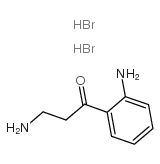
Kynuramine Dihydrobromide structure
|
Common Name | Kynuramine Dihydrobromide | ||
|---|---|---|---|---|
| CAS Number | 304-47-2 | Molecular Weight | 326.02800 | |
| Density | N/A | Boiling Point | 367.3ºC at 760mmHg | |
| Molecular Formula | C9H14Br2N2O | Melting Point | N/A | |
| MSDS | Chinese USA | Flash Point | 175.9ºC | |
Use of Kynuramine DihydrobromideKynuramine (dihydrobromide), an endogenously occurring amine, is a fluorescent substrate and probe of plasma amine oxidase[1][2]. |
This table lists Chinese names, IUPAC names and various aliases of this chemical substance.
| Name | Kynuramine dihydrobromide |
|---|---|
| Synonym | More Synonyms |
This table contains bioactivity, target information and biological‑assay experimental data of this compound.
| Description | Kynuramine (dihydrobromide), an endogenously occurring amine, is a fluorescent substrate and probe of plasma amine oxidase[1][2]. |
|---|---|
| Related Catalog | |
| In Vitro | Kynuramine (dihydrobromide) 在体外抑制突触前和突触后 α-肾上腺素受体[2]。 Kynuramine 已被证明是狗脑动脉血清素受体的部分激动剂[2]。 Kynuramine (20 μg/mL) 经常导致回肠轻微收缩,但未能改变胆碱能刺激的抽搐反应[2]。 |
| In Vivo | Kynuramine (dihydrobromide) (0.064、0.32、1.6 或 8 μg;脑室内;单剂量) 促进雌激素激发的去卵巢大鼠前凸行为[3]。 Kynuramine (1.25、2.5 和 5.0 mg/kg;静脉注射;单剂量) 可增加大鼠的心率和血压[4]。 Animal Model: Female rats[3]. Dosage: 0.064-8 μg. Administration: Intraventricular injection; single does. Result: Produced facilitation of lordosis behavior. Animal Model: Male rats (about 200g)[4]. Dosage: 1.25-5.0 mg/kg. Administration: Intravenous injection; single does. Result: Promoted heart rate and blood pressure. |
| References |
This table shows physicochemical parameters including melting point, boiling point, density, solubility and optical rotation. Missing data is marked as N/A.
| Boiling Point | 367.3ºC at 760mmHg |
|---|---|
| Molecular Formula | C9H14Br2N2O |
| Molecular Weight | 326.02800 |
| Flash Point | 175.9ºC |
| Exact Mass | 323.94700 |
| PSA | 69.11000 |
| LogP | 3.99800 |
| InChIKey | KNLPLQJBAIXOQE-UHFFFAOYSA-N |
| SMILES | Br.Br.NCCC(=O)c1ccccc1N |
| Storage condition | 20°C |
This table provides MSDS information including hazard classification, first‑aid, fire‑fighting, spill handling, operation and storage instructions.
This table covers safety warnings, protective measures, incompatible substances and disposal guidelines for this compound.
| Personal Protective Equipment | Eyeshields;Gloves;type N95 (US);type P1 (EN143) respirator filter |
|---|---|
| RIDADR | NONH for all modes of transport |
| WGK Germany | 3 |
This table lists relevant public references with title, journal and publication metadata for this compound.
|
Azure B and a synthetic structural analogue of methylene blue, ethylthioninium chloride, present with antidepressant-like properties.
Life Sci. 117(2) , 56-66, (2015) The phenothiazinium compound, methylene blue (MB), possesses diverse pharmacological actions and is attracting attention for the treatment of bipolar disorder and Alzheimer's disease. MB acts on both ... |
|
|
Synergistic antidepressant-like effect of ferulic acid in combination with piperine: involvement of monoaminergic system.
Metab. Brain Dis. 30 , 1505-14, (2015) The lifetime prevalence rate for major depressive disorder (MDD) is approximately 17 % for most developed countries around the world. Dietary polyphenols are currently used as an adjuvant therapy to a... |
|
|
Selective monoamine oxidase B inhibition by an Aphanizomenon flos-aquae extract and by its constitutive active principles phycocyanin and mycosporine-like amino acids.
Phytomedicine 21(7) , 992-7, (2014) Aphanizomenon flos-aquae (AFA) is a fresh water unicellular blue-green alga that has been traditionally used for over 25 years for its health-enhancing properties. Recent studies have shown the abilit... |
This table collects all English aliases, systematic names and CAS‑related synonyms of the compound.
| 3-(2-Aminophenyl)-3-oxopropanamine |
| 3-amino-1-(2-aminophenyl)propan-1-one,hydrobromide |
This section contains frequently‑asked‑questions about this compound, including basic parameters, properties, storage conditions and corresponding answers.
| Q: What is the boiling point of Kynuramine dihydrobromide? |
| A: Boiling point of Kynuramine dihydrobromide is 367.3ºC at 760mmHg. |
| Q: What is the LogP of Kynuramine dihydrobromide? |
| A: LogP of Kynuramine dihydrobromide is 3.99800. |
| Q: What English synonyms does Kynuramine dihydrobromide have? |
| A: English synonyms of Kynuramine dihydrobromide: 3-(2-Aminophenyl)-3-oxopropanamine, 3-amino-1-(2-aminophenyl)propan-1-one,hydrobromide. |
| Q: What is the molecular formula of Kynuramine dihydrobromide? |
| A: Molecular formula of Kynuramine dihydrobromide is C9H14Br2N2O. |
| Q: What is the English name of Kynuramine dihydrobromide? |
| A: The English name of Kynuramine dihydrobromide is Kynuramine dihydrobromide. |
| Q: What is the CAS number of Kynuramine dihydrobromide? |
| A: CAS number of Kynuramine dihydrobromide is 304-47-2. |
| Q: What is the polar surface area (PSA) of Kynuramine dihydrobromide? |
| A: Polar surface area (PSA) of Kynuramine dihydrobromide is 69.11000. |
| Q: What is the molecular weight of Kynuramine dihydrobromide? |
| A: Molecular weight of Kynuramine dihydrobromide is 326.02800. |
| Q: What is the InChIKey of Kynuramine dihydrobromide? |
| A: InChIKey of Kynuramine dihydrobromide is KNLPLQJBAIXOQE-UHFFFAOYSA-N. |
| Q: What are the uses of Kynuramine dihydrobromide? |
| A: Main uses of Kynuramine dihydrobromide: Kynuramine (dihydrobromide), an endogenously occurring amine, is a fluorescent substrate and probe of plasma amine oxidase[1][2]. |
This table lists manufacturers and suppliers of this compound, including vendor names and product supply reference information.
| Shanghai Nianxing Industrial Co., Ltd |