BAD (103-127) (human)
Modify Date: 2025-08-25 11:33:11
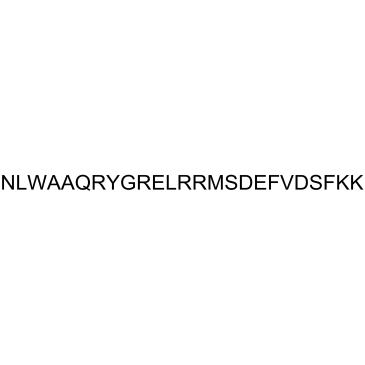
BAD (103-127) (human) structure
|
Common Name | BAD (103-127) (human) | ||
|---|---|---|---|---|
| CAS Number | 331762-68-6 | Molecular Weight | 3103.47 | |
| Density | N/A | Boiling Point | N/A | |
| Molecular Formula | C137H212N42O39S | Melting Point | N/A | |
| MSDS | N/A | Flash Point | N/A | |
Use of BAD (103-127) (human)BAD (103-127) (human), the 25-mer Bad peptide, is derived from the BH3 domain of BAD, can antagonize the function of Bcl-xL. BAD (103-127) (human), the 25-mer Bad peptide, is reported to have almost 800-fold higher affinity for Bcl-XL than the 16-mer peptide[1]. |
| Name | BAD (103-127) (human) |
|---|
| Description | BAD (103-127) (human), the 25-mer Bad peptide, is derived from the BH3 domain of BAD, can antagonize the function of Bcl-xL. BAD (103-127) (human), the 25-mer Bad peptide, is reported to have almost 800-fold higher affinity for Bcl-XL than the 16-mer peptide[1]. |
|---|---|
| Related Catalog | |
| References |
| Molecular Formula | C137H212N42O39S |
|---|---|
| Molecular Weight | 3103.47 |
| InChIKey | NLSLFOGIVJOKDC-ZOKDAYPZSA-N |
| SMILES | CSCCC(NC(=O)C(CCCNC(=N)N)NC(=O)C(CCCNC(=N)N)NC(=O)C(CC(C)C)NC(=O)C(CCC(=O)O)NC(=O)C(CCCNC(=N)N)NC(=O)CNC(=O)C(Cc1ccc(O)cc1)NC(=O)C(CCCNC(=N)N)NC(=O)C(CCC(N)=O)NC(=O)C(C)NC(=O)C(C)NC(=O)C(Cc1c[nH]c2ccccc12)NC(=O)C(CC(C)C)NC(=O)C(N)CC(N)=O)C(=O)NC(CO)C(=O)NC(CC(=O)O)C(=O)NC(CCC(=O)O)C(=O)NC(Cc1ccccc1)C(=O)NC(C(=O)NC(CC(=O)O)C(=O)NC(CO)C(=O)NC(Cc1ccccc1)C(=O)NC(CCCCN)C(=O)NC(CCCCN)C(=O)O)C(C)C |