MEG hemisulfate
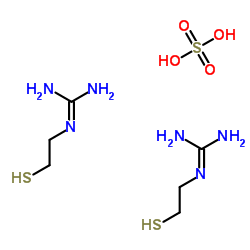
MEG hemisulfate structure
|
Common Name | MEG hemisulfate | ||
|---|---|---|---|---|
| CAS Number | 3979-00-8 | Molecular Weight | 336.456 | |
| Density | N/A | Boiling Point | 645.7ºC at 760 mmHg | |
| Molecular Formula | C6H20N6O4S3 | Melting Point | N/A | |
| MSDS | Chinese USA | Flash Point | 344.3ºC | |
Use of MEG hemisulfateMEG (Mercaptoethylguanidine) hemisulfate is a potent and selective inhibitor of the inducible NO synthase (iNOS), with EC50s of 11.5, 110, and 60 μM for iNOS, ecNOS, and bNOS respectively in tissue homogenates. MEG hemisulfate is also a potent scavenger of peroxynitrite and inhibits peroxynitrite-induced oxidative processes. MEG hemisulfate has a protective effect in many experimental models of inflammation, including ischemia/reperfusion injury, periodontitis, hemorrhagic shock, inflammatory bowel disease, and endotoxic and septic shock[1][2][3][4]. |
Summary: MEG(硫酸盐),also known as Mercaptoethylguanidine hemisulfate salt,with the chemical formula C6H20N6O4S3 and molecular weight of 336.456,CAS number 3979-00-8. For research-use only, not for medical or clinical usage.
This table lists Chinese names, IUPAC names and various aliases of this chemical substance.
| Name | Mercaptoethylguanidine hemisulfate salt |
|---|---|
| Synonym | More Synonyms |
This table contains bioactivity, target information and biological‑assay experimental data of this compound.
| Description | MEG (Mercaptoethylguanidine) hemisulfate is a potent and selective inhibitor of the inducible NO synthase (iNOS), with EC50s of 11.5, 110, and 60 μM for iNOS, ecNOS, and bNOS respectively in tissue homogenates. MEG hemisulfate is also a potent scavenger of peroxynitrite and inhibits peroxynitrite-induced oxidative processes. MEG hemisulfate has a protective effect in many experimental models of inflammation, including ischemia/reperfusion injury, periodontitis, hemorrhagic shock, inflammatory bowel disease, and endotoxic and septic shock[1][2][3][4]. |
|---|---|
| Related Catalog | |
| Target |
IC50: 11.5 μM (iNOS), 110 μM (ecNOS), 60 μM (bNOS)[1] |
| In Vitro | MEG (0.1-1000 μM; 18 h) reduces nitrite accumulation in the supernatant of cultured J774.2 macrophages activated with LPS (10 μg/mL) and INF (50 μg/mL). MEG inhibits iNOS activity in homogenates of lungs taken from LPS-treated rats[1]. MEG (1 μM-3 mM; 3 min) dose-dependently inhibits the peroxynitrite-induced oxidation of cytochrome c2+ and hydroxylation of benzoate[2]. MEG (1-300 μM) inhibits the suppression of mitochondrial respiration and DNA single strand breakage in response to peroxynitrite in J774 cells[2]. MEG (300 μM; 30 min) inhibits the suppression of vascular contractility in response to peroxynitrite in thoracic aortic rings[2]. |
| In Vivo | MEG (10 mg/kg; i.p. for 5 d) attenuates the degree of lipid peroxidation, protein oxidation, and peroxynitrites level and ameliorated the decrease of antioxidant enzymes activities in the esophagus of rats subjected to caustic burn injury[3]. MEG (30-60 mg/kg; a single i.p.) decreases mean arterial blood pressure (MAP) of normal rats[1]. MEG (10 mg/kg; a single i.p.) improves the renal dysfunction and tissue injury induced by ischemia/reperfusion (I/R) of rat kidney[4]. Animal Model: Sprague-Dawley rats (200-250 g) were injured the esophagus[3] Dosage: 10 mg/kg Administration: I.p. for 5 days Result: Reduced the stenosis index (SI) and the histopathologic damage score. Decreased the malondialdehyde and protein carbonyl content and increased the activities of superoxide dismutase and glutathione peroxidase. Regulated the nitrate and nitrite level. |
| References |
This table shows physicochemical parameters including melting point, boiling point, density, solubility and optical rotation. Missing data is marked as N/A.
| Boiling Point | 645.7ºC at 760 mmHg |
|---|---|
| Molecular Formula | C6H20N6O4S3 |
| Molecular Weight | 336.456 |
| Flash Point | 344.3ºC |
| Exact Mass | 336.070801 |
| PSA | 284.38000 |
| LogP | 1.60840 |
| InChIKey | XJKZAAUVINNNNC-UHFFFAOYSA-N |
| SMILES | NC(N)=NCCS.NC(N)=NCCS.O=S(=O)(O)O |
This table provides MSDS information including hazard classification, first‑aid, fire‑fighting, spill handling, operation and storage instructions.
This table covers safety warnings, protective measures, incompatible substances and disposal guidelines for this compound.
| Personal Protective Equipment | Eyeshields;Gloves;type N95 (US);type P1 (EN143) respirator filter |
|---|---|
| Hazard Codes | Xi |
| RIDADR | NONH for all modes of transport |
This table lists relevant public references with title, journal and publication metadata for this compound.
|
Nitric oxide is synthesized in acute leukemia cells after exposure to phenolic antioxidants and initially protects against mitochondrial membrane depolarization.
Cancer Lett. 215(1) , 43-52, (2004) We investigated the early events involved in loss of mitochondrial membrane potential (DeltaPsi(mt)) leading to apoptosis in cells derived from patients with acute lymphocytic leukemia after exposure ... |
|
|
Mitogen-activated protein kinase phosphorylation in kidneys of beta(s) sickle cell mice.
J. Am. Soc. Nephrol. 11(6) , 1026-32, (2000) Previous studies in beta(s) sickle cell mice demonstrated renal immunostaining for nitrotyrosine, which is putative evidence of peroxynitrite (ONOO(-)) formation. ONOO(-) is known to nitrate tyrosine ... |
|
|
Inhibition of nitric oxide synthase ameliorates cellular injury in sickle cell mouse kidneys.
Kidney Int. 58(1) , 82-9, (2000) In previous studies of transgenic sickle cell mice, increased renal expression of inducible nitric oxide synthase (iNOS) and endothelial cell isoform of NOS (EcNOS) was found by Western blot and immun... |
This table collects all English aliases, systematic names and CAS‑related synonyms of the compound.
| 2-(2-Sulfanylethyl)guanidine sulfate (2:1) |
| 2-(2-sulfanylethyl)guanidine,sulfuric acid |
| Guanidine, N''-(2-mercaptoethyl)-, sulfate (2:1) |
| MEG hemisulfate salt |
This section contains frequently‑asked‑questions about this compound, including basic parameters, properties, storage conditions and corresponding answers.
| Q: What is the molecular formula of Mercaptoethylguanidine hemisulfate salt? |
| A: Molecular formula of Mercaptoethylguanidine hemisulfate salt is C6H20N6O4S3. |
| Q: What is the molecular weight of Mercaptoethylguanidine hemisulfate salt? |
| A: Molecular weight of Mercaptoethylguanidine hemisulfate salt is 336.456. |
| Q: What is the InChIKey of Mercaptoethylguanidine hemisulfate salt? |
| A: InChIKey of Mercaptoethylguanidine hemisulfate salt is XJKZAAUVINNNNC-UHFFFAOYSA-N. |
| Q: What is the polar surface area (PSA) of Mercaptoethylguanidine hemisulfate salt? |
| A: Polar surface area (PSA) of Mercaptoethylguanidine hemisulfate salt is 284.38000. |
| Q: What is the SMILES notation of Mercaptoethylguanidine hemisulfate salt? |
| A: SMILES notation of Mercaptoethylguanidine hemisulfate salt is NC(N)=NCCS.NC(N)=NCCS.O=S(=O)(O)O. |
| Q: What is the boiling point of Mercaptoethylguanidine hemisulfate salt? |
| A: Boiling point of Mercaptoethylguanidine hemisulfate salt is 645.7ºC at 760 mmHg. |
| Q: What is the CAS number of Mercaptoethylguanidine hemisulfate salt? |
| A: CAS number of Mercaptoethylguanidine hemisulfate salt is 3979-00-8. |
| Q: What is the LogP of Mercaptoethylguanidine hemisulfate salt? |
| A: LogP of Mercaptoethylguanidine hemisulfate salt is 1.60840. |
| Q: What is the English name of Mercaptoethylguanidine hemisulfate salt? |
| A: The English name of Mercaptoethylguanidine hemisulfate salt is Mercaptoethylguanidine hemisulfate salt. |
| Q: What English synonyms does Mercaptoethylguanidine hemisulfate salt have? |
| A: English synonyms of Mercaptoethylguanidine hemisulfate salt: 2-(2-Sulfanylethyl)guanidine sulfate (2:1), 2-(2-sulfanylethyl)guanidine,sulfuric acid, Guanidine, N''-(2-mercaptoethyl)-, sulfate (2:1), MEG hemisulfate salt. |
This table lists manufacturers and suppliers of this compound, including vendor names and product supply reference information.
| Shanghai Nianxing Industrial Co., Ltd |