Homocysteic acid
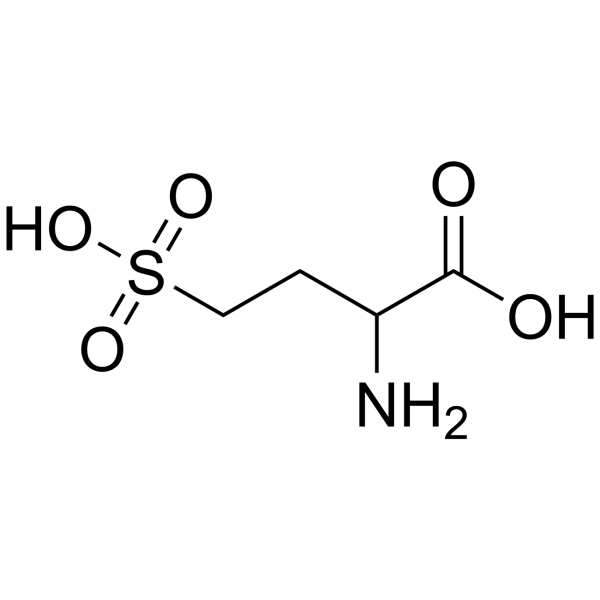
Homocysteic acid structure
|
Common Name | Homocysteic acid | ||
|---|---|---|---|---|
| CAS Number | 504-33-6 | Molecular Weight | 183.183 | |
| Density | 1.6±0.1 g/cm3 | Boiling Point | N/A | |
| Molecular Formula | C4H9NO5S | Melting Point | 273 °C | |
| MSDS | Chinese USA | Flash Point | N/A | |
Use of Homocysteic acid2-amino-4-sulfobutanoic acid is an alanine derivative[1]. |
Summary: dl-Homocysteic acid (DL-homocysteic acid), molecular formula C4H9NO5S, molecular weight 183.183, appears as white crystalline powder, melting point 273°C, density 1.6±0.1 g/cm3. For research-use only, not for medical or clinical usage.
This table lists Chinese names, IUPAC names and various aliases of this chemical substance.
| Name | dl-homocysteic acid |
|---|---|
| Synonym | More Synonyms |
This table contains bioactivity, target information and biological‑assay experimental data of this compound.
| Description | 2-amino-4-sulfobutanoic acid is an alanine derivative[1]. |
|---|---|
| Related Catalog | |
| In Vitro | Amino acids and amino acid derivatives have been commercially used as ergogenic supplements. They influence the secretion of anabolic hormones, supply of fuel during exercise, mental performance during stress related tasks and prevent exercise induced muscle damage. They are recognized to be beneficial as ergogenic dietary substances[1]. |
| References |
This table shows physicochemical parameters including melting point, boiling point, density, solubility and optical rotation. Missing data is marked as N/A.
| Density | 1.6±0.1 g/cm3 |
|---|---|
| Melting Point | 273 °C |
| Molecular Formula | C4H9NO5S |
| Molecular Weight | 183.183 |
| Exact Mass | 183.020142 |
| PSA | 126.07000 |
| LogP | -2.26 |
| Index of Refraction | 1.560 |
| InChIKey | VBOQYPQEPHKASR-UHFFFAOYSA-N |
| SMILES | NC(CCS(=O)(=O)O)C(=O)O |
This table provides MSDS information including hazard classification, first‑aid, fire‑fighting, spill handling, operation and storage instructions.
This table presents publicly reported synthetic routes, reaction conditions, reactants and product information of the compound.
|
~%
Homocysteic acid CAS#:504-33-6 |
| Literature: Dent Biochemical Journal, 1948 , vol. 43, p. 175 |
|
~%
Homocysteic acid CAS#:504-33-6 |
| Literature: Butz; du Vigneaud Journal of Biological Chemistry, 1932 , vol. 99, p. 135,140 |
![4,4'-Dithiobis[2-aminobutyric Acid] structure](https://image.chemsrc.com/caspic/253/462-10-2.png)


This table lists upstream starting materials and downstream derivative products related to this chemical.
| Precursor 4 | |
|---|---|
| DownStream 0 | |
This table shows customs‑related data including HS‑code, tariff and regulatory conditions for import and export.
| HS Code | 2922499990 |
|---|---|
| Summary | HS:2922499990 other amino-acids, other than those containing more than one kind of oxygen function, and their esters; salts thereof VAT:17.0% Tax rebate rate:9.0% Supervision conditions:AB(certificate of inspection for goods inward,certificate of inspection for goods outward) MFN tariff:6.5% General tariff:30.0% |
This table lists relevant public references with title, journal and publication metadata for this compound.
|
15-Deoxy-Δ12,14-prostaglandin J2 (15d-PGJ2) protects neurons from oxidative death via an Nrf2 astrocyte-specific mechanism independent of PPARγ.
J. Neurochem. 124(4) , 536-47, (2013) Astrocytes are critical for the antioxidant support of neurons. Recently, we demonstrated that low level hydrogen peroxide (H(2) O(2) ) facilitates astrocyte-dependent neuroprotection independent of t... |
|
|
Prebiotic synthesis of methionine and other sulfur-containing organic compounds on the primitive Earth: a contemporary reassessment based on an unpublished 1958 Stanley Miller experiment.
Orig. Life Evol. Biosph. 41(3) , 201-12, (2011) Original extracts from an unpublished 1958 experiment conducted by the late Stanley L. Miller were recently found and analyzed using modern state-of-the-art analytical methods. The extracts were produ... |
|
|
Nucleus raphe pallidus participates in midbrain-medullary cardiovascular sympathoinhibition during electroacupuncture.
Am. J. Physiol. Regul. Integr. Comp. Physiol. 299(5) , R1369-76, (2010) We have shown that electroacupuncture (EA) inhibits sympathoexcitatory rostral ventrolateral medulla (rVLM) neurons and reflex responses following activation of a long-loop pathway in the arcuate nucl... |
This table collects all English aliases, systematic names and CAS‑related synonyms of the compound.
| D,L-homocysteic acid |
| L-2-AMINO-4-SULFOBUTYRIC ACID |
| H-CYA-OH |
| EINECS 207-991-0 |
| Homocysteic acid |
| (DL)-2-Amino-4-sulfobutanoic Acid |
| 2-AMINO-4-SULPHOBUTYRIC ACID |
| DL-2-AMINO-4-SULFOBUTYRIC ACID |
| 2-Amino-4-sulfo-buttersaeure |
| MFCD00007536 |
| DL-Homocysteic Acid |
| 2-AMINO-4-SULFONY-BUTANOIC ACID |
| 2-Amino-4-sulfobutanoic acid |
| HOMOCYSTEIC ACID,DL |
| β-Glycineethyl sulfonic acid |
| DL-HoMocysteic-d4 Acid H2O |
| 2-Amino-4-sulfobutyricacid |
This section contains frequently‑asked‑questions about this compound, including basic parameters, properties, storage conditions and corresponding answers.
| Q: What is the molecular weight of dl-homocysteic acid? |
| A: Molecular weight of dl-homocysteic acid is 183.183. |
| Q: What is the safety information for dl-homocysteic acid? |
| A: Safety information for dl-homocysteic acid: S24/25. |
| Q: What is the InChIKey of dl-homocysteic acid? |
| A: InChIKey of dl-homocysteic acid is VBOQYPQEPHKASR-UHFFFAOYSA-N. |
| Q: What are the upstream materials of dl-homocysteic acid? |
| A: Related upstream materials(CAS) of dl-homocysteic acid: 462-10-2;7732-18-5;7722-84-1;7726-95-6. |
| Q: What are the uses of dl-homocysteic acid? |
| A: Main uses of dl-homocysteic acid: 2-amino-4-sulfobutanoic acid is an alanine derivative[1]. |
| Q: What is the melting point of dl-homocysteic acid? |
| A: Melting point of dl-homocysteic acid is 273 °C. |
| Q: What is the polar surface area (PSA) of dl-homocysteic acid? |
| A: Polar surface area (PSA) of dl-homocysteic acid is 126.07000. |
| Q: What is the LogP of dl-homocysteic acid? |
| A: LogP of dl-homocysteic acid is -2.26. |
| Q: What is the CAS number of dl-homocysteic acid? |
| A: CAS number of dl-homocysteic acid is 504-33-6. |
| Q: What English synonyms does dl-homocysteic acid have? |
| A: English synonyms of dl-homocysteic acid: D,L-homocysteic acid, L-2-AMINO-4-SULFOBUTYRIC ACID, H-CYA-OH, EINECS 207-991-0, Homocysteic acid, (DL)-2-Amino-4-sulfobutanoic Acid, 2-AMINO-4-SULPHOBUTYRIC ACID, DL-2-AMINO-4-SULFOBUTYRIC ACID, 2-Amino-4-sulfo-buttersaeure, MFCD00007536, DL-Homocysteic Acid, 2-AMINO-4-SULFONY-BUTANOIC ACID, 2-Amino-4-sulfobutanoic acid, HOMOCYSTEIC ACID,DL, β-Glycineethyl sulfonic acid, DL-HoMocysteic-d4 Acid H2O, 2-Amino-4-sulfobutyricacid. |
This table lists manufacturers and suppliers of this compound, including vendor names and product supply reference information.
| Shanghai Nianxing Industrial Co., Ltd |
| Dayang Chem (Hangzhou) Co., Ltd. |