Clovamide
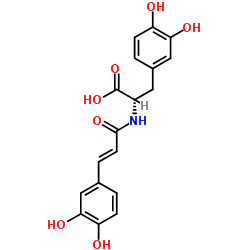
Clovamide structure
|
Common Name | Clovamide | ||
|---|---|---|---|---|
| CAS Number | 53755-02-5 | Molecular Weight | 359.33 | |
| Density | 1.5±0.1 g/cm3 | Boiling Point | 777.0±60.0 °C at 760 mmHg | |
| Molecular Formula | C18H17NO7 | Melting Point | N/A | |
| MSDS | N/A | Flash Point | 423.7±32.9 °C | |
Use of ClovamideClovamide (trans-Clovamide), a natural phenolic compound, is a potent antioxidant. Clovamide is an excellent ROS and oxygen radical scavenger. Clovamide also has anti-inflammatory and neuroprotective effects[1][2]. Clovamide is an anti-microbial with activity against the human pathogens influenza A subtype H5N1, Trypanosoma evansi, and Heliobacter pylori[3]. |
This table lists Chinese names, IUPAC names and various aliases of this chemical substance.
| Name | 3-(3,4-dihydroxy-phenyl)-2-[3-(3,4-dihydroxy-phenyl)-acryloylamino]propionic acid |
|---|---|
| Synonym | More Synonyms |
This table contains bioactivity, target information and biological‑assay experimental data of this compound.
| Description | Clovamide (trans-Clovamide), a natural phenolic compound, is a potent antioxidant. Clovamide is an excellent ROS and oxygen radical scavenger. Clovamide also has anti-inflammatory and neuroprotective effects[1][2]. Clovamide is an anti-microbial with activity against the human pathogens influenza A subtype H5N1, Trypanosoma evansi, and Heliobacter pylori[3]. |
|---|---|
| Related Catalog | |
| In Vitro | Clovamide is able to protect neurons from injury in three in vitro models of neuronal death: oxidative stress, excitotoxicity and OGD/reoxygenation. In SH-SY5Y human neuroblastoma cells, Clovamide (10-100 µM) significantly protects cell death, with an EC50 value of 3.6 µM. Clovamide also significantly enhances PPARγ expression[2]. Clovamide inhibits growth of three pathogens of cacao in the genus Phytophthora, is a substrate for cacao polyphenol oxidase, and is a contributor to enzymatic browning. Clovamide inhibiteds proteinase and pectinase in vitro[3]. |
| References |
This table shows physicochemical parameters including melting point, boiling point, density, solubility and optical rotation. Missing data is marked as N/A.
| Density | 1.5±0.1 g/cm3 |
|---|---|
| Boiling Point | 777.0±60.0 °C at 760 mmHg |
| Molecular Formula | C18H17NO7 |
| Molecular Weight | 359.33 |
| Flash Point | 423.7±32.9 °C |
| Exact Mass | 359.100494 |
| PSA | 147.32000 |
| LogP | 0.84 |
| Vapour Pressure | 0.0±2.8 mmHg at 25°C |
| Index of Refraction | 1.723 |
| InChIKey | GPZFXSWMDFBRGS-UXONFWTHSA-N |
| SMILES | O=C(C=Cc1ccc(O)c(O)c1)NC(Cc1ccc(O)c(O)c1)C(=O)O |
This table contains target information, in‑vitro & in‑vivo assay data for this compound.
This table collects all English aliases, systematic names and CAS‑related synonyms of the compound.
| clovamide |
| (-)-N-[3',4'-dihydroxy-(E)-cinnamoyl]-3-hydroxy-L-tyrosine |
| 3-(3,4-dihydroxy-phenyl)-(S)-2-[3-trans-(3,4-dihydroxy-phenyl)-acryloylamino]-propionic acid |
| N-[(2E)-3-(3,4-Dihydroxyphenyl)-2-propenoyl]-3-hydroxy-L-tyrosine |
| N-(3',4'-DIHYDROXY-(E)-CINNAMOYL)-3-HYDROXY-L-TYROSINE |
| N-[(2E)-3-(3,4-dihydroxyphenyl)prop-2-enoyl]-3-hydroxy-L-tyrosine |
| caffeoyl L-DOPA |
This section contains frequently‑asked‑questions about this compound, including basic parameters, properties, storage conditions and corresponding answers.
| Q: What is the polar surface area (PSA) of 3-(3,4-dihydroxy-phenyl)-2-[3-(3,4-dihydroxy-phenyl)-acryloylamino]propionic acid? |
| A: Polar surface area (PSA) of 3-(3,4-dihydroxy-phenyl)-2-[3-(3,4-dihydroxy-phenyl)-acryloylamino]propionic acid is 147.32000. |
| Q: What is the molecular formula of 3-(3,4-dihydroxy-phenyl)-2-[3-(3,4-dihydroxy-phenyl)-acryloylamino]propionic acid? |
| A: Molecular formula of 3-(3,4-dihydroxy-phenyl)-2-[3-(3,4-dihydroxy-phenyl)-acryloylamino]propionic acid is C18H17NO7. |
| Q: What is the molecular weight of 3-(3,4-dihydroxy-phenyl)-2-[3-(3,4-dihydroxy-phenyl)-acryloylamino]propionic acid? |
| A: Molecular weight of 3-(3,4-dihydroxy-phenyl)-2-[3-(3,4-dihydroxy-phenyl)-acryloylamino]propionic acid is 359.33. |
| Q: What is the CAS number of 3-(3,4-dihydroxy-phenyl)-2-[3-(3,4-dihydroxy-phenyl)-acryloylamino]propionic acid? |
| A: CAS number of 3-(3,4-dihydroxy-phenyl)-2-[3-(3,4-dihydroxy-phenyl)-acryloylamino]propionic acid is 53755-02-5. |
| Q: What is the LogP of 3-(3,4-dihydroxy-phenyl)-2-[3-(3,4-dihydroxy-phenyl)-acryloylamino]propionic acid? |
| A: LogP of 3-(3,4-dihydroxy-phenyl)-2-[3-(3,4-dihydroxy-phenyl)-acryloylamino]propionic acid is 0.84. |
| Q: What are the uses of 3-(3,4-dihydroxy-phenyl)-2-[3-(3,4-dihydroxy-phenyl)-acryloylamino]propionic acid? |
| A: Main uses of 3-(3,4-dihydroxy-phenyl)-2-[3-(3,4-dihydroxy-phenyl)-acryloylamino]propionic acid: Clovamide (trans-Clovamide), a natural phenolic compound, is a potent antioxidant. Clovamide is an excellent ROS and oxygen radical scavenger. Clovamide also has anti-inflammatory and neuroprotective effects[1][2]. Clovamide is an anti-microbial with activity against the human pathogens influenza A subtype H5N1, Trypanosoma evansi, and Heliobacter pylori[3]. |
| Q: What English synonyms does 3-(3,4-dihydroxy-phenyl)-2-[3-(3,4-dihydroxy-phenyl)-acryloylamino]propionic acid have? |
| A: English synonyms of 3-(3,4-dihydroxy-phenyl)-2-[3-(3,4-dihydroxy-phenyl)-acryloylamino]propionic acid: clovamide, (-)-N-[3',4'-dihydroxy-(E)-cinnamoyl]-3-hydroxy-L-tyrosine, 3-(3,4-dihydroxy-phenyl)-(S)-2-[3-trans-(3,4-dihydroxy-phenyl)-acryloylamino]-propionic acid, N-[(2E)-3-(3,4-Dihydroxyphenyl)-2-propenoyl]-3-hydroxy-L-tyrosine, N-(3',4'-DIHYDROXY-(E)-CINNAMOYL)-3-HYDROXY-L-TYROSINE, N-[(2E)-3-(3,4-dihydroxyphenyl)prop-2-enoyl]-3-hydroxy-L-tyrosine, caffeoyl L-DOPA. |
| Q: What is the English name of 3-(3,4-dihydroxy-phenyl)-2-[3-(3,4-dihydroxy-phenyl)-acryloylamino]propionic acid? |
| A: The English name of 3-(3,4-dihydroxy-phenyl)-2-[3-(3,4-dihydroxy-phenyl)-acryloylamino]propionic acid is 3-(3,4-dihydroxy-phenyl)-2-[3-(3,4-dihydroxy-phenyl)-acryloylamino]propionic acid. |
| Q: What is the SMILES notation of 3-(3,4-dihydroxy-phenyl)-2-[3-(3,4-dihydroxy-phenyl)-acryloylamino]propionic acid? |
| A: SMILES notation of 3-(3,4-dihydroxy-phenyl)-2-[3-(3,4-dihydroxy-phenyl)-acryloylamino]propionic acid is O=C(C=Cc1ccc(O)c(O)c1)NC(Cc1ccc(O)c(O)c1)C(=O)O. |
| Q: What is the InChIKey of 3-(3,4-dihydroxy-phenyl)-2-[3-(3,4-dihydroxy-phenyl)-acryloylamino]propionic acid? |
| A: InChIKey of 3-(3,4-dihydroxy-phenyl)-2-[3-(3,4-dihydroxy-phenyl)-acryloylamino]propionic acid is GPZFXSWMDFBRGS-UXONFWTHSA-N. |
This table lists manufacturers and suppliers of this compound, including vendor names and product supply reference information.
| Shanghai Nianxing Industrial Co., Ltd |