Coelenterazine
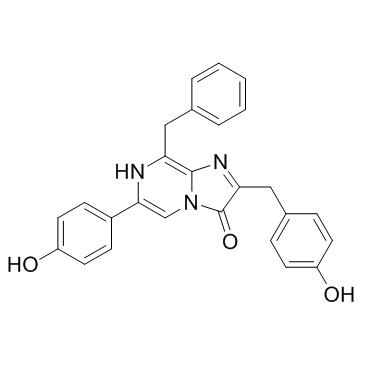
Coelenterazine structure
|
Common Name | Coelenterazine | ||
|---|---|---|---|---|
| CAS Number | 55779-48-1 | Molecular Weight | 423.463 | |
| Density | 1.3±0.1 g/cm3 | Boiling Point | 641.4±65.0 °C at 760 mmHg | |
| Molecular Formula | C26H21N3O3 | Melting Point | N/A | |
| MSDS | Chinese USA | Flash Point | 341.7±34.3 °C | |
Use of CoelenterazineCoelenterazine is widely distributed among marine organisms which can produce bioluminescence by calcium-dependent oxidation mediated by the photoprotein aequorin. |
Summary: Oplophorus luciferin, also known as Coelenterazine, has a CAS number of 55779-48-1, with a molecular formula of C26H21N3O3 and a molecular weight of 423.463. It is a solid, yellow in appearance, with a boiling point of 641.4±65.0 °C and a density of 1.3±0.1 g/cm3. For research-use only, not for medical or clinical usage.
This table lists Chinese names, IUPAC names and various aliases of this chemical substance.
| Name | Oplophorus luciferin |
|---|---|
| Synonym | More Synonyms |
This table contains bioactivity, target information and biological‑assay experimental data of this compound.
| Description | Coelenterazine is widely distributed among marine organisms which can produce bioluminescence by calcium-dependent oxidation mediated by the photoprotein aequorin. |
|---|---|
| Related Catalog | |
| In Vitro | On addition of Coelenterazine to the buffer, intact KB 3-1 Rluc cells show high bioluminescence, whereas intact KB 8-5-11 Rluc cells show low bioluminescence. A specific Pgp-mediated reduction in steady-state content of Coelenterazine exists in KB 8-5-11 Rluc cells compare to KB 3-1 Rluc cells. Bioluminescence signals from KB 3-1 Rluc cells, both in the absence and presence of GF120918 (300 nM), are readily detected with as little as 1 nM extracellular Coelenterazine and increase in a concentration-dependent manner to 1 μM extracellular Coelenterazine. In Pgp-expressing cells, there is evidence for a GF120918-reversible concentration-dependent saturation of bioluminescence with an EC50 of 257 nM Coelenterazine. The plateau in bioluminescence signal observed in KB 8-5-11 Rluc cells implies hat the capacity of Pgp to limit delivery of Coelenterazine to cytosolic Rluc is not exceeded within the concentration range test[1]. |
| In Vivo | At baseline, KB 3-1 Rluc tumors show a 4-fold higher bioluminescence signal in vivo than KB 8-5-11 Rluc tumors. Normalized bioluminescence signals arise from KB 3-1 Rluc tumors, signals emits from KB 8-5-11 Rluc tumors in vivo are consistently reduced by ≈75%[1] . |
| Cell Assay | Cells are plated at a density of 5×10⁴ cells per well into 24-well plates and grown to 80-100% confluency. Just before imaging, media are changed to a colorless solution containing (in mM): 2.7 KCl, 139 NaCl, 8.1 Na2HPO4, 0.7 H2O, 1.5 KH2PO4, 1.8 CaCl2, 1 MgCl2 and 5.5 d-glucose. Cells are preincubated for 15 min in the absence or presence of Pgp modulator, after which Coelenterazine (final concentration of 470 nM) is added directly to the cells[1]. |
| Animal Admin | Mice are anesthetized with metofane or isoflurane before tail vein injection of Coelenterazine (4 μg/g) formulated from an ethanol stock diluted in sodium phosphate buffer (50 mM). Bioluminescence imaging is performed on the in vivo imaging system at 2, 6, 8, and 11 min after injection. Anesthesia is maintained during imaging by nose cone delivery of 2.5% isoflurane. After imaging, animals are killed by cervical dislocation; tumors are then harvested and weighed[1]. |
| References |
This table shows physicochemical parameters including melting point, boiling point, density, solubility and optical rotation. Missing data is marked as N/A.
| Density | 1.3±0.1 g/cm3 |
|---|---|
| Boiling Point | 641.4±65.0 °C at 760 mmHg |
| Molecular Formula | C26H21N3O3 |
| Molecular Weight | 423.463 |
| Flash Point | 341.7±34.3 °C |
| Exact Mass | 423.158295 |
| PSA | 90.62000 |
| LogP | 3.87 |
| Appearance of Characters | solid | yellow |
| Vapour Pressure | 0.0±2.0 mmHg at 25°C |
| Index of Refraction | 1.689 |
| InChIKey | LNCOEGVEEQDKGX-UHFFFAOYSA-N |
| SMILES | C1=CC=C(C=C1)CC2=NC(=CN3C2=NC(=C3O)CC4=CC=C(C=C4)O)C5=CC=C(C=C5)O |
| Storage condition | −20°C |
| Water Solubility | methanol and ethanol: soluble |
This table provides MSDS information including hazard classification, first‑aid, fire‑fighting, spill handling, operation and storage instructions.
This table covers safety warnings, protective measures, incompatible substances and disposal guidelines for this compound.
| Hazard Statements | H413 |
|---|---|
| Personal Protective Equipment | Eyeshields;Gloves;type N95 (US);type P1 (EN143) respirator filter |
| Hazard Codes | Xi |
| Risk Phrases | 36/37/38 |
| Safety Phrases | S26-S36 |
| RIDADR | NONH for all modes of transport |
| WGK Germany | 3 |
This table presents publicly reported synthetic routes, reaction conditions, reactants and product information of the compound.
This table lists upstream starting materials and downstream derivative products related to this chemical.
| Precursor 9 | |
|---|---|
| DownStream 1 | |
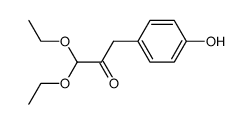 CAS#:625848-58-0
![[4-(2,3-dioxopropyl)phenyl] acetate Structure](https://image.chemsrc.com/caspic/418/56071-70-6.png) CAS#:56071-70-6
CAS#:56071-70-6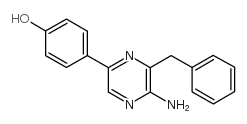 CAS#:37156-84-6
![3-[4-(tert-butyldimethylsilyloxy)phenyl]-1,1-diethoxypropan-2-one Structure](https://image.chemsrc.com/caspic/071/165330-28-9.png) CAS#:165330-28-9
CAS#:165330-28-9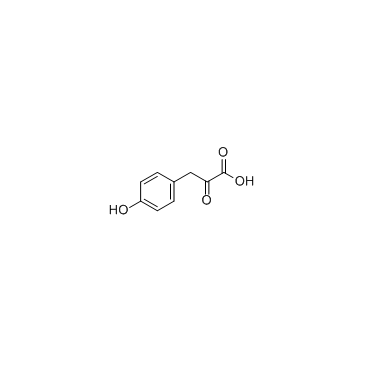 CAS#:156-39-8
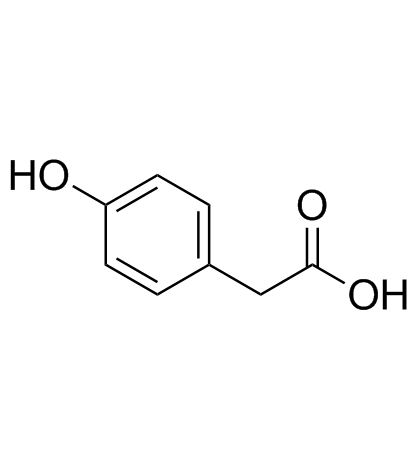 CAS#:156-38-7
![1-[4-(ACETYLOXY)PHENYL]-3-BROMO-2-PROPANONE Structure](https://image.chemsrc.com/caspic/273/56071-69-3.png) CAS#:56071-69-3
CAS#:56071-69-3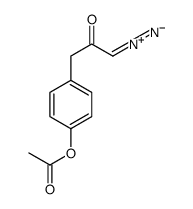 CAS#:52727-20-5
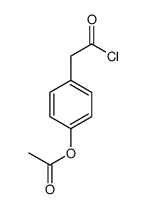 CAS#:65448-20-6
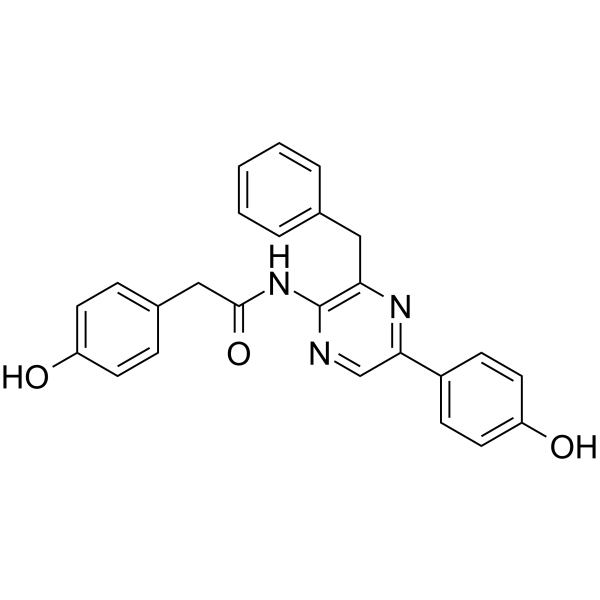 CAS#:50611-86-4
This table lists relevant public references with title, journal and publication metadata for this compound.
|
Rp-cAMPS Prodrugs Reveal the cAMP Dependence of First-Phase Glucose-Stimulated Insulin Secretion.
Mol. Endocrinol. 29 , 988-1005, (2015) cAMP-elevating agents such as the incretin hormone glucagon-like peptide-1 potentiate glucose-stimulated insulin secretion (GSIS) from pancreatic β-cells. However, a debate has existed since the 1970s... |
|
|
Fluorophore-NanoLuc BRET Reporters Enable Sensitive In Vivo Optical Imaging and Flow Cytometry for Monitoring Tumorigenesis.
Cancer Res. 75 , 5023-33, (2015) Fluorescent proteins are widely used to study molecular and cellular events, yet this traditionally relies on delivery of excitation light, which can trigger autofluorescence, photoxicity, and photobl... |
|
|
A Novel Mutation in Isoform 3 of the Plasma Membrane Ca2+ Pump Impairs Cellular Ca2+ Homeostasis in a Patient with Cerebellar Ataxia and Laminin Subunit 1α Mutations.
J. Biol. Chem. 290 , 16132-41, (2015) The particular importance of Ca(2+) signaling to neurons demands its precise regulation within their cytoplasm. Isoform 3 of the plasma membrane Ca(2+) ATPase (the PMCA3 pump), which is highly express... |
This table contains target information, in‑vitro & in‑vivo assay data for this compound.
|
Name: Induction of singlet oxygen production in methanol assessed as ABDA florescence quenc...
Source: ChEMBL
Target: N/A
External Id: CHEMBL4409061
|
|
Name: Krel expressed as Ki with respect to Ktrolox
Source: ChEMBL
Target: N/A
External Id: CHEMBL846488
|
|
Name: Cytotoxicity against human PC3 cells assessed as reduction in cell viability at 0.1 t...
Source: ChEMBL
Target: PC-3
External Id: CHEMBL4409066
|
|
Name: Cytotoxicity against human MCF7 cells assessed as reduction in cell viability at 0.1 ...
Source: ChEMBL
Target: MCF7
External Id: CHEMBL4409067
|
|
Name: Induction of singlet production in acetate buffer using chemiluminescent substrate by...
Source: ChEMBL
Target: N/A
External Id: CHEMBL4409057
|
|
Name: Induction of singlet production in methanol in presence of potassium superoxide using...
Source: ChEMBL
Target: N/A
External Id: CHEMBL4409059
|
This table collects all English aliases, systematic names and CAS‑related synonyms of the compound.
| Coelenterazine, native |
| 2-(4-Hydroxybenzyl)-6-(4-hydroxyphenyl)-8-benzyl-3,7-dihydroimidazo(1,2-a)pyrazin-3-one |
| Coelenterazine |
| MFCD00467176 |
| 8-Benzyl-2-(4-hydroxybenzyl)-6-(4-hydroxyphenyl)imidazo[1,2-a]pyrazin-3(7H)-one |
This section contains frequently‑asked‑questions about this compound, including basic parameters, properties, storage conditions and corresponding answers.
| Q: How is the water solubility of Oplophorus luciferin? |
| A: Water solubility of Oplophorus luciferin: methanol and ethanol: soluble. |
| Q: What are the uses of Oplophorus luciferin? |
| A: Main uses of Oplophorus luciferin: Coelenterazine is widely distributed among marine organisms which can produce bioluminescence by calcium-dependent oxidation mediated by the photoprotein aequorin. |
| Q: What is the boiling point of Oplophorus luciferin? |
| A: Boiling point of Oplophorus luciferin is 641.4±65.0 °C at 760 mmHg. |
| Q: What is the InChIKey of Oplophorus luciferin? |
| A: InChIKey of Oplophorus luciferin is LNCOEGVEEQDKGX-UHFFFAOYSA-N. |
| Q: What is the English name of Oplophorus luciferin? |
| A: The English name of Oplophorus luciferin is Oplophorus luciferin. |
| Q: What is the CAS number of Oplophorus luciferin? |
| A: CAS number of Oplophorus luciferin is 55779-48-1. |
| Q: What is the physical appearance of Oplophorus luciferin? |
| A: Oplophorus luciferin appears as solid | yellow. |
| Q: What English synonyms does Oplophorus luciferin have? |
| A: English synonyms of Oplophorus luciferin: Coelenterazine, native, 2-(4-Hydroxybenzyl)-6-(4-hydroxyphenyl)-8-benzyl-3,7-dihydroimidazo(1,2-a)pyrazin-3-one, Coelenterazine, MFCD00467176, 8-Benzyl-2-(4-hydroxybenzyl)-6-(4-hydroxyphenyl)imidazo[1,2-a]pyrazin-3(7H)-one. |
| Q: What are the downstream products of Oplophorus luciferin? |
| A: Related downstream products(CAS) of Oplophorus luciferin: 50611-86-4. |
| Q: What is the molecular weight of Oplophorus luciferin? |
| A: Molecular weight of Oplophorus luciferin is 423.463. |
This table lists manufacturers and suppliers of this compound, including vendor names and product supply reference information.
| Shanghai Nianxing Industrial Co., Ltd |