phenoxybenzamine
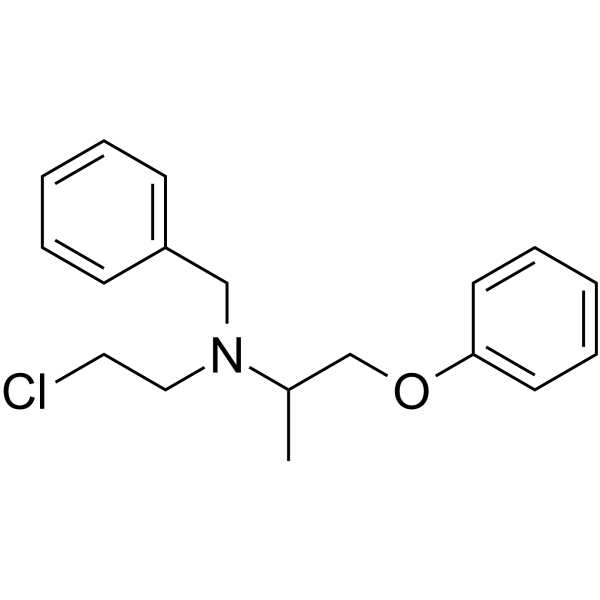
phenoxybenzamine structure
|
Common Name | phenoxybenzamine | ||
|---|---|---|---|---|
| CAS Number | 59-96-1 | Molecular Weight | 303.82600 | |
| Density | 1.102g/cm3 | Boiling Point | 381.5ºC at 760mmHg | |
| Molecular Formula | C18H22ClNO | Melting Point | 38-40ºC | |
| MSDS | N/A | Flash Point | 184.5ºC | |
Use of phenoxybenzaminePhenoxybenzamine is a nonselective, irreversible, orally active α-adrenoceptor antagonist that is commonly used for the research of hypertension, specifically caused by pheochromocytoma. Phenoxybenzamine also shows antitumor activity[1][2]. |
Summary: Phenoxybenzamine (N-benzyl-N-(2-chloroethyl)-1-phenoxypropan-2-amine, CAS number: 59-96-1), with molecular formula C18H22ClNO and molecular weight 303.82600, has a melting point of 38-40ºC and a boiling point of 381.5ºC. For research-use only, not for medical or clinical usage.
This table lists Chinese names, IUPAC names and various aliases of this chemical substance.
| Name | N-benzyl-N-(2-chloroethyl)-1-phenoxypropan-2-amine |
|---|---|
| Synonym | More Synonyms |
This table contains bioactivity, target information and biological‑assay experimental data of this compound.
| Description | Phenoxybenzamine is a nonselective, irreversible, orally active α-adrenoceptor antagonist that is commonly used for the research of hypertension, specifically caused by pheochromocytoma. Phenoxybenzamine also shows antitumor activity[1][2]. |
|---|---|
| Related Catalog | |
| Target |
α-adrenoceptor[1] |
| In Vitro | Phenoxybenzamine hydrochloride (0-100 μM; 96 h) markedly inhibits U251 and U87MG cells proliferation[2]. Phenoxybenzamine hydrochloride (10 μM; 24 h or 72 h) inhibits migration and invasion of U251 and U87MG cells[2]. Phenoxybenzamine hydrochloride (10 μM; 12 h) activates LINGO-1 and inhibits the TrkB-Akt pathway[2]. Phenoxybenzamine (0.1 μM-1 mM; 0-16 h) prevents hippocampal cell death after oxygen glucose deprivation[3]. Cell Proliferation Assay[2] Cell Line: U251 and U87MG cells Concentration: 0.1, 1, 10, 50 and 100 μM Incubation Time: 96 h Result: Cell proliferation was inhibited markedly, the inhibition rate being 26.5 % for U251 cells and 27.3 % for U87MG cells at 10 μM. Cell Migration Assay [2] Cell Line: U251 and U87MG cells Concentration: 10 μM Incubation Time: 24 h Result: Apparent inhibition on migration was observed, and the inhibition rate was 28.6 and 39.8 % for U251 and U87MG, respectively. Cell Invasion Assay[2] Cell Line: U251 and U87MG cells Concentration: 10 μM Incubation Time: 72 h Result: Attenuated the invasion properties of both U251 and U87MG markedly, as represented by the number of invaded cells per field declining from 365/field to 132/field (36.2 %) for U251 and 444/field to 298/field (67.1 %) for U87MG. Western Blot Analysis[2] Cell Line: U251 Concentration: 10 μM Incubation Time: 12 h Result: Decreased the protein level of TrkB, p-TrkB, and p-Akt, but Akt remained unchanged significantly. |
| In Vivo | Phenoxybenzamine hydrochloride (20 nM; s.c.; 2-day interval for 26 days) shows anti-tumorigenic effect in mice[2]. Phenoxybenzamine (1.0 mg/kg; i.v.; daily for 30 days) is neuroprotective in a rat model of severe traumatic brain injury[3]. Animal Model: Nude mice, U87MG tumor model[2] Dosage: 20 nM Administration: Subcutaneous injection, 2-day interval for 26 days Result: Reduced the tumor cells. Animal Model: Male Wistar rats (350–500 g), traumatic brain injury (TBI) model[3] Dosage: 1.0 mg/kg Administration: Intravenous injection, daily for 30 days Result: Showed significant improvements in neurological severity score (NSS) and foot fault scoring on days 14, 21, and 30. Reduced cognitive impairment associated with severe TBI and reduced the expression of pro-inflammatory genes. |
| References |
This table shows physicochemical parameters including melting point, boiling point, density, solubility and optical rotation. Missing data is marked as N/A.
| Density | 1.102g/cm3 |
|---|---|
| Boiling Point | 381.5ºC at 760mmHg |
| Melting Point | 38-40ºC |
| Molecular Formula | C18H22ClNO |
| Molecular Weight | 303.82600 |
| Flash Point | 184.5ºC |
| Exact Mass | 303.13900 |
| PSA | 12.47000 |
| LogP | 4.19490 |
| Index of Refraction | 1.559 |
| InChIKey | QZVCTJOXCFMACW-UHFFFAOYSA-N |
| SMILES | CC(COc1ccccc1)N(CCCl)Cc1ccccc1 |
This table summarizes toxicological test data, acute & chronic toxicity and ecological hazard parameters for this chemical.
CHEMICAL IDENTIFICATION
HEALTH HAZARD DATAACUTE TOXICITY DATA
|
This table covers safety warnings, protective measures, incompatible substances and disposal guidelines for this compound.
| HS Code | 2922299090 |
|---|
This table shows customs‑related data including HS‑code, tariff and regulatory conditions for import and export.
| HS Code | 2922299090 |
|---|---|
| Summary | 2922299090. other amino-naphthols and other amino-phenols, other than those containing more than one kind of oxygen function, their ethers and esters; salts thereof. VAT:17.0%. Tax rebate rate:13.0%. . MFN tariff:6.5%. General tariff:30.0% |
This table collects all English aliases, systematic names and CAS‑related synonyms of the compound.
| N-(2-chloroethyl)-N-(1-methyl-2-phenoxy-ethyl)benzenemethanamine |
| Dibenylin |
| Dibenziran |
| Phenoxybenzamin |
| Dibenylene |
| Dibenzylin |
| Fenoxibenzamina |
| Dibenyline |
| Bensylyt |
| Benzylyt |
| phenoxybenzamine |
| Dibenzyran |
This section contains frequently‑asked‑questions about this compound, including basic parameters, properties, storage conditions and corresponding answers.
| Q: What is the polar surface area (PSA) of N-benzyl-N-(2-chloroethyl)-1-phenoxypropan-2-amine? |
| A: Polar surface area (PSA) of N-benzyl-N-(2-chloroethyl)-1-phenoxypropan-2-amine is 12.47000. |
| Q: What is the molecular weight of N-benzyl-N-(2-chloroethyl)-1-phenoxypropan-2-amine? |
| A: Molecular weight of N-benzyl-N-(2-chloroethyl)-1-phenoxypropan-2-amine is 303.82600. |
| Q: What are the uses of N-benzyl-N-(2-chloroethyl)-1-phenoxypropan-2-amine? |
| A: Main uses of N-benzyl-N-(2-chloroethyl)-1-phenoxypropan-2-amine: Phenoxybenzamine is a nonselective, irreversible, orally active α-adrenoceptor antagonist that is commonly used for the research of hypertension, specifically caused by pheochromocytoma. Phenoxybenzamine also shows antitumor activity[1][2]. |
| Q: What English synonyms does N-benzyl-N-(2-chloroethyl)-1-phenoxypropan-2-amine have? |
| A: English synonyms of N-benzyl-N-(2-chloroethyl)-1-phenoxypropan-2-amine: N-(2-chloroethyl)-N-(1-methyl-2-phenoxy-ethyl)benzenemethanamine, Dibenylin, Dibenziran, Phenoxybenzamin, Dibenylene, Dibenzylin, Fenoxibenzamina, Dibenyline, Bensylyt, Benzylyt, phenoxybenzamine, Dibenzyran. |
| Q: What is the boiling point of N-benzyl-N-(2-chloroethyl)-1-phenoxypropan-2-amine? |
| A: Boiling point of N-benzyl-N-(2-chloroethyl)-1-phenoxypropan-2-amine is 381.5ºC at 760mmHg. |
| Q: What is the English name of N-benzyl-N-(2-chloroethyl)-1-phenoxypropan-2-amine? |
| A: The English name of N-benzyl-N-(2-chloroethyl)-1-phenoxypropan-2-amine is N-benzyl-N-(2-chloroethyl)-1-phenoxypropan-2-amine. |
| Q: What is the InChIKey of N-benzyl-N-(2-chloroethyl)-1-phenoxypropan-2-amine? |
| A: InChIKey of N-benzyl-N-(2-chloroethyl)-1-phenoxypropan-2-amine is QZVCTJOXCFMACW-UHFFFAOYSA-N. |
| Q: What is the melting point of N-benzyl-N-(2-chloroethyl)-1-phenoxypropan-2-amine? |
| A: Melting point of N-benzyl-N-(2-chloroethyl)-1-phenoxypropan-2-amine is 38-40ºC. |
| Q: What is the SMILES notation of N-benzyl-N-(2-chloroethyl)-1-phenoxypropan-2-amine? |
| A: SMILES notation of N-benzyl-N-(2-chloroethyl)-1-phenoxypropan-2-amine is CC(COc1ccccc1)N(CCCl)Cc1ccccc1. |
| Q: What is the LogP of N-benzyl-N-(2-chloroethyl)-1-phenoxypropan-2-amine? |
| A: LogP of N-benzyl-N-(2-chloroethyl)-1-phenoxypropan-2-amine is 4.19490. |
This table lists manufacturers and suppliers of this compound, including vendor names and product supply reference information.
| Dayang Chem (Hangzhou) Co., Ltd. |