4-Pentenoic acid
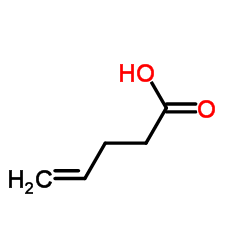
4-Pentenoic acid structure
|
Common Name | 4-Pentenoic acid | ||
|---|---|---|---|---|
| CAS Number | 591-80-0 | Molecular Weight | 100.116 | |
| Density | 1.0±0.1 g/cm3 | Boiling Point | 188.5±0.0 °C at 760 mmHg | |
| Molecular Formula | C5H8O2 | Melting Point | 54-57 °C(lit.) | |
| MSDS | Chinese USA | Flash Point | 89.4±0.0 °C | |
| Symbol |


GHS05, GHS07 |
Signal Word | Danger | |
Use of 4-Pentenoic acid4-Pentenoic acid is an endogenous metabolite. |
This table lists Chinese names, IUPAC names and various aliases of this chemical substance.
| Name | pent-4-enoic acid |
|---|---|
| Synonym | More Synonyms |
This table contains bioactivity, target information and biological‑assay experimental data of this compound.
| Description | 4-Pentenoic acid is an endogenous metabolite. |
|---|---|
| Related Catalog | |
| Target |
Human Endogenous Metabolite |
This table shows physicochemical parameters including melting point, boiling point, density, solubility and optical rotation. Missing data is marked as N/A.
| Density | 1.0±0.1 g/cm3 |
|---|---|
| Boiling Point | 188.5±0.0 °C at 760 mmHg |
| Melting Point | 54-57 °C(lit.) |
| Molecular Formula | C5H8O2 |
| Molecular Weight | 100.116 |
| Flash Point | 89.4±0.0 °C |
| Exact Mass | 100.052429 |
| PSA | 37.30000 |
| LogP | 0.99 |
| Vapour density | >1 (vs air) |
| Vapour Pressure | 0.3±0.7 mmHg at 25°C |
| Index of Refraction | 1.439 |
| InChIKey | HVAMZGADVCBITI-UHFFFAOYSA-N |
| SMILES | C=CCCC(=O)O |
| Storage condition | 2-8°C |
This table provides MSDS information including hazard classification, first‑aid, fire‑fighting, spill handling, operation and storage instructions.
This table summarizes toxicological test data, acute & chronic toxicity and ecological hazard parameters for this chemical.
CHEMICAL IDENTIFICATION
HEALTH HAZARD DATAACUTE TOXICITY DATA
|
This table covers safety warnings, protective measures, incompatible substances and disposal guidelines for this compound.
| Symbol |
GHS05, GHS07 |
|---|---|
| Signal Word | Danger |
| Hazard Statements | H302-H314 |
| Precautionary Statements | P280-P305 + P351 + P338-P310 |
| Personal Protective Equipment | Faceshields;full-face respirator (US);Gloves;Goggles;multi-purpose combination respirator cartridge (US);type ABEK (EN14387) respirator filter |
| Hazard Codes | C:Corrosive; |
| Risk Phrases | R22;R34 |
| Safety Phrases | S26-S36/37/39-S45 |
| RIDADR | UN 3261 8/PG 2 |
| WGK Germany | 3 |
| RTECS | SC4751000 |
| Packaging Group | III |
| Hazard Class | 8 |
| HS Code | 29161980 |
This table presents publicly reported synthetic routes, reaction conditions, reactants and product information of the compound.
This table shows customs‑related data including HS‑code, tariff and regulatory conditions for import and export.
| HS Code | 29161980 |
|---|
This table lists relevant public references with title, journal and publication metadata for this compound.
|
Surface Eroding, Semicrystalline Polyanhydrides via Thiol-Ene "Click" Photopolymerization.
Biomacromolecules 16 , 1650-9, (2015) Surface eroding and semicrystalline polyanhydrides, with tunable erosion times and drug delivery pharmacokinetics largely dictated by erosion, are produced easily with thiol-ene "click" polymerization... |
|
|
Resveratrol protects against experimental induced Reye's syndrome by prohibition of oxidative stress and restoration of complex I activity.
Can. J. Physiol. Pharmacol. 92(9) , 780-8, (2014) This study was designed to investigate whether resveratrol could provide protection against Reye's syndrome induced by 4-pentenoic acid in Wistar albino rats. Compared with rats with untreated Reye's ... |
|
|
Pentenoic acid pathways for cellulosic biofuels.
Angew. Chem. Int. Ed. Engl. 49(26) , 4336-8, (2010)
|
This table contains target information, in‑vitro & in‑vivo assay data for this compound.
This table collects all English aliases, systematic names and CAS‑related synonyms of the compound.
| pent-4-enoic acid |
| MFCD00004407 |
| 4-Pentenoic acid |
| EINECS 228-028-0 |
| Allylacetic acid |
This section contains frequently‑asked‑questions about this compound, including basic parameters, properties, storage conditions and corresponding answers.
| Q: What is the melting point of pent-4-enoic acid? |
| A: Melting point of pent-4-enoic acid is 54-57 °C(lit.). |
| Q: What is the LogP of pent-4-enoic acid? |
| A: LogP of pent-4-enoic acid is 0.99. |
| Q: What is the polar surface area (PSA) of pent-4-enoic acid? |
| A: Polar surface area (PSA) of pent-4-enoic acid is 37.30000. |
| Q: What is the English name of pent-4-enoic acid? |
| A: The English name of pent-4-enoic acid is pent-4-enoic acid. |
| Q: What are the storage conditions for pent-4-enoic acid? |
| A: Storage conditions for pent-4-enoic acid: 2-8°C. |
| Q: What is the molecular weight of pent-4-enoic acid? |
| A: Molecular weight of pent-4-enoic acid is 100.116. |
| Q: What is the SMILES notation of pent-4-enoic acid? |
| A: SMILES notation of pent-4-enoic acid is C=CCCC(=O)O. |
| Q: What is the CAS number of pent-4-enoic acid? |
| A: CAS number of pent-4-enoic acid is 591-80-0. |
| Q: What English synonyms does pent-4-enoic acid have? |
| A: English synonyms of pent-4-enoic acid: pent-4-enoic acid, MFCD00004407, 4-Pentenoic acid, EINECS 228-028-0, Allylacetic acid. |
| Q: What is the safety information for pent-4-enoic acid? |
| A: Safety information for pent-4-enoic acid: S26-S36/37/39-S45. |
This table lists manufacturers and suppliers of this compound, including vendor names and product supply reference information.
| Shanghai Nianxing Industrial Co., Ltd |
| Dayang Chem (Hangzhou) Co., Ltd. |
| Zhongshan Xingrui Chemical Co. , Ltd. |
The content on this webpage is sourced from various professional data sources. If you have any questions or concerns regarding the content, please feel free to contact service1@chemsrc.com.
- Shanghai Nianxing Industrial Co., Ltd
- China
- Product Name: 4-Pentenoic acid
- Price: Check
- Purity: 98.0%
- Delivery: 10 Day
- Contact: Yang
- Email: sales@echemcloud.com
- Dayang Chem (Hangzhou) Co., Ltd.
- China
- Product Name: Allylacetic acid
- Price: $Inquiry/100g $Inquiry/1kg $Inquiry/100kg $Inquiry/1000kg
- Purity: 98.0%
- Delivery: Inquiry
- Contact: Ms Wang
- Email: enquiry@dycnchem.com
- Zhongshan Xingrui Chemical Co. , Ltd.
- China
- Product Name: 4-Pentenoic acid
- Price: ¥Inquiry/25kg
- Purity: 99.0%
- Delivery: Inquiry
- Contact: Wang Jie

- Email: 3096638339@qq.com
Get all suppliers and price by the below link: