Dimethoate

Modify Date: 2026-07-01 19:40:48

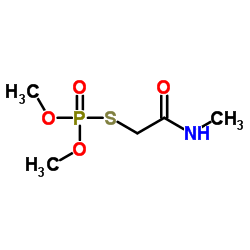
Dimethoate Structure
Dimethoate structure
Common Name Dimethoate
CAS Number 60-51-5 Molecular Weight 229.257
Density 1.4±0.1 g/cm3 Boiling Point 310.3±52.0 °C at 760 mmHg
Molecular Formula C5H12NO3PS2 Melting Point 52-52.5°C
MSDS Chinese USA Flash Point 141.4±30.7 °C
Symbol GHS07
GHS07
Signal Word Warning

 Use of Dimethoate


Dimethoate is an effective systemic insecticide for use on plants, has shown promise as a chemotherapeutic agent for control of cattle grubs and certain other insect pests of farm animals, and has high contact toxicity to house-flies and many other insects[1].

 Names

This table lists Chinese names, IUPAC names and various aliases of this chemical substance.

Name dimethoate
Synonym More Synonyms

 Dimethoate Biological Activity

This table contains bioactivity, target information and biological‑assay experimental data of this compound.

Description Dimethoate is an effective systemic insecticide for use on plants, has shown promise as a chemotherapeutic agent for control of cattle grubs and certain other insect pests of farm animals, and has high contact toxicity to house-flies and many other insects[1].
Related Catalog
References

[1]. CASIDA JE, et al. Toxic hazard from formulating the insecticide dimethoate in methyl 'Cellosolve'. Nature. 1961;189:507-508.

 Chemical & Physical Properties

This table shows physicochemical parameters including melting point, boiling point, density, solubility and optical rotation. Missing data is marked as N/A.

Density 1.4±0.1 g/cm3
Boiling Point 310.3±52.0 °C at 760 mmHg
Melting Point 52-52.5°C
Molecular Formula C5H12NO3PS2
Molecular Weight 229.257
Flash Point 141.4±30.7 °C
Exact Mass 228.999619
PSA 114.76000
LogP 1.32
Vapour Pressure 0.0±1.5 mmHg at 25°C
Index of Refraction 1.548
InChIKey MCWXGJITAZMZEV-UHFFFAOYSA-N
SMILES CNC(=O)CSP(=S)(OC)OC
Storage condition 0-6°C
Water Solubility Slightly soluble. 2.5 g/100 mL

 MSDS

This table provides MSDS information including hazard classification, first‑aid, fire‑fighting, spill handling, operation and storage instructions.

 Toxicological Information

This table summarizes toxicological test data, acute & chronic toxicity and ecological hazard parameters for this chemical.

CHEMICAL IDENTIFICATION

RTECS NUMBER :
TE1750000
CHEMICAL NAME :
Phosphorodithioic acid, O,O-dimethyl ester, S-ester with 2-mercapto-N-methylacetamide
CAS REGISTRY NUMBER :
60-51-5
BEILSTEIN REFERENCE NO. :
1785339
LAST UPDATED :
199710
DATA ITEMS CITED :
96
MOLECULAR FORMULA :
C5-H12-N-O3-P-S2
MOLECULAR WEIGHT :
229.27
WISWESSER LINE NOTATION :
1OPS&O1&S1VM1

HEALTH HAZARD DATA

ACUTE TOXICITY DATA

TYPE OF TEST :
TDLo - Lowest published toxic dose
ROUTE OF EXPOSURE :
Oral
SPECIES OBSERVED :
Human - man
DOSE/DURATION :
286 mg/kg
TOXIC EFFECTS :
Peripheral Nerve and Sensation - fasciculations Behavioral - coma Lungs, Thorax, or Respiration - dyspnea
TYPE OF TEST :
LD50 - Lethal dose, 50 percent kill
ROUTE OF EXPOSURE :
Oral
SPECIES OBSERVED :
Human
DOSE/DURATION :
30 mg/kg
TOXIC EFFECTS :
Details of toxic effects not reported other than lethal dose value
TYPE OF TEST :
TDLo - Lowest published toxic dose
ROUTE OF EXPOSURE :
Oral
SPECIES OBSERVED :
Human - man
DOSE/DURATION :
300 mg/kg
TOXIC EFFECTS :
Behavioral - coma Cardiac - pulse rate Vascular - BP lowering not characterized in autonomic section
TYPE OF TEST :
TDLo - Lowest published toxic dose
ROUTE OF EXPOSURE :
Oral
SPECIES OBSERVED :
Human - man
DOSE/DURATION :
357 mg/kg
TOXIC EFFECTS :
Brain and Coverings - other degenerative changes Cardiac - cardiomyopathy including infarction Kidney, Ureter, Bladder - changes in tubules (including acute renal failure, acute tubular necrosis)
TYPE OF TEST :
LD50 - Lethal dose, 50 percent kill
ROUTE OF EXPOSURE :
Oral
SPECIES OBSERVED :
Rodent - rat
DOSE/DURATION :
60 mg/kg
TOXIC EFFECTS :
Details of toxic effects not reported other than lethal dose value
TYPE OF TEST :
LD50 - Lethal dose, 50 percent kill
ROUTE OF EXPOSURE :
Administration onto the skin
SPECIES OBSERVED :
Rodent - rat
DOSE/DURATION :
353 mg/kg
TOXIC EFFECTS :
Details of toxic effects not reported other than lethal dose value
TYPE OF TEST :
LD50 - Lethal dose, 50 percent kill
ROUTE OF EXPOSURE :
Intraperitoneal
SPECIES OBSERVED :
Rodent - rat
DOSE/DURATION :
100 mg/kg
TOXIC EFFECTS :
Sense Organs and Special Senses (Eye) - lacrimation Lungs, Thorax, or Respiration - dyspnea Gastrointestinal - changes in structure or function of salivary glands
TYPE OF TEST :
LD50 - Lethal dose, 50 percent kill
ROUTE OF EXPOSURE :
Subcutaneous
SPECIES OBSERVED :
Rodent - rat
DOSE/DURATION :
350 mg/kg
TOXIC EFFECTS :
Sense Organs and Special Senses (Eye) - lacrimation Lungs, Thorax, or Respiration - dyspnea Gastrointestinal - changes in structure or function of salivary glands
TYPE OF TEST :
LD50 - Lethal dose, 50 percent kill
ROUTE OF EXPOSURE :
Intravenous
SPECIES OBSERVED :
Rodent - rat
DOSE/DURATION :
450 mg/kg
TOXIC EFFECTS :
Sense Organs and Special Senses (Eye) - lacrimation Lungs, Thorax, or Respiration - dyspnea Gastrointestinal - changes in structure or function of salivary glands
TYPE OF TEST :
LD50 - Lethal dose, 50 percent kill
ROUTE OF EXPOSURE :
Unreported
SPECIES OBSERVED :
Rodent - rat
DOSE/DURATION :
215 mg/kg
TOXIC EFFECTS :
Details of toxic effects not reported other than lethal dose value
TYPE OF TEST :
LD50 - Lethal dose, 50 percent kill
ROUTE OF EXPOSURE :
Oral
SPECIES OBSERVED :
Rodent - mouse
DOSE/DURATION :
60 mg/kg
TOXIC EFFECTS :
Sense Organs and Special Senses (Eye) - lacrimation Lungs, Thorax, or Respiration - dyspnea Gastrointestinal - changes in structure or function of salivary glands
TYPE OF TEST :
LD50 - Lethal dose, 50 percent kill
ROUTE OF EXPOSURE :
Administration onto the skin
SPECIES OBSERVED :
Rodent - mouse
DOSE/DURATION :
1 gm/kg
TOXIC EFFECTS :
Details of toxic effects not reported other than lethal dose value
TYPE OF TEST :
LD50 - Lethal dose, 50 percent kill
ROUTE OF EXPOSURE :
Intraperitoneal
SPECIES OBSERVED :
Rodent - mouse
DOSE/DURATION :
45 mg/kg
TOXIC EFFECTS :
Sense Organs and Special Senses (Eye) - lacrimation Lungs, Thorax, or Respiration - dyspnea Gastrointestinal - changes in structure or function of salivary glands
TYPE OF TEST :
LD50 - Lethal dose, 50 percent kill
ROUTE OF EXPOSURE :
Subcutaneous
SPECIES OBSERVED :
Rodent - mouse
DOSE/DURATION :
60 mg/kg
TOXIC EFFECTS :
Sense Organs and Special Senses (Eye) - lacrimation Lungs, Thorax, or Respiration - dyspnea Gastrointestinal - changes in structure or function of salivary glands
TYPE OF TEST :
LD50 - Lethal dose, 50 percent kill
ROUTE OF EXPOSURE :
Oral
SPECIES OBSERVED :
Mammal - dog
DOSE/DURATION :
400 mg/kg
TOXIC EFFECTS :
Details of toxic effects not reported other than lethal dose value
TYPE OF TEST :
LD50 - Lethal dose, 50 percent kill
ROUTE OF EXPOSURE :
Oral
SPECIES OBSERVED :
Mammal - cat
DOSE/DURATION :
100 mg/kg
TOXIC EFFECTS :
Behavioral - excitement
TYPE OF TEST :
LD50 - Lethal dose, 50 percent kill
ROUTE OF EXPOSURE :
Oral
SPECIES OBSERVED :
Rodent - rabbit
DOSE/DURATION :
300 mg/kg
TOXIC EFFECTS :
Details of toxic effects not reported other than lethal dose value
TYPE OF TEST :
LD50 - Lethal dose, 50 percent kill
ROUTE OF EXPOSURE :
Administration onto the skin
SPECIES OBSERVED :
Rodent - rabbit
DOSE/DURATION :
1 gm/kg
TOXIC EFFECTS :
Behavioral - excitement
TYPE OF TEST :
LD50 - Lethal dose, 50 percent kill
ROUTE OF EXPOSURE :
Oral
SPECIES OBSERVED :
Rodent - guinea pig
DOSE/DURATION :
350 mg/kg
TOXIC EFFECTS :
Details of toxic effects not reported other than lethal dose value
TYPE OF TEST :
LD50 - Lethal dose, 50 percent kill
ROUTE OF EXPOSURE :
Administration onto the skin
SPECIES OBSERVED :
Rodent - guinea pig
DOSE/DURATION :
965 mg/kg
TOXIC EFFECTS :
Details of toxic effects not reported other than lethal dose value
TYPE OF TEST :
LD10 - Lethal Dose
ROUTE OF EXPOSURE :
Intraperitoneal
SPECIES OBSERVED :
Rodent - guinea pig
DOSE/DURATION :
390 mg/kg
TOXIC EFFECTS :
Details of toxic effects not reported other than lethal dose value
TYPE OF TEST :
LD50 - Lethal dose, 50 percent kill
ROUTE OF EXPOSURE :
Oral
SPECIES OBSERVED :
Rodent - hamster
DOSE/DURATION :
200 mg/kg
TOXIC EFFECTS :
Sense Organs and Special Senses (Eye) - lacrimation Lungs, Thorax, or Respiration - dyspnea Gastrointestinal - changes in structure or function of salivary glands
TYPE OF TEST :
LD50 - Lethal dose, 50 percent kill
ROUTE OF EXPOSURE :
Intraperitoneal
SPECIES OBSERVED :
Rodent - hamster
DOSE/DURATION :
160 mg/kg
TOXIC EFFECTS :
Details of toxic effects not reported other than lethal dose value
TYPE OF TEST :
LD50 - Lethal dose, 50 percent kill
ROUTE OF EXPOSURE :
Subcutaneous
SPECIES OBSERVED :
Rodent - hamster
DOSE/DURATION :
60 mg/kg
TOXIC EFFECTS :
Sense Organs and Special Senses (Eye) - lacrimation Lungs, Thorax, or Respiration - dyspnea Gastrointestinal - changes in structure or function of salivary glands
TYPE OF TEST :
LD50 - Lethal dose, 50 percent kill
ROUTE OF EXPOSURE :
Oral
SPECIES OBSERVED :
Bird - chicken
DOSE/DURATION :
25 mg/kg
TOXIC EFFECTS :
Biochemical - Enzyme inhibition, induction, or change in blood or tissue levels - true cholinesterase
TYPE OF TEST :
LD50 - Lethal dose, 50 percent kill
ROUTE OF EXPOSURE :
Oral
SPECIES OBSERVED :
Bird - quail
DOSE/DURATION :
25 mg/kg
TOXIC EFFECTS :
Details of toxic effects not reported other than lethal dose value
TYPE OF TEST :
LD50 - Lethal dose, 50 percent kill
ROUTE OF EXPOSURE :
Oral
SPECIES OBSERVED :
Bird - duck
DOSE/DURATION :
42 mg/kg
TOXIC EFFECTS :
Details of toxic effects not reported other than lethal dose value
TYPE OF TEST :
LD50 - Lethal dose, 50 percent kill
ROUTE OF EXPOSURE :
Oral
SPECIES OBSERVED :
Bird - wild bird species
DOSE/DURATION :
6600 ug/kg
TOXIC EFFECTS :
Details of toxic effects not reported other than lethal dose value
TYPE OF TEST :
TDLo - Lowest published toxic dose
ROUTE OF EXPOSURE :
Oral
SPECIES OBSERVED :
Rodent - rat
DOSE/DURATION :
630 mg/kg/28D-I
TOXIC EFFECTS :
Blood - changes in serum composition (e.g. TP, bilirubin, cholesterol) Biochemical - Enzyme inhibition, induction, or change in blood or tissue levels - multiple enzyme effects
TYPE OF TEST :
TDLo - Lowest published toxic dose
ROUTE OF EXPOSURE :
Oral
SPECIES OBSERVED :
Rodent - rat
DOSE/DURATION :
1092 mg/kg/52W-C
TOXIC EFFECTS :
Blood - other changes Biochemical - Enzyme inhibition, induction, or change in blood or tissue levels - true cholinesterase
TYPE OF TEST :
TDLo - Lowest published toxic dose
ROUTE OF EXPOSURE :
Oral
SPECIES OBSERVED :
Rodent - rat
DOSE/DURATION :
300 mg/kg/6W-I
TOXIC EFFECTS :
Brain and Coverings - changes in surface EEG Peripheral Nerve and Sensation - recording from peripheral motor nerve Biochemical - Enzyme inhibition, induction, or change in blood or tissue levels - true cholinesterase
TYPE OF TEST :
TDLo - Lowest published toxic dose
ROUTE OF EXPOSURE :
Oral
SPECIES OBSERVED :
Rodent - rat
DOSE/DURATION :
3330 mg/kg/90D-C
TOXIC EFFECTS :
Sense Organs and Special Senses (Eye) - effect, not otherwise specified Nutritional and Gross Metabolic - weight loss or decreased weight gain Biochemical - Enzyme inhibition, induction, or change in blood or tissue levels - true cholinesterase
TYPE OF TEST :
TCLo - Lowest published toxic concentration
ROUTE OF EXPOSURE :
Inhalation
SPECIES OBSERVED :
Rodent - rat
DOSE/DURATION :
4500 ug/m3/13W-I
TOXIC EFFECTS :
Kidney, Ureter, Bladder - other changes in urine composition Blood - changes in leukocyte (WBC) count Biochemical - Enzyme inhibition, induction, or change in blood or tissue levels - true cholinesterase
TYPE OF TEST :
TCLo - Lowest published toxic concentration
ROUTE OF EXPOSURE :
Inhalation
SPECIES OBSERVED :
Rodent - rat
DOSE/DURATION :
257 ug/m3/24H/15W-I
TOXIC EFFECTS :
Kidney, Ureter, Bladder - other changes in urine composition Blood - changes in serum composition (e.g. TP, bilirubin, cholesterol) Biochemical - Enzyme inhibition, induction, or change in blood or tissue levels - true cholinesterase
TYPE OF TEST :
TDLo - Lowest published toxic dose
ROUTE OF EXPOSURE :
Oral
SPECIES OBSERVED :
Rodent - rat
DOSE/DURATION :
3852 mg/kg/26W-I
TOXIC EFFECTS :
Lungs, Thorax, or Respiration - structural or functional change in trachea or bronchi Liver - fatty liver degeneration Kidney, Ureter, Bladder - changes in both tubules and glomeruli
TYPE OF TEST :
TDLo - Lowest published toxic dose
ROUTE OF EXPOSURE :
Oral
SPECIES OBSERVED :
Mammal - dog
DOSE/DURATION :
3937 mg/kg/90D-C
TOXIC EFFECTS :
Biochemical - Enzyme inhibition, induction, or change in blood or tissue levels - true cholinesterase
TYPE OF TEST :
TCLo - Lowest published toxic concentration
ROUTE OF EXPOSURE :
Inhalation
SPECIES OBSERVED :
Rodent - guinea pig
DOSE/DURATION :
4500 ug/m3/8H/13W-I
TOXIC EFFECTS :
Kidney, Ureter, Bladder - other changes in urine composition Blood - changes in leukocyte (WBC) count Biochemical - Enzyme inhibition, induction, or change in blood or tissue levels - true cholinesterase
TYPE OF TEST :
TDLo - Lowest published toxic dose
ROUTE OF EXPOSURE :
Oral
SPECIES OBSERVED :
Bird - chicken
DOSE/DURATION :
56 mg/kg/4W-I
TOXIC EFFECTS :
Liver - other changes Endocrine - other changes Blood - changes in serum composition (e.g. TP, bilirubin, cholesterol)
TYPE OF TEST :
TDLo - Lowest published toxic dose
ROUTE OF EXPOSURE :
Oral
SPECIES OBSERVED :
Rodent - rat
DOSE/DURATION :
256 mg/kg/4W-I
TOXIC EFFECTS :
Tumorigenic - Carcinogenic by RTECS criteria Liver - tumors Blood - tumors
TYPE OF TEST :
TDLo - Lowest published toxic dose
ROUTE OF EXPOSURE :
Intramuscular
SPECIES OBSERVED :
Rodent - rat
DOSE/DURATION :
176 mg/kg/6W-I
TOXIC EFFECTS :
Tumorigenic - Carcinogenic by RTECS criteria Liver - tumors Blood - tumors
TYPE OF TEST :
TDLo - Lowest published toxic dose
ROUTE OF EXPOSURE :
Oral
DOSE :
120 mg/kg
SEX/DURATION :
female 6-15 day(s) after conception
TOXIC EFFECTS :
Reproductive - Specific Developmental Abnormalities - musculoskeletal system
TYPE OF TEST :
TDLo - Lowest published toxic dose
ROUTE OF EXPOSURE :
Oral
DOSE :
113 mg/kg
SEX/DURATION :
female 6-20 day(s) after conception
TOXIC EFFECTS :
Reproductive - Maternal Effects - other effects Reproductive - Effects on Embryo or Fetus - fetotoxicity (except death, e.g., stunted fetus) Reproductive - Effects on Embryo or Fetus - other effects to embryo
TYPE OF TEST :
TDLo - Lowest published toxic dose
ROUTE OF EXPOSURE :
Oral
DOSE :
1050 mg/kg
SEX/DURATION :
multigenerations
TOXIC EFFECTS :
Reproductive - Fertility - female fertility index (e.g. # females pregnant per # sperm positive females; # females pregnant per # females mated) Reproductive - Fertility - other measures of fertility Reproductive - Effects on Newborn - weaning or lactation index (e.g., # alive at weaning per # alive at day 4)
TYPE OF TEST :
TDLo - Lowest published toxic dose
ROUTE OF EXPOSURE :
Oral
DOSE :
220 mg/kg
SEX/DURATION :
female 6-16 day(s) after conception
TOXIC EFFECTS :
Reproductive - Effects on Embryo or Fetus - fetotoxicity (except death, e.g., stunted fetus)
TYPE OF TEST :
TDLo - Lowest published toxic dose
ROUTE OF EXPOSURE :
Oral
DOSE :
440 mg/kg
SEX/DURATION :
female 6-16 day(s) after conception
TOXIC EFFECTS :
Reproductive - Specific Developmental Abnormalities - musculoskeletal system
TYPE OF TEST :
TDLo - Lowest published toxic dose
ROUTE OF EXPOSURE :
Intraperitoneal
DOSE :
40 mg/kg
SEX/DURATION :
female 1 day(s) after conception
TOXIC EFFECTS :
Reproductive - Effects on Embryo or Fetus - fetal death
TYPE OF TEST :
TDLo - Lowest published toxic dose
ROUTE OF EXPOSURE :
Oral
DOSE :
108 mg/kg
SEX/DURATION :
female 14-22 day(s) after conception
TOXIC EFFECTS :
Reproductive - Specific Developmental Abnormalities - musculoskeletal system
TYPE OF TEST :
Specific locus test
TYPE OF TEST :
Sex chromosome loss and nondisjunction
TYPE OF TEST :
Sex chromosome loss and nondisjunction
TYPE OF TEST :
Micronucleus test
TYPE OF TEST :
Cytogenetic analysis
TYPE OF TEST :
Micronucleus test
TYPE OF TEST :
Unscheduled DNA synthesis
TYPE OF TEST :
Mutation test systems - not otherwise specified
TYPE OF TEST :
Cytogenetic analysis
TYPE OF TEST :
Cytogenetic analysis
TYPE OF TEST :
Cytogenetic analysis
TYPE OF TEST :
Cytogenetic analysis

MUTATION DATA

TYPE OF TEST :
Sister chromatid exchange
TEST SYSTEM :
Rodent - hamster Lung
DOSE/DURATION :
20 mg/L
REFERENCE :
ENMUDM Environmental Mutagenesis. (New York, NY) V.1-9, 1979-87. For publisher information, see EMMUEG. Volume(issue)/page/year: 4,621,1982 *** REVIEWS *** TOXICOLOGY REVIEW AQMOAC Air Quality Monographs. (Washington, DC) No.69-1 - No.75-25, 1969-75(?). Discontinued. Volume(issue)/page/year: #73-19,1973 TOXICOLOGY REVIEW RREVAH Residue Reviews. (Springer-Verlag New York, Inc., Service Center, 44 Hartz Way, Secaucus, NJ 07094) V.1- 1962- Volume(issue)/page/year: 46,1,1973 TOXICOLOGY REVIEW MZUZA8 Meditsinskii Zhurnal Uzbekistana. (V/O Mezhdunarodnaya Kniga, 113095 Moscow, USSR) No.1- 1957- Volume(issue)/page/year: (8),90,1973 TOXICOLOGY REVIEW DTTIAF Deutsche Tieraerztliche Wochenschrift. (Hanover, Fed. Rep. Ger.) V.1-77, 1893-1970. Volume(issue)/page/year: 80,485,1973 TOXICOLOGY REVIEW RREVAH Residue Reviews. (Springer-Verlag New York, Inc., Service Center, 44 Hartz Way, Secaucus, NJ 07094) V.1- 1962- Volume(issue)/page/year: 63,1,1976 TOXICOLOGY REVIEW ENVRAL Environmental Research. (Academic Press, Inc., 1 E. First St., Duluth, MN 55802) V.1- 1967- Volume(issue)/page/year: 34,193,1984 TOXICOLOGY REVIEW NULSAK Nucleus (Calcutta). (Dr. A.K. Sharma, Centre of Advanced Studies in Cell and Chromosome Research, Calcutta, 35 Baliygunge Circular Rd., Calcutta 700 019, India) V.1- 1958- Volume(issue)/page/year: 28,243,1985 *** U.S. STANDARDS AND REGULATIONS *** EPA FIFRA 1988 PESTICIDE SUBJECT TO REGISTRATION OR RE-REGISTRATION FEREAC Federal Register. (U.S. Government Printing Office, Supt. of Documents, Washington, DC 20402) V.1- 1936- Volume(issue)/page/year: 54,7740,1989 *** NIOSH STANDARDS DEVELOPMENT AND SURVEILLANCE DATA *** NIOSH OCCUPATIONAL EXPOSURE SURVEY DATA : NOHS - National Occupational Hazard Survey (1974) NOHS Hazard Code - 84534 No. of Facilities: 30 (estimated) No. of Industries: 2 No. of Occupations: 2 No. of Employees: 90 (estimated) NOES - National Occupational Exposure Survey (1983) NOES Hazard Code - 84534 No. of Facilities: 54 (estimated) No. of Industries: 1 No. of Occupations: 1 No. of Employees: 1665 (estimated) No. of Female Employees: 107 (estimated)

 Safety Information

This table covers safety warnings, protective measures, incompatible substances and disposal guidelines for this compound.

Symbol GHS07
GHS07
Signal Word Warning
Hazard Statements H302-H312
Precautionary Statements P280
Personal Protective Equipment dust mask type N95 (US);Eyeshields;Faceshields;Gloves
Hazard Codes Xn:Harmful
Risk Phrases R21/22
Safety Phrases S2-S36/37-S24/25-S23-S53-S26
RIDADR UN 2783
RTECS TE1750000
Packaging Group III
Hazard Class 6.1(b)
HS Code 2930909063

 Synthetic Route

This table presents publicly reported synthetic routes, reaction conditions, reactants and product information of the compound.

~%

Dimethoate Structure

Dimethoate

CAS#:60-51-5

Learn More
Literature: Die Entwicklung neuer insektizider Phosphorsaeure-Ester, 3. Aufl. S. 117,122 DE1076662 , ;

~%

Dimethoate Structure

Dimethoate

CAS#:60-51-5

Learn More
Literature: GB791824 , ;

~%

Dimethoate Structure

Dimethoate

CAS#:60-51-5

Learn More
Literature: Die Entwicklung neuer insektizider Phosphorsaeure-Ester, 3. Aufl. S. 117,122

~%

Dimethoate Structure

Dimethoate

CAS#:60-51-5

Detail Learn More
Literature: Journal fuer Praktische Chemie (Leipzig), , vol. 330, # 6 p. 911 - 918

~%

Dimethoate Structure

Dimethoate

CAS#:60-51-5

Detail Learn More
Literature: Zeitschrift fuer Chemie (Stuttgart, Germany), , vol. 29, # 2 p. 52 - 56

 Customs

This table shows customs‑related data including HS‑code, tariff and regulatory conditions for import and export.

HS Code 2930909063
Summary 2930909063 o,o-dimethyl s-(2-(methylamino)-2-oxoethyl) phosphorothioate。supervision conditions:s(import or export registration certificate for pesticides)。VAT:17.0%。tax rebate rate:9.0%。MFN tarrif:6.5%。general tariff:30.0%

 Articles42

More Articles

This table lists relevant public references with title, journal and publication metadata for this compound.

Effects of solvent on the toxicity of dimethoate in a honey bee in vitro larval study.

Pest Manag. Sci. 69(4) , 462-3, (2013)

There is increasing interest in the toxicity of pesticides to honey bee larvae. The solubility of pesticides in the artificial diet used to dose larvae is a key issue. There has been no full evaluatio...

Biomarkers and energy reserves in the isopod Porcellionides pruinosus: the effects of long-term exposure to dimethoate.

Sci. Total Environ. 502 , 91-102, (2015)

Terrestrial isopods from the species Porcellionides pruinosus were exposed to the recommended field dose application (0.4 mg/kg soil) and a sublethal concentration (10mg/kg soil) of dimethoate at two ...

Ultra-high performance liquid chromatography-quadrupole time-of-flight mass spectrometry to identify contaminants in water: an insight on environmental forensics.

J. Chromatogr. A. 1345 , 86-97, (2014)

Ultra-high pressure liquid chromatography-quadrupole time-of-flight mass spectrometry (UHPLC-QqTOF-MS) acquiring full scan MS data for quantification, and automatic data dependent information product ...

 DimethoateBioassay

View more

This table contains target information, in‑vitro & in‑vivo assay data for this compound.

Name: Luminescence-based cell-based primary high throughput screening assay to identify ago...
Source: The Scripps Research Institute Molecular Screening Center
Target: mu-type opioid receptor isoform MOR-1 [Homo sapiens]
External Id: OPRM1-OPRD1_AG_LUMI_1536_1X%ACT PRUN
Name: Fluorescence-based cell-based primary high throughput screening assay to identify ago...
Source: The Scripps Research Institute Molecular Screening Center
Target: muscarinic acetylcholine receptor M1 [Homo sapiens]
External Id: CHRM1_AG_FLUO8_1536_1X%ACT PRUN
Name: Fluorescence-based cell-based primary high throughput screening assay to identify pos...
Source: The Scripps Research Institute Molecular Screening Center
Target: muscarinic acetylcholine receptor M1 [Homo sapiens]
External Id: CHRM1_PAM_FLUO8_1536_1X%ACT PRUN
Name: Fluorescence polarization-based biochemical high throughput primary assay to identify...
Source: The Scripps Research Institute Molecular Screening Center
Target: RecName: Full=Sialate O-acetylesterase; AltName: Full=H-Lse; AltName: Full=Sialic acid-specific 9-O-acetylesterase; Flags: Precursor [Homo sapiens]
External Id: SIAE_INH_FP_1536_1X%INH PRUN
Name: p53 small molecule agonists, cell-based qHTS assay
Source: 824
External Id: P53344
Name: p53 small molecule agonists, cell-based qHTS assay with human liver microsomes
Source: 824
Target: tumor suppressor p53 [Homo sapiens]
External Id: P53MS233
Total 325, Current Page 1 of 33
1
2
3
4
5

 Synonyms

This table collects all English aliases, systematic names and CAS‑related synonyms of the compound.

O,O-Dimethyl phosphorodithioate S-ester with 2-mercapto-N-methylacetamide (8CI)
L 395
O,O-Dimethyl S-(N-Methylcarbamoylmethyl) Phosphorodithioate
O,O-dimethyl S-methylcarbamoylmethyl phosphorodithioate
CHAMP
O,O-Dimethyl S-(N-methylcarbamoylmethyl) dithiophosphate
Phosphorodithioic acid, O,O-dimethyl S-[2-(methylamino)-2-oxoethyl] ester
O,O-dimethyl S-[2-(methylamino)-2-oxoethyl] dithiophosphate
1OPS&O1&S1VM1
phosphamide
Aadimethoal
O,O-Dimethyl S-((methylcarbamoyl)methyl)phosphorodithioate
Tara
Dimethoate
Phosphorodithioic Acid O,O-Dimethyl S-[2-(Methylamino)-2-oxoethyl] Ester
Phosphorodithioic Acid O,O-Dimethyl Ester Ester with 2-Mercapto-N-methylacetamide
BI 58
O,O-Dimethyl methylcarbamoylmethyl phosphorodithioate
ROGOR
CYGON
O,O-dimethyl S-(2-(methylamino)-2-oxoethyl) phosphorodithioate
FIP
MFCD00053676
O,O-Dimethyl S-(N-methylcarbamylmethyl) thiothionophosphate
Dithiophosphate de S-[2-(méthylamino)-2-oxoéthyle] et de O,O-diméthyle
O,O-dimethyl S-methylcarbamoylmethylphosphorodithioate
Lurgo
O,O-Dimethyl S-methylcarbomoylmethyl phosphorodithioate
O,O-Dimethyl-S-(N-monomethyl)-carbamyl methyl dithiophosphate
EINECS 200-480-3
O,O-Dimethyl S-[2-(methylamino)-2-oxoethyl] phosphorodithioate
oms94
2-dimethoxyphosphinothioylthio-N-methylacetamide

 Dimethoate | FAQ

This section contains frequently‑asked‑questions about this compound, including basic parameters, properties, storage conditions and corresponding answers.

Q: What is the melting point of dimethoate?
A: Melting point of dimethoate is 52-52.5°C.
Q: What is the polar surface area (PSA) of dimethoate?
A: Polar surface area (PSA) of dimethoate is 114.76000.
Q: What is the CAS number of dimethoate?
A: CAS number of dimethoate is 60-51-5.
Q: What are the uses of dimethoate?
A: Main uses of dimethoate: Dimethoate is an effective systemic insecticide for use on plants, has shown promise as a chemotherapeutic agent for control of cattle grubs and certain other insect pests of farm animals, and has high contact toxicity to house-flies and many other insects[1].
Q: What are the storage conditions for dimethoate?
A: Storage conditions for dimethoate: 0-6°C.
Q: What are the downstream products of dimethoate?
A: Related downstream products(CAS) of dimethoate: 1112-38-5;20938-74-3;3268-87-9;1113-02-6;63124-33-4.
Q: What is the InChIKey of dimethoate?
A: InChIKey of dimethoate is MCWXGJITAZMZEV-UHFFFAOYSA-N.
Q: What is the safety information for dimethoate?
A: Safety information for dimethoate: S2-S36/37-S24/25-S23-S53-S26.
Q: What is the molecular formula of dimethoate?
A: Molecular formula of dimethoate is C5H12NO3PS2.
Q: What are the upstream materials of dimethoate?
A: Related upstream materials(CAS) of dimethoate: 74-89-5;96-30-0;16001-68-6;34680-81-4;757-86-8.

 Dimethoatefactory

This table lists manufacturers and suppliers of this compound, including vendor names and product supply reference information.

Shanghai Nianxing Industrial Co., Ltd
Henan Tianfu Chemical Co., Ltd.
The content on this webpage is sourced from various professional data sources. If you have any questions or concerns regarding the content, please feel free to contact service1@chemsrc.com.
Top Suppliers:I want be here


Get all suppliers and price by the below link:

Dimethoate suppliers


Price: ¥850/250 mg

Reference only. check more Dimethoate price