Glycochenodeoxycholic acid
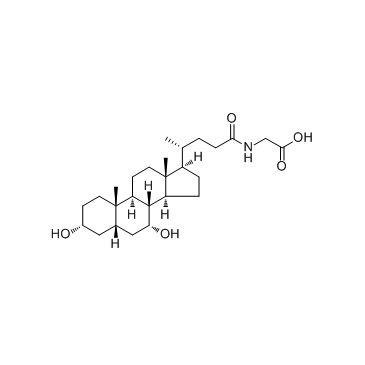
Glycochenodeoxycholic acid structure
|
Common Name | Glycochenodeoxycholic acid | ||
|---|---|---|---|---|
| CAS Number | 640-79-9 | Molecular Weight | 449.62300 | |
| Density | N/A | Boiling Point | N/A | |
| Molecular Formula | C26H43NO5 | Melting Point | N/A | |
| MSDS | N/A | Flash Point | N/A | |
Use of Glycochenodeoxycholic acidGlycochenodeoxycholic acid is a bile salt formed in the liver from chenodeoxycholate and glycine; used to induce hepatocyte apoptosis in research. |
This table lists Chinese names, IUPAC names and various aliases of this chemical substance.
| Name | glycochenodeoxycholic acid |
|---|---|
| Synonym | More Synonyms |
This table contains bioactivity, target information and biological‑assay experimental data of this compound.
| Description | Glycochenodeoxycholic acid is a bile salt formed in the liver from chenodeoxycholate and glycine; used to induce hepatocyte apoptosis in research. |
|---|---|
| Related Catalog | |
| Target |
Human Endogenous Metabolite |
| In Vitro | Chenodeoxycholate is toxic to hepatocytes, and accumulation of chenodeoxycholate in the liver during cholestasis may potentiate hepatocellular injury. At a concentration of 250μM, glycochenodeoxycholate is more toxic than either chenodeoxycholate or taurochenodeoxycholate. Glycochenodeoxycholate cytotoxicity may result from ATP depletion followed by a subsequent rise in Ca2+. The rise in Ca2+ leads to an increase in calcium-dependent degradative proteolysis and, ultimately, cell death[1]. 4 h exposure of 50 μM GCDC induces apoptosis in 42% of hepatocytes. Intracellular PKC activity decreased to 44% of controls 2 h after exposure of hepatocytes to GCDC. GCDC-induced apoptosis is associated with decreases in total cellular PKC activity, which appear to be dependent on intracellular calpain-like protease activity[2]. |
| In Vivo | GCDCA induces ER-related calcium release within about ten seconds. Significant increases in activities of calpain and caspase-12 are observed after 15 h of GCDCA treatment. Bip and Chop mRNA expressions are increased with the treated GCDCA dose and incubation time. Cytochrome c release from mitochondria peaks in about 2 h of incubation[3]. |
| Animal Admin | Rats: The freshly isolated hepatocytes are preincubated for 2 h at a density of 1× 10⁶ cells/mL in a mixture of William’s E medium supplement with 10% FBS. Isolated rat hepatocytes are incubated in William’s E medium with or without (used as a control) GCDCA (50, 100 and 300 μM), or TG (1, 2 and 5 μM) for 1-24 h[3]. |
| References |
This table shows physicochemical parameters including melting point, boiling point, density, solubility and optical rotation. Missing data is marked as N/A.
| Molecular Formula | C26H43NO5 |
|---|---|
| Molecular Weight | 449.62300 |
| Exact Mass | 449.31400 |
| PSA | 110.35000 |
| LogP | 4.43440 |
| InChIKey | GHCZAUBVMUEKKP-GYPHWSFCSA-N |
| SMILES | CC(CCC(=O)NCC(=O)O)C1CCC2C3C(O)CC4CC(O)CCC4(C)C3CCC12C |
| Storage condition | -20°C |
This table contains target information, in‑vitro & in‑vivo assay data for this compound.
|
Name: Cytotoxicity against human HuH7 cells assessed as cell viability at 500 uM after 24 h...
Source: ChEMBL
Target: N/A
External Id: CHEMBL1251410
|
|
Name: Cytotoxicity against human HET-1A cells assessed as cell viability after 24 hrs by MT...
Source: ChEMBL
Target: N/A
External Id: CHEMBL1251409
|
|
Name: Cytotoxicity against human HET-1A cells assessed as cell viability at >1 mM after 24 ...
Source: ChEMBL
Target: N/A
External Id: CHEMBL1251408
|
|
Name: TP_TRANSPORTER: uptake of Glycochenodeoxycholate at 20 uM in Oatp1-expressing HeLa ce...
Source: ChEMBL
Target: Solute carrier organic anion transporter family member 1A1
External Id: CHEMBL2075557
|
|
Name: Binding affinity for Farnesoid X Receptor (FXR)
Source: ChEMBL
Target: Bile acid receptor
External Id: CHEMBL682032
|
|
Name: TP_TRANSPORTER: uptake in ASBT-expressing COS cells
Source: ChEMBL
Target: Ileal sodium/bile acid cotransporter
External Id: CHEMBL2076059
|
|
Name: Cytotoxicity against human HET-1A cells assessed as cell viability at 500 uM after 24...
Source: ChEMBL
Target: N/A
External Id: CHEMBL1251411
|
|
Name: TP_TRANSPORTER: inhibition of BSP uptake (BSP: 2 uM, GCDCA: 100 uM) in Xenopus laevis...
Source: ChEMBL
Target: Solute carrier organic anion transporter family member 1A1
External Id: CHEMBL2077148
|
|
Name: TP_TRANSPORTER: inhibition of Taurocholate uptake (Taurochorate: 20 uM, GCDCA: 200 uM...
Source: ChEMBL
Target: Solute carrier organic anion transporter family member 1A1
External Id: CHEMBL2075676
|
|
Name: Agonist activity at human TGR5 expressed in CHO cells by luciferase assay relative to...
Source: ChEMBL
Target: G-protein coupled bile acid receptor 1
External Id: CHEMBL949257
|
This table collects all English aliases, systematic names and CAS‑related synonyms of the compound.
| Chenodeoxycholylglycine |
| [3H]-Glycylchenodeoxycholic acid |
| [14C]-Glycylchenodeoxycholic acid |
| 2-[[(4R)-4-[(3R,5S,7R,8R,9S,10S,13R,14S,17R)-3,7-dihydroxy-10,13-dimethyl-2,3,4,5,6,7,8,9,11,12,14,15,16,17-tetradecahydro-1H-cyclopenta[a]phenanthren-17-yl]pentanoyl]amino]acetic acid |
| Glycine chenodeoxycholate |
| Chenodeoxyglycocholic acid |
| Chenodeoxycholic acid glycine conjugate |
| Glycochenodeoxycholate |
| Chenodeoxyglycocholate |
This section contains frequently‑asked‑questions about this compound, including basic parameters, properties, storage conditions and corresponding answers.
| Q: What are the uses of glycochenodeoxycholic acid? |
| A: Main uses of glycochenodeoxycholic acid: Glycochenodeoxycholic acid is a bile salt formed in the liver from chenodeoxycholate and glycine; used to induce hepatocyte apoptosis in research. |
| Q: What are the storage conditions for glycochenodeoxycholic acid? |
| A: Storage conditions for glycochenodeoxycholic acid: -20°C. |
| Q: What is the CAS number of glycochenodeoxycholic acid? |
| A: CAS number of glycochenodeoxycholic acid is 640-79-9. |
| Q: What is the InChIKey of glycochenodeoxycholic acid? |
| A: InChIKey of glycochenodeoxycholic acid is GHCZAUBVMUEKKP-GYPHWSFCSA-N. |
| Q: What is the SMILES notation of glycochenodeoxycholic acid? |
| A: SMILES notation of glycochenodeoxycholic acid is CC(CCC(=O)NCC(=O)O)C1CCC2C3C(O)CC4CC(O)CCC4(C)C3CCC12C. |
| Q: What is the LogP of glycochenodeoxycholic acid? |
| A: LogP of glycochenodeoxycholic acid is 4.43440. |
| Q: What English synonyms does glycochenodeoxycholic acid have? |
| A: English synonyms of glycochenodeoxycholic acid: Chenodeoxycholylglycine, [3H]-Glycylchenodeoxycholic acid, [14C]-Glycylchenodeoxycholic acid, 2-[[(4R)-4-[(3R,5S,7R,8R,9S,10S,13R,14S,17R)-3,7-dihydroxy-10,13-dimethyl-2,3,4,5,6,7,8,9,11,12,14,15,16,17-tetradecahydro-1H-cyclopenta[a]phenanthren-17-yl]pentanoyl]amino]acetic acid, Glycine chenodeoxycholate, Chenodeoxyglycocholic acid, Chenodeoxycholic acid glycine conjugate, Glycochenodeoxycholate, Chenodeoxyglycocholate. |
| Q: What is the English name of glycochenodeoxycholic acid? |
| A: The English name of glycochenodeoxycholic acid is glycochenodeoxycholic acid. |
| Q: What is the polar surface area (PSA) of glycochenodeoxycholic acid? |
| A: Polar surface area (PSA) of glycochenodeoxycholic acid is 110.35000. |
| Q: What is the molecular formula of glycochenodeoxycholic acid? |
| A: Molecular formula of glycochenodeoxycholic acid is C26H43NO5. |
This table lists manufacturers and suppliers of this compound, including vendor names and product supply reference information.
| Shanghai Nianxing Industrial Co., Ltd |