Hexaconazole
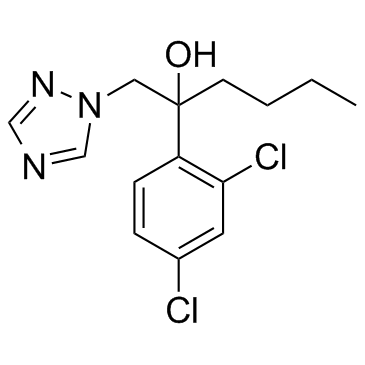
Hexaconazole structure
|
Common Name | Hexaconazole | ||
|---|---|---|---|---|
| CAS Number | 79983-71-4 | Molecular Weight | 314.210 | |
| Density | 1.3±0.1 g/cm3 | Boiling Point | 490.3±55.0 °C at 760 mmHg | |
| Molecular Formula | C14H17Cl2N3O | Melting Point | 111ºC | |
| MSDS | Chinese USA | Flash Point | 250.3±31.5 °C | |
| Symbol |


GHS07, GHS09 |
Signal Word | Warning | |
Use of HexaconazoleHexaconazole is a systemic fungicide used for the control of many fungi particularly Ascomycetes and Basidiomycetes. In vitro: Among the enzymatic antioxidants, superoxide dismutase and peroxidase are significantly up-regulated by hexaconazole. [1] Hexaconazole and its enantiomers cause the down-regulation of tryptophan levels and the up-regulation of kynurenine (KYN) levels, suggesting a role for hexaconazole in the activation of the KYN pathway and providing information for the mechanism of its toxicity.[2] |
This table lists Chinese names, IUPAC names and various aliases of this chemical substance.
| Name | hexaconazole |
|---|---|
| Synonym | More Synonyms |
This table contains bioactivity, target information and biological‑assay experimental data of this compound.
| Description | Hexaconazole is a systemic fungicide used for the control of many fungi particularly Ascomycetes and Basidiomycetes. In vitro: Among the enzymatic antioxidants, superoxide dismutase and peroxidase are significantly up-regulated by hexaconazole. [1] Hexaconazole and its enantiomers cause the down-regulation of tryptophan levels and the up-regulation of kynurenine (KYN) levels, suggesting a role for hexaconazole in the activation of the KYN pathway and providing information for the mechanism of its toxicity.[2] |
|---|---|
| Related Catalog | |
| References |
This table shows physicochemical parameters including melting point, boiling point, density, solubility and optical rotation. Missing data is marked as N/A.
| Density | 1.3±0.1 g/cm3 |
|---|---|
| Boiling Point | 490.3±55.0 °C at 760 mmHg |
| Melting Point | 111ºC |
| Molecular Formula | C14H17Cl2N3O |
| Molecular Weight | 314.210 |
| Flash Point | 250.3±31.5 °C |
| Exact Mass | 313.074860 |
| PSA | 50.94000 |
| LogP | 3.66 |
| Vapour Pressure | 0.0±1.3 mmHg at 25°C |
| Index of Refraction | 1.598 |
| InChIKey | STMIIPIFODONDC-UHFFFAOYSA-N |
| SMILES | CCCCC(O)(Cn1cncn1)c1ccc(Cl)cc1Cl |
| Storage condition | 0-6°C |
This table provides MSDS information including hazard classification, first‑aid, fire‑fighting, spill handling, operation and storage instructions.
This table summarizes toxicological test data, acute & chronic toxicity and ecological hazard parameters for this chemical.
CHEMICAL IDENTIFICATION
HEALTH HAZARD DATAACUTE TOXICITY DATA
|
This table covers safety warnings, protective measures, incompatible substances and disposal guidelines for this compound.
| Symbol |
GHS07, GHS09 |
|---|---|
| Signal Word | Warning |
| Hazard Statements | H302-H317-H411 |
| Precautionary Statements | P280-P301 + P312 + P330 |
| Personal Protective Equipment | dust mask type N95 (US);Eyeshields;Faceshields;Gloves |
| Hazard Codes | Xn:Harmful |
| Risk Phrases | R22;R43;R51/53 |
| Safety Phrases | S2-S24-S37-S61 |
| RIDADR | UN3077 9/PG 3 |
| RTECS | XZ4803200 |
| HS Code | 2933990014 |
This table shows customs‑related data including HS‑code, tariff and regulatory conditions for import and export.
| HS Code | 2933990014 |
|---|---|
| Summary | 2933990014 1-(4-chlorophenoxy)-3,3-dimethyl-1-(1h-1,2,4-triazol-1-yl)butan-2-one。supervision conditions:s(import or export registration certificate for pesticides)。VAT:17.0%。tax rebate rate:9.0%。MFN tarrif:6.5%。general tariff:20.0% |
This table lists relevant public references with title, journal and publication metadata for this compound.
|
Solarization and biosolarization enhance fungicide dissipation in the soil.
Chemosphere 79(2) , 216-20, (2010) Although there is some evidence regarding the effect of solarization and biosolarization on pesticide degradation, information is still scarce. The aim of this study was to determine the effect of the... |
|
|
Enantiomeric separation of triazole fungicides with 3-μm and 5-μml particle chiral columns by reverse-phase high-performance liquid chromatography.
Chirality 23(6) , 479-86, (2011) This study used chiral columns packed with 3-μm and 5-μm particles to comparatively separate enantiomers of 9 triazole fungicides, and Lux Cellulose-1 columns with chiral stationary phase of cellulose... |
|
|
Enantiomer separation of triazole fungicides by high-performance liquid chromatography.
Chirality 21(4) , 421-7, (2009) Enantiomer separation is one of the most important prerequisites for the investigation of environmental enantioselective behaviors for chiral pesticides. In the present study, the enantiomer separatio... |
This table contains target information, in‑vitro & in‑vivo assay data for this compound.
This table collects all English aliases, systematic names and CAS‑related synonyms of the compound.
| 2-(2,4-Dichlorophenyl)-1-(1H-1,2,4-triazol-1-yl)-2-hexanol |
| 2-(2,4-Dichlorophenyl)-1-(1H-1,2,4-triazol-1-yl)hexan-2-ol |
| Contaf 5EC |
| Anvil L |
| α-butyl-α-(2,4-dichlorophenyl)-1H-1,2,4-triazole-1-ethanol |
| Chlortriafol |
| MFCD00144441 |
| Hexaconazole |
| (RS)-2-(2,4-dichlorophenyl)-1-(1H-1,2,4-triazol-1-yl)hexan-2-ol |
| Anvil |
| Anvil Liquid |
| 2-(2,4-Dichlorphenyl)-1-(1H-1,2,4-triazol-1-yl)hexan-2-ol |
| rac-(2R)-2-(2,4-dichlorophenyl)-1-(1H-1,2,4-triazol-1-yl)hexan-2-ol |
| 2-(2,4-dichlorophenyl)-1-(1,2,4-triazol-1-yl)hexan-2-ol |
| Sitara |
| Hexaconazol |
| Contaf |
| EINECS 413-050-7 |
| (±)-a-Butyl-a-(2,4-dichlorophenyl)-1H-1,2,4-triazole-1-ethanol |
This section contains frequently‑asked‑questions about this compound, including basic parameters, properties, storage conditions and corresponding answers.
| Q: What is the CAS number of hexaconazole? |
| A: CAS number of hexaconazole is 79983-71-4. |
| Q: What is the molecular formula of hexaconazole? |
| A: Molecular formula of hexaconazole is C14H17Cl2N3O. |
| Q: What is the safety information for hexaconazole? |
| A: Safety information for hexaconazole: S2-S24-S37-S61. |
| Q: What is the SMILES notation of hexaconazole? |
| A: SMILES notation of hexaconazole is CCCCC(O)(Cn1cncn1)c1ccc(Cl)cc1Cl. |
| Q: What is the InChIKey of hexaconazole? |
| A: InChIKey of hexaconazole is STMIIPIFODONDC-UHFFFAOYSA-N. |
| Q: What is the LogP of hexaconazole? |
| A: LogP of hexaconazole is 3.66. |
| Q: What is the English name of hexaconazole? |
| A: The English name of hexaconazole is hexaconazole. |
| Q: What is the boiling point of hexaconazole? |
| A: Boiling point of hexaconazole is 490.3±55.0 °C at 760 mmHg. |
| Q: What is the polar surface area (PSA) of hexaconazole? |
| A: Polar surface area (PSA) of hexaconazole is 50.94000. |
| Q: What is the melting point of hexaconazole? |
| A: Melting point of hexaconazole is 111ºC. |
This table lists manufacturers and suppliers of this compound, including vendor names and product supply reference information.
| Shanghai Nianxing Industrial Co., Ltd |
| Dayang Chem (Hangzhou) Co., Ltd. |
| Henan Tianfu Chemical Co., Ltd. |