Salicylanilide
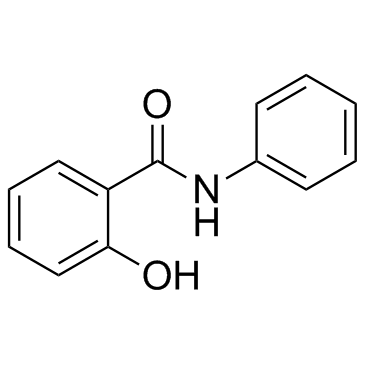
Salicylanilide structure
|
Common Name | Salicylanilide | ||
|---|---|---|---|---|
| CAS Number | 87-17-2 | Molecular Weight | 213.232 | |
| Density | 1.3±0.1 g/cm3 | Boiling Point | 294.3±23.0 °C at 760 mmHg | |
| Molecular Formula | C13H11NO2 | Melting Point | 136-138 °C(lit.) | |
| MSDS | Chinese USA | Flash Point | 131.8±22.6 °C | |
| Symbol |


GHS07, GHS09 |
Signal Word | Warning | |
Use of SalicylanilideSalicylanilide demonstrates a wide range of biological activities including antiviral potency which can inhibit HIV virus by targeting HIV-1 integrase or reverse transcriptase. |
This table lists Chinese names, IUPAC names and various aliases of this chemical substance.
| Name | salicylanilide |
|---|---|
| Synonym | More Synonyms |
This table contains bioactivity, target information and biological‑assay experimental data of this compound.
| Description | Salicylanilide demonstrates a wide range of biological activities including antiviral potency which can inhibit HIV virus by targeting HIV-1 integrase or reverse transcriptase. |
|---|---|
| Related Catalog | |
| Target |
HIV-1 integrase, reverse transcriptase[1] |
| In Vitro | Some Salicylanilides and salicylamides could inhibit HIV virus by targeting of HIV-1 integrase or reverse transcriptase. Hepatitis C virus is another virus, which can be potentially afflicted by Salicylanilides on the level of two enzymes-NS3 protease and NS5B RNA polymerase[1]. |
| References |
This table shows physicochemical parameters including melting point, boiling point, density, solubility and optical rotation. Missing data is marked as N/A.
| Density | 1.3±0.1 g/cm3 |
|---|---|
| Boiling Point | 294.3±23.0 °C at 760 mmHg |
| Melting Point | 136-138 °C(lit.) |
| Molecular Formula | C13H11NO2 |
| Molecular Weight | 213.232 |
| Flash Point | 131.8±22.6 °C |
| Exact Mass | 213.078979 |
| PSA | 49.33000 |
| LogP | 3.27 |
| Vapour Pressure | 0.0±0.6 mmHg at 25°C |
| Index of Refraction | 1.676 |
| InChIKey | WKEDVNSFRWHDNR-UHFFFAOYSA-N |
| SMILES | O=C(Nc1ccccc1)c1ccccc1O |
| Water Solubility | SLIGHTLY SOLUBLE |
This table provides MSDS information including hazard classification, first‑aid, fire‑fighting, spill handling, operation and storage instructions.
This table summarizes toxicological test data, acute & chronic toxicity and ecological hazard parameters for this chemical.
CHEMICAL IDENTIFICATION
HEALTH HAZARD DATAACUTE TOXICITY DATA
|
This table covers safety warnings, protective measures, incompatible substances and disposal guidelines for this compound.
| Symbol |
GHS07, GHS09 |
|---|---|
| Signal Word | Warning |
| Hazard Statements | H315-H319-H335-H400 |
| Precautionary Statements | P261-P273-P305 + P351 + P338 |
| Personal Protective Equipment | dust mask type N95 (US);Eyeshields;Gloves |
| Hazard Codes | Xi:Irritant; |
| Risk Phrases | R36/37/38 |
| Safety Phrases | S26-S37/39 |
| RIDADR | UN 3077 9 / PGIII |
| WGK Germany | 2 |
| RTECS | VN7850000 |
| HS Code | 29242995 |
This table presents publicly reported synthetic routes, reaction conditions, reactants and product information of the compound.
This table shows customs‑related data including HS‑code, tariff and regulatory conditions for import and export.
| HS Code | 2924299090 |
|---|---|
| Summary | 2924299090. other cyclic amides (including cyclic carbamates) and their derivatives; salts thereof. VAT:17.0%. Tax rebate rate:13.0%. . MFN tariff:6.5%. General tariff:30.0% |
This table lists relevant public references with title, journal and publication metadata for this compound.
|
A closer study of peak distortions in supercritical fluid chromatography as generated by the injection.
J. Chromatogr. A. 1400 , 131-9, (2015) In SFC the sample cannot be dissolved in the mobile phase, so it is often dissolved in pure modifier, or another liquid, sometimes resulting in serious distortions of the eluted peak profiles already ... |
|
|
Application of reactive salicylanilide to viscose fabrics as antibacterial and antifungus finishing.
Int. J. Biol. Macromol. 50(1) , 273-6, (2012) In the present study salicylanilide was reacted with 2,4,6-trichloro-1,3,5-triazine producing reactive salicylanilide at a yield of 45% according to reaction conditions set. The reactive salicylanilid... |
|
|
Harmaline-resistant mutant of Methanothermobacter thermautotrophicus with a lesion in Na(+)/H(+) antiport.
Gen. Physiol. Biophys. 30 Spec No , S54-60, (2011) A spontaneous mutant of Methanothermobacter thermautotrophicus resistant to the Na(+)/H(+) antiporter inhibitor harmaline was isolated. The Na(+)/H(+) exchange activity in the mutant cells was remarka... |
This table contains target information, in‑vitro & in‑vivo assay data for this compound.
|
Name: Luminescence-based cell-based primary high throughput screening assay to identify ago...
Source: The Scripps Research Institute Molecular Screening Center
Target: mu-type opioid receptor isoform MOR-1 [Homo sapiens]
External Id: OPRM1-OPRD1_AG_LUMI_1536_1X%ACT PRUN
|
|
Name: Fluorescence-based cell-based primary high throughput screening assay to identify ago...
Source: The Scripps Research Institute Molecular Screening Center
Target: muscarinic acetylcholine receptor M1 [Homo sapiens]
External Id: CHRM1_AG_FLUO8_1536_1X%ACT PRUN
|
|
Name: Cytochrome P450 Family 1 Subfamily A Member 2 (CYP1A2) small molecule antagonists: lu...
Source: 824
External Id: CYP273
|
|
Name: Increase the activity of the Burkholderia fixLJ 2-component system
Source: ICCB-Longwood/NSRB Screening Facility, Harvard Medical School
Target: Burkholderia multivorans
External Id: HMS1625
|
|
Name: Fluorescence-based cell-based primary high throughput screening assay to identify pos...
Source: The Scripps Research Institute Molecular Screening Center
Target: muscarinic acetylcholine receptor M1 [Homo sapiens]
External Id: CHRM1_PAM_FLUO8_1536_1X%ACT PRUN
|
|
Name: Fluorescence polarization-based biochemical high throughput primary assay to identify...
Source: The Scripps Research Institute Molecular Screening Center
Target: RecName: Full=Sialate O-acetylesterase; AltName: Full=H-Lse; AltName: Full=Sialic acid-specific 9-O-acetylesterase; Flags: Precursor [Homo sapiens]
External Id: SIAE_INH_FP_1536_1X%INH PRUN
|
|
Name: p53 small molecule agonists, cell-based qHTS assay: qHTS cell viability counter scree...
Source: 824
Target: N/A
External Id: P53600
|
|
Name: p53 small molecule agonists, cell-based qHTS assay with rat liver microsomes: qHTS ce...
Source: 824
Target: N/A
External Id: P53MS958
|
|
Name: p53 small molecule agonists, cell-based qHTS assay with rat liver microsomes: Summary
Source: 824
External Id: P53MS482
|
This table collects all English aliases, systematic names and CAS‑related synonyms of the compound.
| 2-Phenylaminocarbonylphenol |
| Salinide |
| Salicylanilid |
| 2-Hydroxy-N-phenylbenzamide |
| Salifebrin |
| Ansadol |
| salicylamide |
| salicylic acid anilide |
| N-Phenylsalicylamide |
| Hyanilid |
| EINECS 201-727-8 |
| 2-hydroxy-N-phenyl-benzamide |
| Aseptolan |
| Salicylanilide |
| MFCD00002212 |
This section contains frequently‑asked‑questions about this compound, including basic parameters, properties, storage conditions and corresponding answers.
| Q: What is the molecular formula of salicylanilide? |
| A: Molecular formula of salicylanilide is C13H11NO2. |
| Q: What is the polar surface area (PSA) of salicylanilide? |
| A: Polar surface area (PSA) of salicylanilide is 49.33000. |
| Q: What is the InChIKey of salicylanilide? |
| A: InChIKey of salicylanilide is WKEDVNSFRWHDNR-UHFFFAOYSA-N. |
| Q: What is the safety information for salicylanilide? |
| A: Safety information for salicylanilide: S26-S37/39. |
| Q: What English synonyms does salicylanilide have? |
| A: English synonyms of salicylanilide: 2-Phenylaminocarbonylphenol, Salinide, Salicylanilid, 2-Hydroxy-N-phenylbenzamide, Salifebrin, Ansadol, salicylamide, salicylic acid anilide, N-Phenylsalicylamide, Hyanilid, EINECS 201-727-8, 2-hydroxy-N-phenyl-benzamide, Aseptolan, Salicylanilide, MFCD00002212. |
| Q: What is the SMILES notation of salicylanilide? |
| A: SMILES notation of salicylanilide is O=C(Nc1ccccc1)c1ccccc1O. |
| Q: How is the water solubility of salicylanilide? |
| A: Water solubility of salicylanilide: SLIGHTLY SOLUBLE. |
| Q: What is the melting point of salicylanilide? |
| A: Melting point of salicylanilide is 136-138 °C(lit.). |
| Q: What are the uses of salicylanilide? |
| A: Main uses of salicylanilide: Salicylanilide demonstrates a wide range of biological activities including antiviral potency which can inhibit HIV virus by targeting HIV-1 integrase or reverse transcriptase. |
| Q: What is the molecular weight of salicylanilide? |
| A: Molecular weight of salicylanilide is 213.232. |
This table lists manufacturers and suppliers of this compound, including vendor names and product supply reference information.
| Shanghai Nianxing Industrial Co., Ltd |
| Dayang Chem (Hangzhou) Co., Ltd. |