isosorbide dinitrate
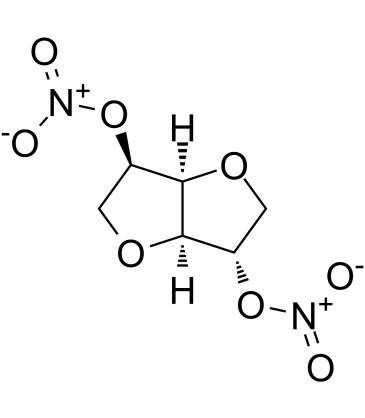
isosorbide dinitrate structure
|
Common Name | isosorbide dinitrate | ||
|---|---|---|---|---|
| CAS Number | 87-33-2 | Molecular Weight | 236.136 | |
| Density | 1.7±0.1 g/cm3 | Boiling Point | 365.9±42.0 °C at 760 mmHg | |
| Molecular Formula | C6H8N2O8 | Melting Point | 700C | |
| MSDS | N/A | Flash Point | 186.6±29.9 °C | |
| Symbol |

GHS07 |
Signal Word | Warning | |
Use of isosorbide dinitrateIsosorbide dinitrate (ISDN) is an NO donor that prevents LV remodeling and degradation of cardiac function following myocardial infarction (MI)[1]. |
This table lists Chinese names, IUPAC names and various aliases of this chemical substance.
| Name | isosorbide dinitrate |
|---|---|
| Synonym | More Synonyms |
This table contains bioactivity, target information and biological‑assay experimental data of this compound.
| Description | Isosorbide dinitrate (ISDN) is an NO donor that prevents LV remodeling and degradation of cardiac function following myocardial infarction (MI)[1]. |
|---|---|
| Related Catalog | |
| In Vivo | Isosorbide dinitrate (3 mg/kg; intratracheal; for 13 days) improves pulmonary artery pressure and ventricular remodeling in a rat model of heart failure following myocardial infarction[1]. Isosorbide dinitrate postconditioning exhibits a cardioprotective effect against rat myocardial ischemia-reperfusion injury in vivo[2]. Animal Model: 5–6 weeks old male juvenile Sprague-Dawley rats (200–250 g)[1] Dosage: 3 mg/kg Administration: Intratracheal; for 13 days following coronary ligation Result: Reduced MI size and alleviated left and right ventricular remodeling following MI. |
| References |
This table shows physicochemical parameters including melting point, boiling point, density, solubility and optical rotation. Missing data is marked as N/A.
| Density | 1.7±0.1 g/cm3 |
|---|---|
| Boiling Point | 365.9±42.0 °C at 760 mmHg |
| Melting Point | 700C |
| Molecular Formula | C6H8N2O8 |
| Molecular Weight | 236.136 |
| Flash Point | 186.6±29.9 °C |
| Exact Mass | 236.028061 |
| PSA | 128.56000 |
| LogP | 0.90 |
| Vapour Pressure | 0.0±0.8 mmHg at 25°C |
| Index of Refraction | 1.538 |
| InChIKey | MOYKHGMNXAOIAT-JGWLITMVSA-N |
| SMILES | O=[N+]([O-])OC1COC2C(O[N+](=O)[O-])COC12 |
This table summarizes toxicological test data, acute & chronic toxicity and ecological hazard parameters for this chemical.
CHEMICAL IDENTIFICATION
HEALTH HAZARD DATAACUTE TOXICITY DATA
MUTATION DATA
|
This table covers safety warnings, protective measures, incompatible substances and disposal guidelines for this compound.
| Symbol |
GHS07 |
|---|---|
| Signal Word | Warning |
| Hazard Statements | H302 |
| Precautionary Statements | P301 + P312 + P330 |
| Hazard Codes | Xn:Harmful; |
| Risk Phrases | R5;R22 |
| Safety Phrases | S36 |
| RIDADR | UN 2907 |
| Packaging Group | II |
| Hazard Class | 1.1A |
| HS Code | 3004909090 |
This table presents publicly reported synthetic routes, reaction conditions, reactants and product information of the compound.
|
~91%
isosorbide dinitrate CAS#:87-33-2 |
| Literature: Bhar, Debjani; Chandrasekaran, Srinivasan Indian Journal of Chemistry, Section B: Organic Chemistry Including Medicinal Chemistry, 1997 , vol. 36, # 9 p. 793 - 795 |
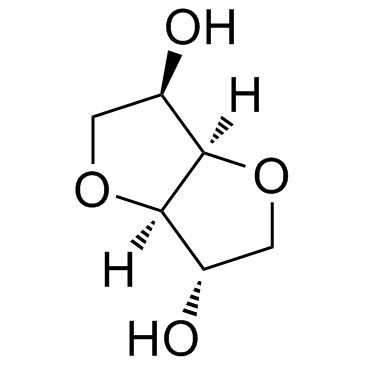
This table lists upstream starting materials and downstream derivative products related to this chemical.
| Precursor 1 | |
|---|---|
| DownStream 2 | |
 CAS#:16051-77-7
This table shows customs‑related data including HS‑code, tariff and regulatory conditions for import and export.
| HS Code | 2932999099 |
|---|---|
| Summary | 2932999099. other heterocyclic compounds with oxygen hetero-atom(s) only. VAT:17.0%. Tax rebate rate:13.0%. . MFN tariff:6.5%. General tariff:20.0% |
This table lists relevant public references with title, journal and publication metadata for this compound.
|
In vitro and in vivo evaluation of novel osmotic pump tablets of isosorbide-5-mononitrate containing polyvinyl pyrrolidone (PVP) for controlled release.
Pharmazie 67(8) , 695-700, (2012) A novel osmotic pump tablet with ethyl cellulose (EC) and polyvinyl pyrrolidone (PVP) as the semipermeable membrane and isosorbide-5-mononitrate (5-ISMN) as the model drug was formulated in this study... |
|
|
Superoxide dismutases, SOD1 and SOD2, play a distinct role in the fat body during pupation in silkworm Bombyx mori.
PLoS ONE 10(2) , e0116007, (2015) One way that aerobic biological systems counteract the generation of reactive oxygen species (ROS) is with superoxide dismutase proteins SOD1 and SOD2 that metabolize superoxide radicals to molecular ... |
|
|
Early administration of isosorbide dinitrate improves survival of cyanide-poisoned rabbits.
Clin. Toxicol. (Phila.) 53(1) , 22-7, (2015) More effective, rapidly delivered, safer antidotes are needed for cyanide poisoning. Previous study has demonstrated a beneficial effect of isosorbide dinitrate on the survival of cyanide-poisoned mic... |
This table collects all English aliases, systematic names and CAS‑related synonyms of the compound.
| Isorbid |
| Canranil |
| vasotrate |
| isosorbide dinitrate |
| 1,4:3,6-Dianhydro-2,5-di-O-nitro-D-glucitol |
| D-Glucitol, 1,4:3,6-dianhydro-, dinitrate |
| [(3S,3aS,6R,6aS)-3-nitrooxy-2,3,3a,5,6,6a-hexahydrofuro[3,2-b]furan-6-yl] nitrate |
| (3R,3aS,6S,6aS)-Hexahydrofuro[3,2-b]furan-3,6-diyldinitrat |
| Nitrol (VAN) |
| NITROL |
| MFCD00868238 |
| dinitrate de (3R,3aS,6S,6aS)-hexahydrofuro[3,2-b]furane-3,6-diyle |
| (3R,3aS,6S,6aS)-hexahydrofuro[3,2-b]furan-3,6-diyl dinitrate |
| EINECS 201-740-9 |
This section contains frequently‑asked‑questions about this compound, including basic parameters, properties, storage conditions and corresponding answers.
| Q: What is the InChIKey of isosorbide dinitrate? |
| A: InChIKey of isosorbide dinitrate is MOYKHGMNXAOIAT-JGWLITMVSA-N. |
| Q: What are the downstream products of isosorbide dinitrate? |
| A: Related downstream products(CAS) of isosorbide dinitrate: 16051-77-7;652-67-5. |
| Q: What is the CAS number of isosorbide dinitrate? |
| A: CAS number of isosorbide dinitrate is 87-33-2. |
| Q: What is the English name of isosorbide dinitrate? |
| A: The English name of isosorbide dinitrate is isosorbide dinitrate. |
| Q: What is the boiling point of isosorbide dinitrate? |
| A: Boiling point of isosorbide dinitrate is 365.9±42.0 °C at 760 mmHg. |
| Q: What is the molecular weight of isosorbide dinitrate? |
| A: Molecular weight of isosorbide dinitrate is 236.136. |
| Q: What is the melting point of isosorbide dinitrate? |
| A: Melting point of isosorbide dinitrate is 700C. |
| Q: What is the LogP of isosorbide dinitrate? |
| A: LogP of isosorbide dinitrate is 0.90. |
| Q: What is the molecular formula of isosorbide dinitrate? |
| A: Molecular formula of isosorbide dinitrate is C6H8N2O8. |
| Q: What is the polar surface area (PSA) of isosorbide dinitrate? |
| A: Polar surface area (PSA) of isosorbide dinitrate is 128.56000. |
This table lists manufacturers and suppliers of this compound, including vendor names and product supply reference information.
| Shanghai Nianxing Industrial Co., Ltd |
| Dayang Chem (Hangzhou) Co., Ltd. |
| Henan Tianfu Chemical Co., Ltd. |