柠檬酸三丁酯
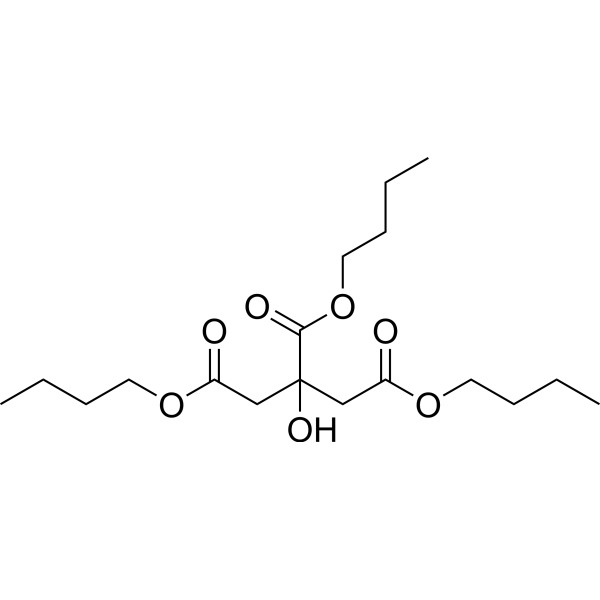
柠檬酸三丁酯结构式

|
常用名 | 柠檬酸三丁酯 | 英文名 | Tributyl citrate |
|---|---|---|---|---|
| CAS号 | 77-94-1 | 分子量 | 360.45 | |
| 密度 | 1.1±0.1 g/cm3 | 沸点 | 389.8±9.0 °C at 760 mmHg | |
| 分子式 | C18H32O7 | 熔点 | ≥300 °C(lit.) | |
| MSDS | 中文版 美版 | 闪点 | 120.7±12.2 °C |
|
Formulation considerations in the design of topical, polymeric film-forming systems for sustained drug delivery to the skin.
Eur. J. Pharm. Biopharm. 91 , 9-15, (2015) Polymeric film-forming systems (FFSs) are potential drug delivery systems for topical application to the skin. The FFSs form thin and transparent polymeric films in situ upon solvent evaporation. Their application convenience and cosmetic attributes, superior... |
|
|
Improved mechanical property and water resistance of zein films by plasticization with tributyl citrate.
J. Agric. Food Chem. 60(23) , 5988-93, (2012) Pure zein film is intrinsically rigid and brittle and lacks necessary mechanical properties for industrial processing. In addition, pure zein film is sensitive to high relative humidity, which limits its application in food packaging. To improve these propert... |
|
|
Development of sustained-release lipophilic calcium stearate pellets via hot melt extrusion.
Eur. J. Pharm. Biopharm. 79(3) , 635-45, (2011) The objective of this study was the development of retarded release pellets using vegetable calcium stearate (CaSt) as a thermoplastic excipient. The matrix carrier was hot melt extruded and pelletized with a hot-strand cutter in a one step continuous process... |
|
|
Guided tissue regeneration with bioabsorbable barriers III 10-year results in infrabony defects.
J. Clin. Periodontol. 36(4) , 349-56, (2009) Evaluation of the 10-year results after GTR-therapy of infrabony defects using two bioabsorbable barriers in a randomized-controlled clinical trial.In 15 patients with periodontitis, 15 pairs of infrabony defects were treated. For each patient, one defect rec... |
|
|
Processing considerations for an EC latex coating system: influence of curing time and temperature.
Pharm. Res. 11(10) , 1474-8, (1994) The influence of curing time and curing temperature for a commercially available ethylcellulose latex coating dispersion (Aquacoat) were evaluated using response surface methodology. Levels for the factor curing time ranged from 30 to 300 minutes while levels... |
|
|
Molecular biomarkers and adaptation to environmental stress in moon jelly (Aurelia spp.).
Mar. Biotechnol. 7(5) , 449-61, (2005) We describe a strategy that identifies molecular biomarkers and links the study of abiotic stress to evolutionary history. By utilizing the moon jellyfish Aurelia spp. as a model, we identified genes differentially regulated in response to the chemical stress... |
|
|
Guided tissue regeneration with bioabsorbable barriers: intrabony defects and class II furcations.
J. Periodontol. 71(6) , 999-1008, (2000) The aim of this study was to compare the effects of guided tissue regeneration (GTR) using 2 different bioabsorbable barriers (control: polylactide acetyltributyl citrate; test: polydioxanon). The polydioxanon barrier is an experimental membrane for GTR thera... |
|
|
Temporary restorative resins using non-phthalate ester plasticizers.
J. Dent. 33(7) , 577-83, (2005) This study examined temporary restorative resins that use non-phthalate ester plasticizers.Three non-phthalate plasticizers were tested: tri-ethyl citrate (TEC), tri-butyl citrate (TBC), and di-butyl sebacate (DBS). The experimental resins were compared with ... |
|
|
[Control of drug release from coated parenteral matrix-retard tablets using softening agents].
Pharmazie 38(9) , 608-11, (1983) Matrix type tablets containing 7-hydroxyethyltheophylline, L-noradrenaline and L-isoproterenol were coated with Eudragit RS 100 film containing different concentrations of 1,2-propyleneglycol (PG) and tributylcitrate (TBC) as hydrophylic and lipophilic soften... |
|
|
[Survey of plasticizers in polyvinyl chloride toys].
Shokuhin Eiseigaku Zasshi 53(1) , 19-27, (2012) Plasticizers in 101 samples of polyvinyl chloride (PVC) toys on the Japanese market were surveyed. No phthalates were detected in designated toys, though bis(2-ethylhexyl)phthalate, diisononyl phthalate, diisobutyl phthalate, dibutyl phthalate, diisodecyl pht... |