2-氨基-6-氯嘌呤
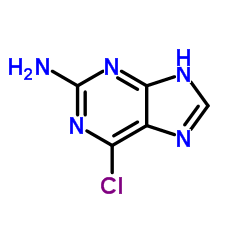
2-氨基-6-氯嘌呤结构式

|
常用名 | 2-氨基-6-氯嘌呤 | 英文名 | 2-Amino-6-chloropurine |
|---|---|---|---|---|
| CAS号 | 10310-21-1 | 分子量 | 169.57 | |
| 密度 | 1.8±0.1 g/cm3 | 沸点 | 315.2ºC at 760mmHg | |
| 分子式 | C5H4ClN5 | 熔点 | >300 °C(lit.) | |
| MSDS | 中文版 美版 | 闪点 | 144.4ºC |
|
The screening and characterization of 6-aminopurine-based xanthine oxidase inhibitors.
Bioorg. Med. Chem. 15 , 3450-6, (2007) Xanthine oxidase (XO) is a key enzyme which can catalyze xanthine to uric acid causing hyperuricemia in humans. By using the fractionation technique and inhibitory activity assay, an active compound that prevents XO from reacting with xanthine was isolated fr... |
|
|
Molecular crowding enhances facilitated diffusion of two human DNA glycosylases.
Nucleic Acids Res. 43 , 4087-97, (2015) Intracellular space is at a premium due to the high concentrations of biomolecules and is expected to have a fundamental effect on how large macromolecules move in the cell. Here, we report that crowded solutions promote intramolecular DNA translocation by tw... |
|
|
Additive Pummerer reaction of 3,5-O-(di-tert-butyl)silylene-4-thiofuranoid glycal: a high-yield and beta-selective entry to 4'-thioribonucleosides.
J. Org. Chem. 74(6) , 2616-9, (2009) Upon reacting 3,5-O-(di-tert-butyl)silylene-4-thiofuranoid glycal S-oxide (6) with Ac(2)O/TMSOAc/BF(3) x OEt(2) in CH(2)Cl(2), the additive Pummerer reaction proceeded to furnish the corresponding 1,2-di-O-acetyl-4-thioribofuranose 7. Compound 7 serves as a h... |
|
|
Testing nucleoside analogues as inhibitors of Bacillus anthracis spore germination in vitro and in macrophage cell culture.
Antimicrob. Agents Chemother. 54 , 5329-36, (2010) Bacillus anthracis, the etiological agent of anthrax, has a dormant stage in its life cycle known as the endospore. When conditions become favorable, spores germinate and transform into vegetative bacteria. In inhalational anthrax, the most fatal manifestatio... |
|
|
Lead compounds for antimalarial chemotherapy: purine base analogs discriminate between human and P. falciparum 6-oxopurine phosphoribosyltransferases.
J. Med. Chem. 49 , 7479-86, (2006) The malarial parasite Plasmodium falciparum depends on the purine salvage enzyme hypoxanthine-guanine-xanthine phosphoribosyltransferase (HGXPRT) to convert purine bases from the host to nucleotides needed for DNA and RNA synthesis. An approach to developing ... |
|
|
Synthesis and biological properties of 9-(trans-4-hydroxy-2-buten-1-yl)adenine and guanine: open-chain analogues of neplanocin A.
J. Med. Chem. 30(2) , 437-40, (1987) Alkylation of adenine (5a) or 2-amino-6-chloropurine (5b) with excess trans-1,4-dichloro-2-butene (4), effected by K2CO3 in dimethyl sulfoxide or tetra-n-butylammonium fluoride in tetrahydrofuran, led in 90-95% regioselectivity to 9-alkylpurines 6a and 6b. Th... |
|
|
Enzymatic synthesis of 2'-deoxyguanosine with nucleoside deoxyribosyltransferase-II.
Biosci. Biotechnol. Biochem. 67 , 989-95, (2003) Nucleoside deoxyribosyltransferase-II (NdRT-II) of Lactobacillus helveticus, which catalyzes the transfer of a glycosyl residue from a donor deoxyribonucleoside to an acceptor base, has a broad specificity for the acceptor bases. Six-substituted purines were ... |
|
|
Tautomeric purine forms of 2-amino-6-chloropurine (N9H10 and N7H10): structures, vibrational assignments, NBO analysis, hyperpolarizability, HOMO-LUMO study using B3 based density functional calculations.
Spectrochim. Acta. A. Mol. Biomol. Spectrosc. 96 , 340-51, (2012) Two purine tautomers of 2-amino-6-chloropurine (ACP), in labeled as N(9)H(10) and N(7)H(10), were investigated by vibrational spectroscopy and quantum chemical method. The FT-IR and FT-Raman spectra of ACP have been recorded in the regions 4000-400 cm(-1) and... |
|
|
Preparative electrochemical reduction of 2-amino-6-chloropurine and synthesis of 6-deoxyacyclovir, a fluorescent substrate of xanthine oxidase and a prodrug of acyclovir.
Acta Chem. Scand. B 41 , 701-707, (1987) D.c. polarography of 2-amino-6-chloropurine in aqueous medium over a broad pH range revealed two diffusion waves, the first of which corresponds to reduction of the C(6)-Cl bond, leading to formation of 2-aminopurine in high yield. Condensation of the sodium ... |
|
|
Mode of action of 2-amino-6-chloro-1-deazapurine.
Biochem. Pharmacol. 33(2) , 261-71, (1984) 2-Amino-6-chloro-1-deazapurine is of interest as a purine analog with demonstrated in vivo activity against mouse leukemia L1210. That the active form of this agent is a nucleotide and that the nucleotide is formed by the action of hypoxanthine (guanine) phos... |