1,2-二肉豆蔻酰-sn-甘油基-3-磷酸-rac-(1-甘油)钠盐
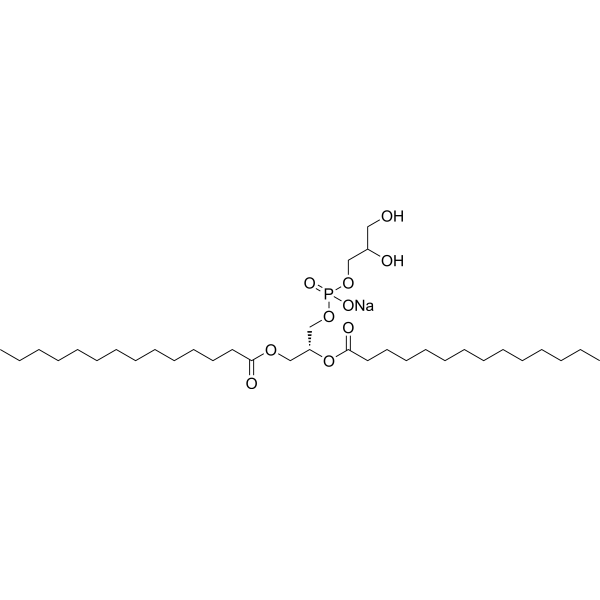
1,2-二肉豆蔻酰-sn-甘油基-3-磷酸-rac-(1-甘油)钠盐结构式

|
常用名 | 1,2-二肉豆蔻酰-sn-甘油基-3-磷酸-rac-(1-甘油)钠盐 | 英文名 | UNII:Q24R39NY7R |
|---|---|---|---|---|
| CAS号 | 200880-40-6 | 分子量 | 688.85 | |
| 密度 | N/A | 沸点 | N/A | |
| 分子式 | C34H66NaO10P | 熔点 | 195 °C(dec.) | |
| MSDS | 美版 | 闪点 | N/A |
|
Influence of the lipid membrane environment on structure and activity of the outer membrane protein Ail from Yersinia pestis.
Biochim. Biophys. Acta 1848(2) , 712-20, (2014) The surrounding environment has significant consequences for the structural and functional properties of membrane proteins. While native structure and function can be reconstituted in lipid bilayer membranes, the detergents used for protein solubilization are... |
|
|
Investigating the role of GXXXG motifs in helical folding and self-association of plasticins, Gly/Leu-rich antimicrobial peptides.
Biophys. Chem. 196 , 40-52, (2014) Plasticins (PTC) are dermaseptin-related antimicrobial peptides characterized by a large number of leucine and glycine residues arranged in GXXXG motifs that are often described to promote helix association within biological membranes. We report the structure... |
|
|
Antimicrobial properties of membrane-active dodecapeptides derived from MSI-78.
Biochim. Biophys. Acta 1848(5) , 1139-46, (2015) Antimicrobial peptides (AMPs) are a class of broad-spectrum antibiotics known by their ability to disrupt bacterial membranes and their low tendency to induce bacterial resistance, arising as excellent candidates to fight bacterial infections. In this study w... |
|
|
Control and role of pH in peptide-lipid interactions in oriented membrane samples.
Biochim. Biophys. Acta 1848(3) , 833-41, (2015) To understand the molecular mechanisms of amphiphilic membrane-active peptides, one needs to study their interactions with lipid bilayers under ambient conditions. However, it is difficult to control the pH of the sample in biophysical experiments that make u... |
|
|
Study of the putative fusion regions of the preS domain of hepatitis B virus.
Biochim. Biophys. Acta 1848(4) , 895-906, (2015) In a previous study, it was shown that purified preS domains of hepatitis B virus (HBV) could interact with acidic phospholipid vesicles and induce aggregation, lipid mixing and leakage of internal contents which could be indicative of their involvement in th... |
|
|
Development of a direct in-matrix extraction (DIME) protocol for MALDI-TOF-MS detection of glycated phospholipids in heat-treated food samples.
J. Mass Spectrom. 49(9) , 831-9, (2014) In foodstuffs, one of the main factors inducing modifications in phospholipids (PLs) structure is the heat treatment. Among PLs, only phosphatidylethanolamines and phosphatidylserines, due to their free amino group, can be involved in Maillard reaction and ca... |
|
|
Membrane interactions of synthetic peptides with antimicrobial potential: effect of electrostatic interactions and amphiphilicity.
Probiotics Antimicrob Proteins 7 , 66-74, (2015) Cationic antimicrobial peptides are considered promising candidates to complement currently used antibiotics, which are less effective against increasingly resistant pathogens. To determine the mechanism of action of these peptides, a better understanding of ... |
|
|
Interactions between phospholipids and titanium dioxide particles.
Colloids Surf. B Biointerfaces 123 , 150-7, (2014) A systematic study was carried out on monolayer films and lipid vesicles to elucidate the interactions between membrane lipids and commercial particles of titanium dioxide TiO2 (TiO2-P25). Pressure-area isotherms of lipids at various pH values were recorded o... |
|
|
Mimicking and Understanding the Agglutination Effect of the Antimicrobial Peptide Thanatin Using Model Phospholipid Vesicles.
Biochemistry 54 , 3932-41, (2015) Thanatin is a cationic 21-residue antimicrobial and antifongical peptide found in the spined soldier bug Podisus maculiventris. It is believed that it does not permeabilize membranes but rather induces the agglutination of bacteria and inhibits cellular respi... |
|
|
Fusogenic properties of the ectodomains of hepatitis C virus envelope proteins.
FEBS J. 281(11) , 2558-69, (2014) We have used an isolated chimeric protein E1340 E2661 that includes the ectodomains of the envelope proteins of hepatitis C virus to study its interaction with model membranes. E1340 E2661 has some of the membrane destabilization properties, vesicle aggregati... |