艾塞那肽
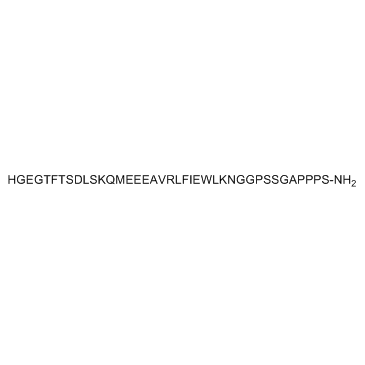
艾塞那肽结构式

|
常用名 | 艾塞那肽 | 英文名 | Exenatide acetate salt |
|---|---|---|---|---|
| CAS号 | 141758-74-9 | 分子量 | 4186.57000 | |
| 密度 | N/A | 沸点 | N/A | |
| 分子式 | C184H282N50O60S | 熔点 | N/A | |
| MSDS | 中文版 美版 | 闪点 | N/A |
艾塞那肽用途Exendin-4 acetate是由39个氨基酸组成的多肽。它是长效的glucagon-like peptide-1受体激动剂,IC50值为3.22 nM。 |

| 中文名 | 艾塞那肽 |
|---|---|
| 英文名 | exendin-4 |
| 英文别名 | 更多 |
| 描述 | Exendin-4 acetate是由39个氨基酸组成的多肽。它是长效的glucagon-like peptide-1受体激动剂,IC50值为3.22 nM。 |
|---|---|
| 相关类别 | |
| 靶点实验 |
IC50: 3.22 nM (glucagon-like peptide-1 receptor)[1] |
| 体外研究 | 在人脐静脉内皮细胞中,exendin-4以剂量依赖的方式显着增加NO产生,内皮NO合酶(eNOS)磷酸化和GTP环化水解酶1(GTPCH1)水平[2]。 Exendin-4对MCF-7乳腺癌细胞有细胞毒作用,48小时IC50为5μM[3]。 |
| 体内研究 | 与对照相比,ob/ob小鼠中的低剂量和高剂量exendin-4治疗均改善血清ALT并降低血清葡萄糖,胰岛素水平和计算的HOMA评分。 Exendin-4处理的ob/ob小鼠在研究期间的最后4周内净体重增加显着减少[4]。用毒蜥外泌肽-4治疗的动物具有更多的胰腺腺泡炎症,更多的核固缩核并且比对照大鼠显着更轻。 Exendin-4治疗与较低的胰岛素和瘦素水平以及较低的HOMA值相关[5]。艾塞那肽引起大鼠胸主动脉的剂量依赖性舒张,这是通过GLP-1受体诱发的,主要由H2S介导,但也由NO和CO介导[6]。 |
| 动物实验 | 大鼠:20只Sprague-Dawley雄性大鼠,其中10只用exendin-4(10μg/ kg)处理,其中10只用作对照。研究期为75天。去除血清和胰腺组织用于生物化学和组织学研究。比较两组之间的血糖,淀粉酶,脂肪酶,胰岛素和脂肪细胞因子[5]。小鼠:在前14天,每24小时用10μg/ kg处理毒蜥外泌肽-4治疗组。这种治疗是诱导期。各对照小鼠(瘦和ob / ob)每24小时接受盐水。 14天后,将Exendin-4处理的小鼠随机分成两组:一组每12小时接受高剂量exendin-4(20μg/ kg),而第二组继续接受低剂量exendin-4(10μg/ kg) )每12个小时。对照小鼠每12小时继续接受盐水。每天对小鼠称重60天治疗期[4]。 |
| 参考文献 |
| 分子式 | C184H282N50O60S |
|---|---|
| 分子量 | 4186.57000 |
| 精确质量 | 4184.03000 |
| PSA | 1775.05000 |
| InChIKey | HTQBXNHDCUEHJF-JHBIHAKISA-N |
| SMILES | CCC(C)C(NC(=O)C(Cc1ccccc1)NC(=O)C(CC(C)C)NC(=O)C(CCCNC(=N)N)NC(=O)C(NC(=O)C(C)NC(=O)C(CCC(=O)O)NC(=O)C(CCC(=O)O)NC(=O)C(CCC(=O)O)NC(=O)C(CCSC)NC(=O)C(CCC(N)=O)NC(=O)C(CCCCN)NC(=O)C(CO)NC(=O)C(CC(C)C)NC(=O)C(CC(=O)O)NC(=O)C(CO)NC(=O)C(NC(=O)C(Cc1ccccc1)NC(=O)C(NC(=O)CNC(=O)C(CCC(=O)O)NC(=O)CNC(=O)C(N)Cc1c[nH]cn1)C(C)O)C(C)O)C(C)C)C(=O)NC(CCC(=O)O)C(=O)NC(Cc1c[nH]c2ccccc12)C(=O)NC(CC(C)C)C(=O)NC(CCCCN)C(=O)NC(CC(N)=O)C(=O)NCC(=O)NCC(=O)N1CCCC1C(=O)NC(CO)C(=O)NC(CO)C(=O)NCC(=O)NC(C)C(=O)N1CCCC1C(=O)N1CCCC1C(=O)N1CCCC1C(=O)NC(CO)C(N)=O |
| 储存条件 | 密封、在 -20ºC下保存 |
| 稳定性 | 如果遵照规格使用和储存则不会分解,未有已知危险反应 |
| 更多 | 1. 性状:白色粉末 2. 密度(g/mL,20℃):未确定 3. 相对蒸汽密度(g/mL,空气=1):未确定 4. 熔点(ºC):未确定 5. 沸点(ºC,常压):未确定 6. 沸点(ºC,KPa):未确定 7. 折射率:未确定 8. 闪点(ºC):未确定 9. 比旋光度(º):未确定 10. 自燃点或引燃温度(ºC):未确定 11. 蒸气压(Pa,20ºC):未确定 12. 饱和蒸气压(KPa,20ºC):未确定 13. 燃烧热(KJ/mol):未确定 14. 临界温度(ºC):未确定 15. 临界压力(KPa):未确定 16. 油水(辛醇/水)分配系数的对数值:未确定 17. 爆炸上限(%,V/V):未确定 18. 爆炸下限(%,V/V):未确定 19. 溶解性:水:20ºC,1g/L |
| 个人防护装备 | Eyeshields;Gloves;type N95 (US);type P1 (EN143) respirator filter |
|---|---|
| 危害码 (欧洲) | Xi |
| 危险品运输编码 | NONH for all modes of transport |
| WGK德国 | 3 |
|
Inhibition of monocyte adhesion to endothelial cells and attenuation of atherosclerotic lesion by a glucagon-like peptide-1 receptor agonist, exendin-4.
Diabetes 59(4) , 1030-7, (2010) Exogenous administration of glucagon-like peptide-1 (GLP-1) or GLP-1 receptor agonists such as an exendin-4 has direct beneficial effects on the cardiovascular system. However, their effects on athero... |
|
|
Exendin-4, a glucagon-like protein-1 (GLP-1) receptor agonist, reverses hepatic steatosis in ob/ob mice.
Hepatology 43(1) , 173-81, (2006) Nonalcoholic fatty liver disease (NAFLD) represents a burgeoning problem in hepatology, and is associated with insulin resistance. Exendin-4 is a peptide agonist of the glucagon-like peptide (GLP) rec... |
|
|
Effects of exenatide (exendin-4) on glycemic control and weight over 30 weeks in metformin-treated patients with type 2 diabetes.
Diabetes Care 28(5) , 1092-100, (2005) This study evaluates the ability of the incretin mimetic exenatide (exendin-4) to improve glycemic control in patients with type 2 diabetes failing to achieve glycemic control with maximally effective... |
| MFCD00240171 |
| Exenatide |
| L-histidylglycyl-L-glutamylglycyl-L-threonyl-L-phenylalanyl-L-threonyl-L-seryl-L-aspartyl-L-leucyl-L-seryl-L-lysyl-L-glutaminyl-L-methionyl-L-glutamyl-L-glutamyl-L-glutamyl-L-alanyl-L-valyl-L-arginyl-L-leucyl-L-phenylalanyl-L-isoleucyl-L-glutamyl-L-tryptophyl-L-leucyl-L-lysyl-L-asparaginylglycylglycyl-L-prolyl-L-seryl-L-serylglycyl-L-alanyl-L-prolyl-L-prolyl-L-prolyl-L-serinamide |
| Exendin-4 |
本网页内容来自不同专业数据源,如对内容有疑义,欢迎联系service1@chemsrc.com。

 351666998
复制
351666998
复制

 133 1186 9306
复制
133 1186 9306
复制

- 上海阿拉丁生化科技股份有限公司
- 上海市 上海市 浦东新区
- 产品名:艾塞那肽
- 纯度:97.0%
- 价格: ¥720.9/1mg ¥需询单/1g ¥需询单/1g ¥需询单/1g
- 联系人:阿拉丁
 2881459338
复制
2881459338
复制
- 联系电话:400-620-6333
- 盼得(上海)国际贸易有限公司
- 上海市 上海市 徐汇区
- 产品名:醋酸艾塞那肽
- 纯度:0.0%
- 价格: ¥需询单/500g ¥需询单/1kg ¥需询单/25kg ¥需询单/200kg
- 联系人:叶经理
1710932455
复制
- 联系电话:18019361053
- 上海化源世纪贸易有限公司
- 上海市 上海市 普陀区
- 产品名:艾塞那肽
- 纯度:98.0%
- 价格:
- 联系人:徐经理
351666998
复制
 133 1186 9306
复制
133 1186 9306
复制
- 联系电话:133 1186 9306
查看所有供应商和价格请点击: