Tetrakis (4-carboxyphenyl) porphyrin
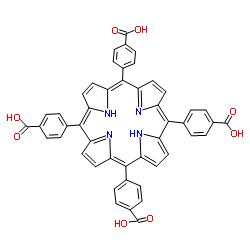
Tetrakis (4-carboxyphenyl) porphyrin structure
|
Common Name | Tetrakis (4-carboxyphenyl) porphyrin | ||
|---|---|---|---|---|
| CAS Number | 14609-54-2 | Molecular Weight | 790.774 | |
| Density | 1.5±0.1 g/cm3 | Boiling Point | N/A | |
| Molecular Formula | C48H30N4O8 | Melting Point | > 300 °C | |
| MSDS | Chinese USA | Flash Point | N/A | |
|
Detection of organophosphate flame retardants in furniture foam and U.S. house dust.
Environ. Sci. Technol. 43(19) , 7490-5, (2009) Restrictions on the use of polybrominated diphenyl ethers (PBDEs) have resulted in the increased use of alternate flame retardant chemicals to meet flammability standards. However, it has been difficult to determine which chemical formulations are currently b... |
|
|
Is the PentaBDE replacement, tris (1,3-dichloro-2-propyl) phosphate (TDCPP), a developmental neurotoxicant? Studies in PC12 cells.
Toxicol. Appl. Pharmacol. 256(3) , 281-9, (2011) Organophosphate flame retardants (OPFRs) are used as replacements for the commercial PentaBDE mixture that was phased out in 2004. OPFRs are ubiquitous in the environment and detected at high concentrations in residential dust, suggesting widespread human exp... |
|
|
Simulation of the plant uptake of organophosphates and other emerging pollutants for greenhouse experiments and field conditions.
Environ. Sci. Pollut. Res. Int. 20(6) , 4018-29, (2013) The uptake of the organophosphates tris(2-chloroethyl) phosphate (TCEP), tris(1-chloro-2-propyl) phosphate (TCPP), tributyl phosphate (TBP), the insect repellant N,N-diethyl toluamide (DEET), and the plasticizer n-butyl benzenesulfonamide (NBBS) into plants w... |
|
|
Attenuation of total organic carbon and unregulated trace organic chemicals in U.S. riverbank filtration systems.
Water Res. 44(15) , 4643-59, (2010) There is increasing concern regarding the presence of unregulated trace organic chemicals in drinking water supplies that receive discharge from municipal wastewater treatment plants. In comparison to conventional and advanced drinking water treatment, riverb... |
|
|
A comparative study of non-covalent encapsulation methods for organic dyes into silica nanoparticles.
Nanoscale Res. Lett. 6 , 328, (2011) Numerous luminophores may be encapsulated into silica nanoparticles (< 100 nm) using the reverse microemulsion process. Nevertheless, the behaviour and effect of such luminescent molecules appear to have been much less studied and may possibly prevent the enc... |
|
|
Municipal landfill leachates: a significant source for new and emerging pollutants.
Sci. Total Environ. 408(21) , 5147-57, (2010) Landfills have historically remained the most common methods of organized waste disposal and still remain so in many regions of the world. Thus, they may contain wastes resulting from several decades of disposal and decomposition with subsequent release of or... |
|
|
Surface plasmon fluorescence investigation of energy-transfer-controllable organic thin films.
Langmuir 24(6) , 2266-70, (2008) Thin functional organic films on a gold substrate were fabricated by adsorbing tetrakis(carboxyphenyl)porphyrin (TCPP) on a spacer layer, which was prepared by the layer-by-layer adsorption of a dendrimer and a linear polymer. The thickness and photoluminesce... |
|
|
A/C magnetic hyperthermia of melanoma mediated by iron(0)/iron oxide core/shell magnetic nanoparticles: a mouse study.
BMC Cancer 10 , 119, (2010) There is renewed interest in magnetic hyperthermia as a treatment modality for cancer, especially when it is combined with other more traditional therapeutic approaches, such as the co-delivery of anticancer drugs or photodynamic therapy.The influence of bima... |
|
|
Investigation of cytotoxic, genotoxic, mutagenic, and estrogenic effects of the flame retardants tris-(2-chloroethyl)-phosphate (TCEP) and tris-(2-chloropropyl)-phosphate (TCPP) in vitro.
Toxicol. Lett. 161(2) , 124-34, (2006) The organophosphorus esters tris-(2-chloroethyl)-phosphate (TCEP) and tris-(2-chloropropyl)-phosphate (TCPP) have been widely used as flame retardants and fire preventing agents, e.g. in polyurethane foams. We investigated the cytotoxic, genotoxic, mutagenic,... |
|
|
pH-responsive, TiO2-attached porphyrin for singlet oxygen production in an aqueous solution.
ACS Appl. Mater. Interfaces 1(8) , 1778-84, (2009) A pH-responsive, TiO2-attached sensitizer was prepared based on the adsorption of 5,10,15,20-tetrakis(4-carboxyphenyl)porphyrin (TCPP) onto TiO2 nanoparticles. This colloidally dispersed TiO2-attached TCPP behaves as a single-phase colloidal sensitizer at pH ... |