Azilsartan
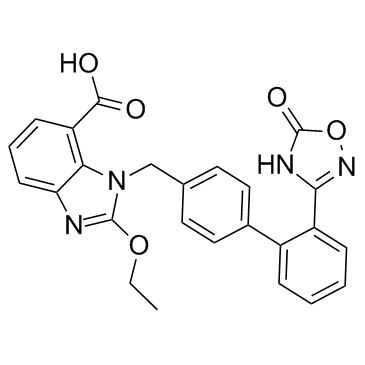
Azilsartan structure
|
Common Name | Azilsartan | ||
|---|---|---|---|---|
| CAS Number | 147403-03-0 | Molecular Weight | 456.450 | |
| Density | 1.4±0.1 g/cm3 | Boiling Point | N/A | |
| Molecular Formula | C25H20N4O5 | Melting Point | N/A | |
| MSDS | Chinese USA | Flash Point | N/A | |
|
Liquid chromatography/tandem mass spectrometry study of forced degradation of azilsartan medoxomil potassium.
Rapid Commun. Mass Spectrom. 29 , 1437-47, (2015) Azilsartan medoxomil potassium (AZM) is a new antihypertensive drug introduced in the year 2011. The presence of degradation products not only affects the quality, but also the safety aspects of the drug. Thus, it is essential to develop an efficient analytic... |
|
|
Olmesartan blocks advanced glycation end products-induced vcam-1 gene expression in mesangial cells by restoring Angiotensin-converting enzyme 2 level.
Horm. Metab. Res. 46(6) , 379-83, (2014) Advanced glycation end products (AGEs) and their receptor (RAGE) system are involved in diabetic nephropathy. Angiotensin-converting enzyme 2 (ACE 2) plays a protective role against cardiovascular and renal injury by stimulating the production of angiotensin-... |
|
|
Azilsartan Improves Salt Sensitivity by Modulating the Proximal Tubular Na+-H+ Exchanger-3 in Mice.
PLoS ONE 11 , e0147786, (2016) A potent angiotensin II type-1 receptor blocker, azilsartan, has been reported to reduce blood pressure more effectively than candesartan. Interestingly, azilsartan can also restore the circadian rhythm of blood pressure. We hypothesized that azilsartan could... |
|
|
Age-related difference in the sleep pressure-lowering effect between an angiotensin II receptor blocker and a calcium channel blocker in Asian hypertensives: the ACS1 Study.
Hypertension 65(4) , 729-35, (2015) Sleep blood pressure (BP), which is partly determined by salt sensitivity and intake, is an important cardiovascular risk in hypertensives. However, there have been no studies on age-related differences in the sleep BP-lowering effect between angiotensin II r... |