D-erythro-Sphingosylphosphorylcholine (Synthetic)
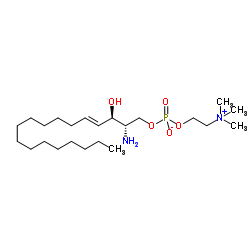
D-erythro-Sphingosylphosphorylcholine (Synthetic) structure
|
Common Name | D-erythro-Sphingosylphosphorylcholine (Synthetic) | ||
|---|---|---|---|---|
| CAS Number | 1670-26-4 | Molecular Weight | 464.619 | |
| Density | N/A | Boiling Point | N/A | |
| Molecular Formula | C23H49N2O5P | Melting Point | 90-102ºC | |
| MSDS | USA | Flash Point | N/A | |
|
Sex-dependent decrease of sphingomyelinase activity during alcohol withdrawal treatment.
Cell Physiol. Biochem. 34(1) , 71-81, (2014) In vitro and in vivo studies have demonstrated the role of the acid sphingomyelinase (ASM) in pathophysiological processes and alterations in response to ethanol exposure. Cellular and plasmatic ASM activities are increased in male alcohol dependent patients ... |
|
|
A novel trigger for cholesterol-dependent smooth muscle contraction mediated by the sphingosylphosphorylcholine-Rho-kinase pathway in the rat basilar artery: a mechanistic role for lipid rafts.
J. Cereb. Blood Flow Metab. 35 , 835-42, (2015) Hyperlipidemia is a risk factor for abnormal cerebrovascular events. Rafts are cholesterol-enriched membrane microdomains that influence signal transduction. We previously showed that Rho-kinase-mediated Ca(2+) sensitization of vascular smooth muscle (VSM) in... |
|
|
EDG3 is a functional receptor specific for sphingosine 1-phosphate and sphingosylphosphorylcholine with signaling characteristics distinct from EDG1 and AGR16.
Biochem. Biophys. Res. Commun. 260 , 203-8, (1999) AGR16/H218/EDG5 and EDG1 are functional receptors for lysosphingolipids, whereas EDG2 and EGD4 are receptors for lysophosphatidic acid (LPA). The present study demonstrates that EDG3, the yet poorly defined member of the EDG family G protein-coupled receptors... |
|
|
Novel neurotrophic effects of sphingosylphosphorylcholine in cerebellar granule neurons and in PC12 cells.
Biochem. Biophys. Res. Commun. 364 , 163-8, (2007) Sphingosylphosphorylcholine (SPC) is a choline-containing naturally occurring derivative of sphingolipid involved in various biological processes. Here we show that SPC displays neurotrophic effects in cerebellar granule neurons (CGNs) and in PC12 cells. When... |
|
|
Sphingosylphosphorylcholine stimulates CCL2 production from human umbilical vein endothelial cells.
J. Immunol. 186 , 4347-53, (2011) Sphingosylphosphorylcholine (SPC) is a component of high-density lipoprotein particles. We investigated the functional role of SPC in HUVECs. SPC stimulation induced production of the CCL2 chemokine in a PTX-sensitive G-protein-dependent manner. SPC treatment... |
|
|
Molecular diversity of sphingolipid signalling.
FEBS Lett. 410 , 34-38, (1997) Sphingolipid breakdown products are now being recognized to play a dual role in cellular signalling, acting as intracellular as well as extracellular signalling molecules. Both types of action may even be found with one sphingolipid species. The recent demons... |
|
|
Effect of sphingosylphosphorylcholine on the single channel gating properties of the cardiac ryanodine receptor.
FEBS Lett. 460 , 467-471, (1999) The effects of the lysosphingolipid, sphingosylphosphorylcholine (SPC), on the cardiac ryanodine receptor (RyR) were examined. The open probability of cardiac RyR incorporated in lipid bilayers was decreased by cytoplasmic, but not lumenal side application of... |
|
|
A facile method for controlling the reaction equilibrium of sphingolipid ceramide N-deacylase for lyso-glycosphingolipid production.
J. Lipid Res. 56 , 1836-42, (2015) Lyso-glycosphingolipids (lyso-GSLs), the N-deacylated forms of glycosphingolipids (GSLs), are important synthetic intermediates for the preparation of GSL analogs. Although lyso-GSLs can be produced by hydrolyzing natural GSLs using sphingolipid ceramide N-de... |