5573-16-0
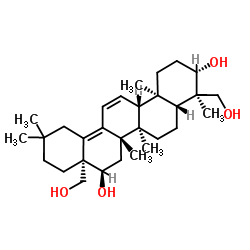
5573-16-0 structure
- Name: Saikogenin D
- Chemical Name: 3β,16α,23,28-Tetrahydroxyoleana-11(12),13(18)-diene
- CAS Number: 5573-16-0
- Molecular Formula: C30H48O4
- Molecular Weight: 472.700
- Catalog: Signaling Pathways GPCR/G Protein Prostaglandin Receptor
- Create Date: 2018-08-11 15:09:53
- Modify Date: 2026-07-16 14:44:28
-
Saikogenin D is isolated from Bupleurum chinense, has anti-inflammatory effects. Saikogenin D activates epoxygenases that converts arachidonic acid to epoxyeicosanoids and dihydroxyeicosatrienoic acids, and the metabolites secondarily inhibit prostaglandin E2 (PGE2) production. Saikogenin D results in an elevation of [Ca2+]i due to Ca2+ release from intracellular stores[1][2].
| Name | 3β,16α,23,28-Tetrahydroxyoleana-11(12),13(18)-diene |
|---|---|
| Synonyms |
SAIKOGENIN D
Oleana-11,13-diene-3,16,23,28-tetrol, (3β,4α,16α) (3β,16α)-Oleana-11,13(18)-diene-3,16,23,28-tetrol (4R)-Oleana-11,13-diene-3β,16α,23,28-tetrol (3S,4R,6,6bS,8R,8aS,14,14bS)-4,8a-Bis(hydroxymethyl)-4,6a,6b,11,11,14b-hexamethyl-1,2,3,4,4a,5,6,6a,6b,7,8,8a,9,10,11,12,14a,14b-octadecahydropicene-3,8-diol |
| Description | Saikogenin D is isolated from Bupleurum chinense, has anti-inflammatory effects. Saikogenin D activates epoxygenases that converts arachidonic acid to epoxyeicosanoids and dihydroxyeicosatrienoic acids, and the metabolites secondarily inhibit prostaglandin E2 (PGE2) production. Saikogenin D results in an elevation of [Ca2+]i due to Ca2+ release from intracellular stores[1][2]. |
|---|---|
| Related Catalog | |
| In Vitro | Saikogenin D (1-20 μM) inhibits PGE2 production induced by the Ca2+ ionophore A23187 in a concentration-dependent manner with an IC50 value of 3 μM in C6 rat glioma cells[1]. Saikogenin D (10-100 μM) elevates [Ca2+]i in a concentration-dependent manner with a EC50 value of 35 μM in the presence or absence of extracellular Ca2+ in C6 rat glioma cells[1]. |
| References |
| Density | 1.2±0.1 g/cm3 |
|---|---|
| Boiling Point | 607.4±55.0 °C at 760 mmHg |
| Melting Point | 261-266 °C |
| Molecular Formula | C30H48O4 |
| Molecular Weight | 472.700 |
| Flash Point | 252.4±26.1 °C |
| Exact Mass | 472.355255 |
| PSA | 80.92000 |
| LogP | 5.38 |
| Vapour Pressure | 0.0±3.9 mmHg at 25°C |
| Index of Refraction | 1.586 |