481704-21-6
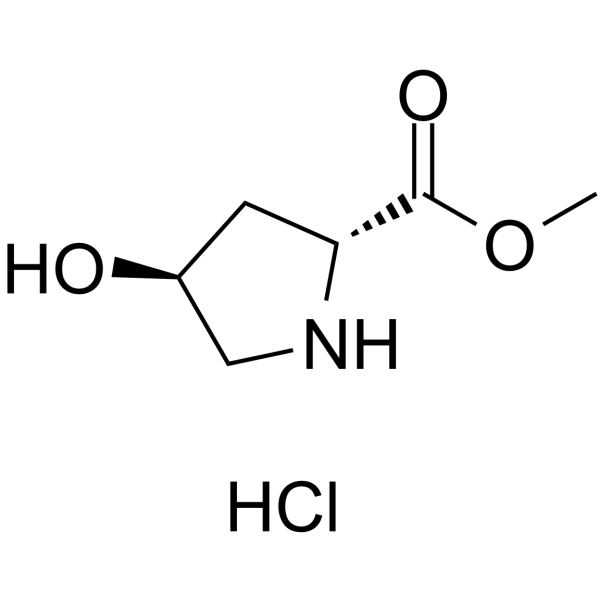
481704-21-6 structure
- Name: tans-4-Hydroxy-D-proline methyl ester hydrochloride
- Chemical Name: (2R,4S)-Methyl 4-hydroxypyrrolidine-2-carboxylatehydrochloride
- CAS Number: 481704-21-6
- Molecular Formula: C6H12ClNO3
- Molecular Weight: 181.617
- Catalog: Biochemical Amino acids and their derivatives Proline derivatives
- Create Date: 2018-12-24 16:59:11
- Modify Date: 2026-08-24 11:07:47
-
tans-4-Hydroxy-D-proline methyl ester hydrochloride is a non-cleavable ADC linker used in the synthesis of antibody-drug conjugates (ADCs). tans-4-Hydroxy-D-proline methyl ester hydrochloride is also a alkyl chain-based PROTAC linker that can be used in the synthesis of PROTACs[1][2].
| Name | (2R,4S)-Methyl 4-hydroxypyrrolidine-2-carboxylatehydrochloride |
|---|---|
| Synonyms |
(2R,4S)-methyl 4-hydroxypyrrolidine-2-cboxylate hydrochloride H-Hyp-OMe.HCl
Methyl (4R)-4-hydroxy-L-prolinate hydrochloride (1:1) Trans-4-HYDROXY-D-PROLINE METHYL ESTER (2R,4S)-trans-4-hydroxy-D-proline methyl ester hydrochloride (2S,4R)-Methyl 4-hydro×ypyrrolidine-2-cbo×ylate hydrochloride L-Proline, 4-hydroxy-, methyl ester, (4R)-, hydrochloride (1:1) TRANS-4-HYDROXY-D-PROLINE METHYL ESTER HYDROCHLORIDE 4-hydroxy-1-Methylpyrrolidine-2-cboxylate hydrochloride (2S,4R)-methyl 4-hydroxypyrrolidine-2-cboxylate hydrochlorid l-hydroxy-2-oxopentane (4S)-D-Proline-4-hydroxyMethylester hydrochloride (2S,4R)-methyl 4-hydroxypyrrolidine-2-cboxylate hydrochloride //BP (2R,4S)-methyl 4-hydroxypyrrolidine-2-cboxylate Hydrochloride/Trans-4-HYDROXY-D-PROLINE METHYL ESTER Hydrochloride D-Proline, 4-hydroxy-, Methyl ester, hydrochloride (1:1), (4S) Methyl (2R,4S)-4-hydroxypyrrolidine-2-cboxylate hydrochloride (S)-4-HYDROXY-D-PROLINE METHYL ESTER HCL trans-4-Hydroxy-D-proline methyl ester hydrochloride, (2R,4S)-4-Hydroxy-2-(methoxycbonyl)pyrrolidine hydrochloride D-Proline-4-hydroxyMethylester hydrochloride (4S) Trans-4-hydroxy-L-proline methyl ester hydrochloride 1-Hydroxy-pentan-2-on 1-hydroxy-pentan-2-one Hydroxymethyl-propyl-keton 1-Hydroxy-2-pentanone (2R,4S) tans-4-Hydroxy-D-proline methyl ester (hydrochloride) 2-Pentanone,1-hydroxy 4S-hydroxy-1-pyrrolidine-2R-carboxylic acid methyl ester hydrochloride salt 1-hydroxy-2-oxopentane (S)-4-Hydroxy-D-proline Methyl Ester Hydrochloride (4S)-4-Hydroxy-D-proline Methyl ester hydrochloride H-D-Hyp-OMe.HCl (4S)-4-hydroxy-D-Proline methyl ester hydrochloride (1:1) L-hydroxyproline methyl ester hydrochloride rans-4-Hydroxy-D-proline methyl ester hydrochloride (2S,4R)-4-Hydroxy-2-(methoxycbonyl)pyrrolidinium chloride H-D-trans-Hyp-OMe.HCl |
| Description | tans-4-Hydroxy-D-proline methyl ester hydrochloride is a non-cleavable ADC linker used in the synthesis of antibody-drug conjugates (ADCs). tans-4-Hydroxy-D-proline methyl ester hydrochloride is also a alkyl chain-based PROTAC linker that can be used in the synthesis of PROTACs[1][2]. |
|---|---|
| Related Catalog | |
| Target |
Non-cleavable |
| In Vitro | ADCs are comprised of an antibody to which is attached an ADC cytotoxin through an ADC linker[1]. PROTACs contain two different ligands connected by a linker; one is a ligand for an E3 ubiquitin ligase and the other is for the target protein. PROTACs exploit the intracellular ubiquitin-proteasome system to selectively degrade target proteins[2]. |
| References |
| Molecular Formula | C6H12ClNO3 |
|---|---|
| Molecular Weight | 181.617 |
| Exact Mass | 181.050568 |
| PSA | 58.56000 |
| LogP | 0.01300 |
|
~85%
481704-21-6 |
| Literature: WO2003/104249 A1, ; Page 14 ; |
|
~%
481704-21-6 |
| Literature: WO2004/7444 A2, ; Page 141 ; |
|
~%
481704-21-6 |
| Literature: WO2013/49164 A1, ; Paragraph 838-839 ; |
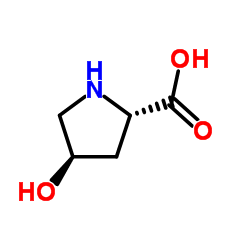


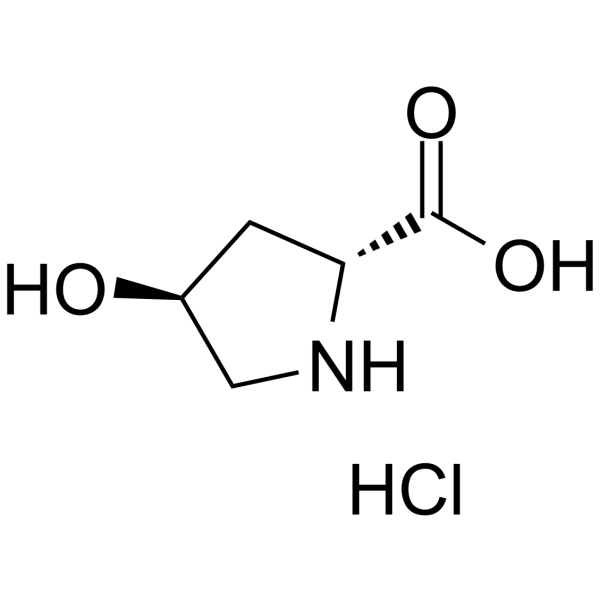
| Precursor 4 | |
|---|---|
| DownStream 0 | |