550-10-7
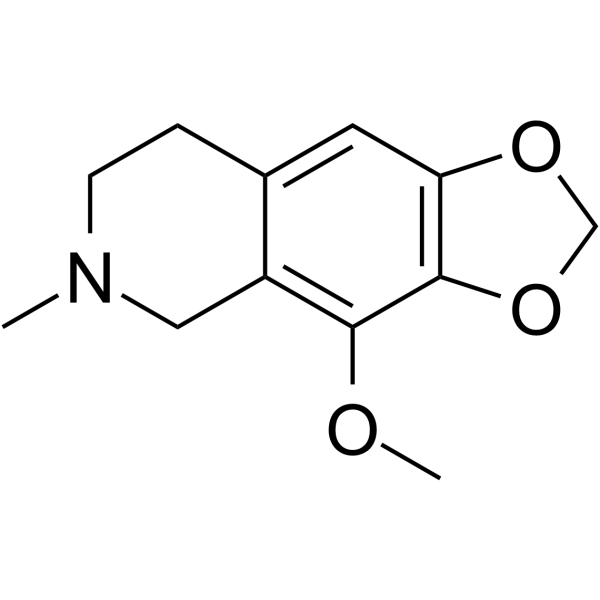
550-10-7 structure
- Name: hydrocotarnine
- Chemical Name: 4-methoxy-6-methyl-7,8-dihydro-5H-[1,3]dioxolo[4,5-g]isoquinoline
- CAS Number: 550-10-7
- Molecular Formula: C12H15NO3
- Molecular Weight: 221.25200
- Catalog: Signaling Pathways Metabolic Enzyme/Protease E1/E2/E3 Enzyme
- Create Date: 2016-04-04 12:12:41
- Modify Date: 2026-07-16 20:52:33
-
Hydrocotarnine is a Cbl inhibitor, and results in inflammasome-mediated IL-18 secretion in colitis. Hydrocotarnine increases expression of GLUT1 and cellular glucose uptake in glycolytic metabolism. Hydrocotarnine acts as an agent that provides analgesic effect in cancer research[1][2][3].
| Name | 4-methoxy-6-methyl-7,8-dihydro-5H-[1,3]dioxolo[4,5-g]isoquinoline |
|---|---|
| Synonyms |
1,2,3,4-Tetrahydro-2-methyl-6,7-(methylenebisoxy)-8-methoxyisoquinoline
4-methoxy-6-methyl-2H,5H,6H,7H,8H-[1,3]dioxolo[4,5-g]isoquinoline 5,6,7,8-Tetrahydro-4-methoxy-6-methyl-1,3-dioxolo[4,5-g]isoquinoline Hydrocotnine Hydrochloride E3 ligating enzyme,IL-18,NP3,E1/E2/E3 Enzyme,hydrocotnine,inflammasome activation,IL-1β,Ubiquitin conjugating enzyme,E1 activating enzyme,inhibit,Ubiquitin activating enzyme,GLUT1,E2 conjugating enzyme,cancer pain,Ubiquitin ligase,Inhibitor,glycolytic metabolism,glycolytic capacity,cellulglucose uptake 8-methoxy-2-methyl-6,7-methylenedioxy-1,2,3,4-tetrahydroisoquinoline 4-methoxy-6-methyl-7,8-dihydro-5H-[1,3]dioxolo[4,5-g]isoquinoline hydrate hydrochloride Hydrocotarnine 1,3-Dioxolo[4,5-g]isoquinoline, 5,6,7,8-tetrahydro-4-methoxy-6-methyl 8-Methoxy-2-methyl-6,7-methylenedioxy-1,2,3,4-tetrahydroisoquinoline 4-Methoxy-6-methyl-5,6,7,8-tetrahydro-1,3-dioxolo[4,5-g]isoquinoline hydrocotnine, 10 mM in DMSO Noscapine Impurity 3(Hydrocotnine) |
| Description | Hydrocotarnine is a Cbl inhibitor, and results in inflammasome-mediated IL-18 secretion in colitis. Hydrocotarnine increases expression of GLUT1 and cellular glucose uptake in glycolytic metabolism. Hydrocotarnine acts as an agent that provides analgesic effect in cancer research[1][2][3]. |
|---|---|
| Related Catalog | |
| Target |
Cbl[1][2] |
| In Vitro | Hydrocotarnine is an analgesic agent (CRIN-2), with the patent ID of WO2011160016A2[1]. Hydrocotarnine (10 μM; 1 h) elevates the secretion of IL-1β and IL-18, and (0.1-10 μM; 1 h) increases the global level of tyrosine-phosphorylated proteins in THP-1 cells[1]. Hydrocotarnine (50 μM; 0-100 min) increases the glycolytic capacity and glycolytic reserve capacity in THP-1-derived macrophages[2]. Hydrocotarnine (50 μM; 16 h) inhibits Cbl and increases the total GLUT1 protein in THP-1-derived macrophages[2]. Hydrocotarnine is known to enhance the analgesic effect of opioids, and alleviates cancer pain[3]. Western Blot Analysis[1] Cell Line: THP-1 cells Concentration: 0.1, 1, 10 μM Incubation Time: 1 hour Result: Induced p-Pyk2 loss and increased the level of tyrosine-phosphorylated proteins in a dose-dependent manner. |
| In Vivo | Hydrocotarnine (10 mg/kg/d; i.p.; 9 d) shows inhibitory effect on Cbl and results in increasing IL-18 levels, indicating that NLRP3 inflammasome activation is enhanced in mice[1]. Hydrocotarnine (10 mg/kg/d; i.p.; 9 d) protects mice from DSS-induced colitis, with low scores of pathological evaluation of inflammation, epithelial defects, and crypt atrophy[1]. Animal Model: DSS-induced colitis model in C57BL/6 mice (6-9 weeks old)[1] Dosage: 10 mg/kg Administration: Intraperitoneal injection; once daily; 9 days while 2.5% DSS treatment began on day 1 and ended on day 7 Result: Significantly attenuated the weight loss of DSS-induced colitis mice compared to PBS-treated control mice, indicating that decreasing negative regulation of the NLRP3 inflammasome activation could attenuate colitis in an animal model. |
| References |
| Boiling Point | 342.4ºC at 760 mmHg |
|---|---|
| Molecular Formula | C12H15NO3 |
| Molecular Weight | 221.25200 |
| Flash Point | 106.7ºC |
| Exact Mass | 221.10500 |
| PSA | 30.93000 |
| LogP | 1.34970 |
CHEMICAL IDENTIFICATION
HEALTH HAZARD DATAACUTE TOXICITY DATA
|
| Precursor 9 | |
|---|---|
| DownStream 5 | |