15982-84-0
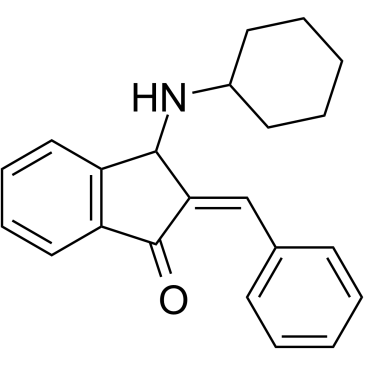
15982-84-0 structure
- Name: (E/Z)-BCI
- Chemical Name: (E/Z)-BCI
- CAS Number: 15982-84-0
- Molecular Formula: C22H23NO
- Molecular Weight: 317.42
- Catalog: Signaling Pathways Metabolic Enzyme/Protease Phosphatase
- Create Date: 2020-01-23 19:04:51
- Modify Date: 2026-07-16 20:38:21
-
(E/Z)-BCI (NSC 150117) is a dual-specificity phosphatase 6 (DUSP6) inhibitor with anti-inflammatory activities. (E/Z)-BCI attenuates LPS-induced inflammatory mediators and ROS production in macrophage cells via activating the Nrf2 signaling axis and inhibiting the NF-κB pathway[1].
| Name | (E/Z)-BCI |
|---|---|
| Synonyms |
(E/Z)-BCI (NSC150117)
2-Benzylidene-3-(cyclohexylamino)-2,3-dihydro-1H-inden-1-one Dual Specificity Protein Phosphatase 1/6 Inhibitor, BCI 1H-Inden-1-one, 3-(cyclohexylamino)-2,3-dihydro-2-(phenylmethylene) (E/Z)-BCI, 10 mM in DMSO (E/Z)-BCI(D6 inhibitor) NSC-150117,ROS,death,LPS,(E/Z)-BCI,gastric cancer,anti-inflammatory,NF-κB,inhibit,Inhibitor,(E/Z) BCI,Nrf2,(E/Z)BCI,Apoptosis,ERK,Phosphatase,D6,NSC150117 Dual Specificity Protein Phosphatase 1/6 Inhibitor |
| Description | (E/Z)-BCI (NSC 150117) is a dual-specificity phosphatase 6 (DUSP6) inhibitor with anti-inflammatory activities. (E/Z)-BCI attenuates LPS-induced inflammatory mediators and ROS production in macrophage cells via activating the Nrf2 signaling axis and inhibiting the NF-κB pathway[1]. |
|---|---|
| Related Catalog | |
| Target |
DUSP6[1] |
| In Vitro | (E/Z)-BCI hydrochloride (2-10 μM; 72 hours) significantly decreases cell viability in a time and dose-dependent manner in gastric epithelial cell GES1, GC cell lines, and AGS cell lines[2]. (E/Z)-BCI hydrochloride (0.5-4 μM; 24 hours) significantly inhibits DUSP6 expression in LPS-activated macrophages[1]. (E/Z)-BCI hydrochloride (0.5-2 μM; 24 hours) treatment significantly inhibits the expression of IL-1β, TNF-α and IL-6 mRNA in LPS-activated macrophages[1]. (E/Z)-BCI hydrochloride decreases ROS production and activates the Nrf2 pathway in LPS-activated macrophages[1].(E/Z)-BCI hydrochloride inhibits cell proliferation, migration and invasion in a receptor-independent manner and enhances Cisplatin (CDDP) cytotoxicity (enhances CDDP-induced cell death and apoptosis) at pharmacological concentrations in the gastric cancer (GC) cells[2]. Cell Viability Assay[2] Cell Line: Gastric epithelial cell GES1, GC cell lines (HGC27, SGC7901, MKN45, BGC823, MGC803, SNU216, NUGC4), AGS cell lines Concentration: 2 μM, 4 μM, 6 μM, 8 μM, 10 μM Incubation Time: 72 hours Result: Cell viability was significantly decreased in a time and dose-dependent manner. Western Blot Analysis[1] Cell Line: RAW264.7 macrophage cells (by LPS-activated macrophages) Concentration: 0.5 μM, 1 μM, 2 μM, 4 μM Incubation Time: 24 hours Result: DUSP6 protein was significantly downregulated in LPS-activated macrophages. RT-PCR[1] Cell Line: RAW264.7 macrophage cells (by LPS-activated macrophages) Concentration: 0.5 μM, 1 μM, 2 μM Incubation Time: 24 hours Result: The expression of IL-1β, TNF-α and IL-6 mRNA was significantly inhibited inLPS-activated macrophages. |
| In Vivo | (E/Z)-BCI hydrochloride (35 mg/kg; intraperitoneal injection; every 7 days; for four weeks; female BALB/c nude mice) treatment enhances cisplatin efficacy in PDX models[2]. Animal Model: Patient-derived xenograft (PDX) models (4-5-week-old female BALB/c nude mice)[2] Dosage: 35 mg/kg Administration: Intraperitoneal injection; every 7 days; for four weeks Result: Tumor weights in the PDX models treated plus CDDP were significantly suppressed compared with tumors from PDX model mice treated with either agent alone. |
| References |
| Molecular Formula | C22H23NO |
|---|---|
| Molecular Weight | 317.42 |
| Hazard Codes | Xi |
|---|