691868-88-9
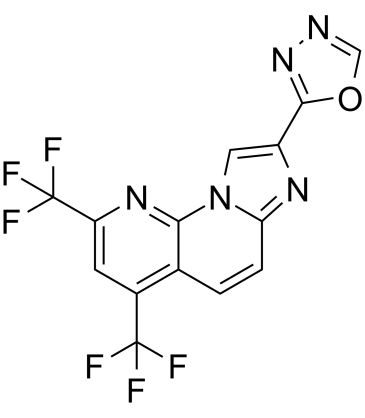
691868-88-9 structure
- Name: RO8191
- Chemical Name: RO8191
- CAS Number: 691868-88-9
- Molecular Formula: C14H5F6N5O
- Molecular Weight: 373.21
- Catalog: Signaling Pathways Anti-infection HCV
- Create Date: 2020-08-07 18:19:39
- Modify Date: 2026-06-30 15:57:23
-
RO8191 (RO4948191), an imidazonaphthyridine compound, is an orally active and potent interferon (IFN) receptor agonist. RO8191 activates IFN-stimulated genes (ISGs) expression and JAK/STAT phosphorylation. RO8191 shows antiviral activity against both HCV and EMCV with an IC50 of 200 nM for HCV replicon[1].
| Name | RO8191 |
|---|---|
| Synonyms |
RO4948191
MFCD03102493 HCV,Inhibitor,JAK,Hatitis C virus,Interferon-alpha/beta rector,CDM3008,Janus kinase,EMCV,CDM 3008,Tyk2,RO-4948191,RO 4948191,HBV,RO8191,interferon,orally,IFN,ISGs,cccDNA,IFN1,STAT,inhibit,JAK1,RO-8191,RO 8191,Hatitis B virus,IFN2,imidazonaphthyridine,Interferon-α/β rector,rlicon 8-(1,3,4-OXADIAZOL-2-YL)-2,4-BIS(TRIFLUOROMETHYL)IMIDAZO[1,2-A][1,8]NAPHTHYRIDINE 2-[2,4-Bis(trifluoromethyl)imidazo[1,2-a]1,8-naphthyridin-8-yl]-1,3,4-oxadiazole Imidazo[1,2-a][1,8]naphthyridine, 8-(1,3,4-oxadiazol-2-yl)-2,4-bis(trifluoromethyl) CDM-3008 |
| Description | RO8191 (RO4948191), an imidazonaphthyridine compound, is an orally active and potent interferon (IFN) receptor agonist. RO8191 activates IFN-stimulated genes (ISGs) expression and JAK/STAT phosphorylation. RO8191 shows antiviral activity against both HCV and EMCV with an IC50 of 200 nM for HCV replicon[1]. |
|---|---|
| Related Catalog | |
| Target |
JAK1 IFNAR2 |
| In Vitro | RO8191 (RO4948191) exerts antiviral activity dependent on IFNAR2/JAK1, but is independent of IFNAR1/Tyk2. RO8191, an IFNAR2 agonist, stimulates IFN signals in mice[1]. RO8191 (0.08, 0.4, 2, 10 μM; for 72 h) strongly suppresses HCV replicon activity at 72 h in a dose-dependent manner. RO8191 reduces levels of the proteins HCV NS3 and NS4A, which are localized mainly in the perinuclear region of the replicon cells[1]. RO8191 (0.08-10 μM; for 72 h) results in the disappearance of viral proteins such as NS3, NS4A/B, and NS5A/B[1]. |
| In Vivo | RO8191 (RO4948191; 30 mg/kg; oral) significantly induces antiviral genes Oas1b, Mx1, and Pkr in the livers of six-week-old C57BL/6J mice[1]. |
| References |
| Molecular Formula | C14H5F6N5O |
|---|---|
| Molecular Weight | 373.21 |
| Symbol |

GHS06 |
|---|---|
| Signal Word | Danger |
| Hazard Statements | H301 |
| Precautionary Statements | P301 + P310 |
| RIDADR | UN 2811 6.1 / PGIII |