1953132-75-6
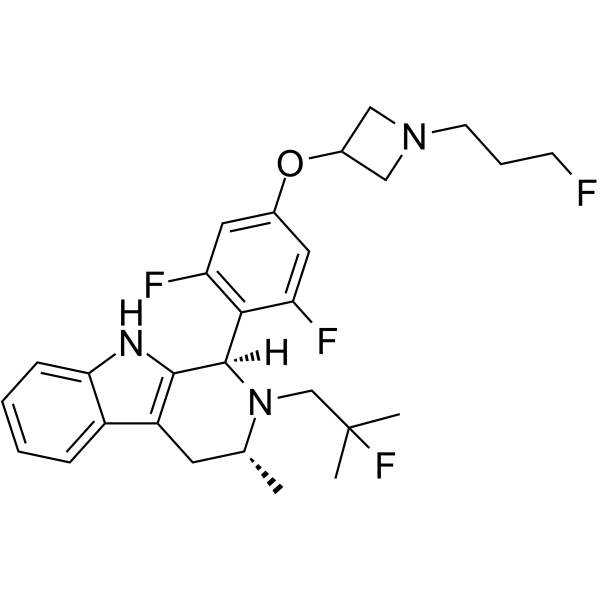
1953132-75-6 structure
- Name: GNE-149
- Chemical Name: GNE-149
- CAS Number: 1953132-75-6
- Molecular Formula: C28H33F4N3O
- Molecular Weight: 503.57
- Catalog: Research Areas Cancer
- Create Date: 2022-03-26 23:06:06
- Modify Date: 2026-07-01 18:52:41
-
GNE-149 is an orally bioavailable full antagonist of estrogen receptor α (ERα; IC50=0.053 nM). GNE-149 is a selective estrogen receptor degrader (SERD). GNE-149 can be used for the research of breast cancer[1].
| Name | GNE-149 |
|---|---|
| Synonyms | 1H-Pyrido[3,4-b]indole, 1-[2,6-difluoro-4-[[1-(3-fluoropropyl)-3-azetidinyl]oxy]phenyl]-2-(2-fluoro-2-methylpropyl)-2,3,4,9-tetrahydro-3-methyl-, (1R,3R) |
| Description | GNE-149 is an orally bioavailable full antagonist of estrogen receptor α (ERα; IC50=0.053 nM). GNE-149 is a selective estrogen receptor degrader (SERD). GNE-149 can be used for the research of breast cancer[1]. |
|---|---|
| Related Catalog | |
| Target |
ERα:0.053 nM (IC50) |
| In Vitro | GNE-149 exhibits antiproliferative activity in MCF7 and T47D cells with IC50s of 0.66 and 0.69 nM, respectively[1]. GNE-149 exhibits ERα Degradation in MCF7 and T47D cells with IC50s of 0.053 and 0.031 nM, respectively[1]. |
| In Vivo | GNE-149 (0.3-30 mg/kg) exhibits in vivo efficacy in an MCF7 xenograft mouse model harboring either wild-type (WT) ERα or overexpressed Y537S mutant[1]. GNE-149 has favorable pharmacokinetic profile, including total clearance (CL; 19, 8, and 13 mL/min/kg for Rat, Dog, and Cyno) and oral bioavailability (F; 31%, 49%, and 28% for Rat, Dog, and Cyno)[1]. Animal Model: Female Crl:NU Foxn1 nu mice (at 7 weeks of age) bearing wild-type (WT) ERαor overexpressed Y537S mutant MCF7 tumor[1] Dosage: 0.3, 1, 3, 10, and 30 mg/kg Administration: Orally q.d. for 21 days Result: Exhibited dose-dependent efficacy in the MCF7 WT and Y537S mutant xenograft model, with tumor regression observed at all doses above 0.3 mg/kg in Y537S mutant xenograft model. |
| References |
| Molecular Formula | C28H33F4N3O |
|---|---|
| Molecular Weight | 503.57 |