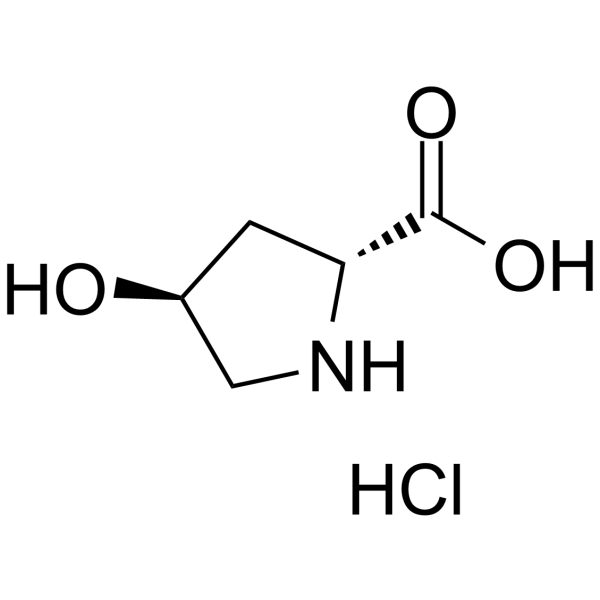
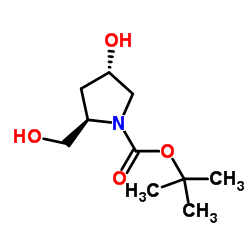
135042-17-0
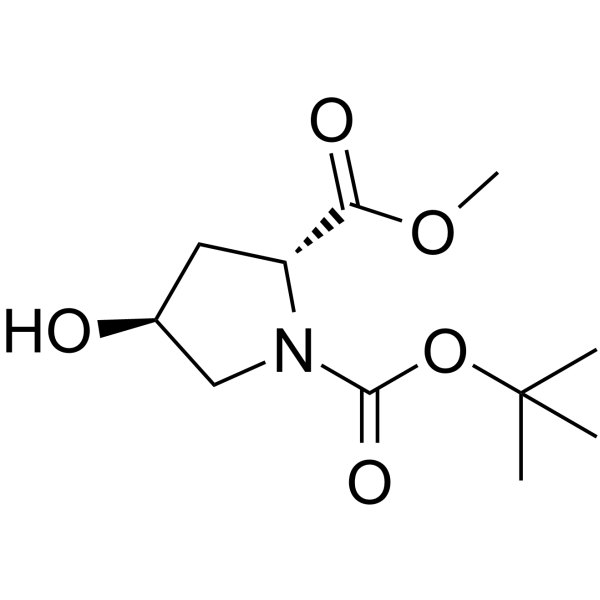
135042-17-0 structure
- Name: Boc-trans-D-Hyp-OMe
- Chemical Name: (2R,4S)-1-tert-Butyl 2-methyl 4-hydroxypyrrolidine-1,2-dicarboxylate
- CAS Number: 135042-17-0
- Molecular Formula: C11H19NO5
- Molecular Weight: 245.272
- Catalog: Biochemical Amino acids and their derivatives Proline derivatives
- Create Date: 2019-01-09 12:50:43
- Modify Date: 2026-07-05 17:52:39
-
Boc-trans-D-Hyp-OMe is a non-cleavable ADC linker used in the synthesis of antibody-drug conjugates (ADCs). Boc-trans-D-Hyp-OMe is also a alkyl chain-based PROTAC linker that can be used in the synthesis of PROTACs[1][2].
| Name | (2R,4S)-1-tert-Butyl 2-methyl 4-hydroxypyrrolidine-1,2-dicarboxylate |
|---|---|
| Synonyms |
N-BOC-TRANS-4-HYDROXY-D-PROLINE METHYL ESTER //BP
(Tert-Butoxy)carbonyl D-trans-Hyp-OMe N-Boc-trans-D-Hyp-Ome Methyl (2R,4S)-1-Boc-4-hydroxypyrrolidine-2-cboxylate trans-Boc-D-Hpy-Ome 1,2-Pyrrolidinedicboxylic acid, 4-hydroxy-, 1-(1,1-diMethylethyl) 2-Methyl ester, (2R,4S) 1-O-tert-butyl 2-O-methyl (2R,4S)-4-hydroxypyrrolidine-1,2-dicboxylate 1-(1,1-Dimethylethyl) 2-methyl (2R,4S)-4-hydroxy-1,2-pyrrolidinedicboxylate (4S)-4-Hydroxy-2-methyl-1-{[(2-methyl-2-propanyl)oxy]carbonyl}-D-proline (2R,4S)-1-tert-butyl 2-methyl 4-hydroxypyrrolidine-1,2-dicboxylate N-BOC-TRANS-4-HYDROXY-D-PROLINE METHYL ESTER (CAS NO.135-0) (2R,4S)-4-hydroxypyrrolidine-1,2-dicboxylate (2R,4S)-4-Hydroxypyrrolidine-1,2-dicboxylic acid 1-tert-butyl ester 2-Methyl ester (N-Boc-trans-4-Hydroxy-D-proline Methyl ester N-BOC-TRANS-4-HYDROXY-D-PROLINE METHYL ESTER 1-(tert-Butyl) 2-methyl (2R,4S)-4-hydroxy-1,2-pyrrolidinedicboxylate N-Boc-Trans-4-Hydroxy-D-Proline Methyl Este N-Boc-Trans-5-Hydroxy-D-Proline Methyl Ester N-tert-butoxycbonyl-trans-4-hydroxy-D-proline Methyl ester (2R,4S)-4-Hydroxypyrrolidine-1,2-dicboxylic acid 1-tert-butyl ester 2-methyl 1-tert-butyl 2-methyl (2R,4S)-4-hydroxypyrrolidine-1,2-dicboxylate Boc-trans-4-Hydroxy-D-proline Methyl ester (2R,4S)-1-tert-butyl 2-methyl 4-hydroxypyrrolidine-1,2-dicboxylate/N-BOC-TRANS-4-HYDROXY-D-PROLINE METHYL ESTER Boc-D-trans-Hyp-OMe 1-O-tert-butyl 2-O-methyl (2R,4S)-4-hydroxypyrrolidine-1,2-dicarboxylate (2R,4S)-4-Hydroxypyrrolidine-1,2-dicboxylic acid 1-tert-butyl ester 2-methyl ester (2R,4S)-N-Boc-trans-4-hydroxy-D-proline methyl ester Methyl (4S)-1-Boc-4-hydroxy-D-prolinate (2R,4S)-N-Boc-4-hydroxyproline methyl ester |
| Description | Boc-trans-D-Hyp-OMe is a non-cleavable ADC linker used in the synthesis of antibody-drug conjugates (ADCs). Boc-trans-D-Hyp-OMe is also a alkyl chain-based PROTAC linker that can be used in the synthesis of PROTACs[1][2]. |
|---|---|
| Related Catalog | |
| Target |
Non-cleavable |
| In Vitro | ADCs are comprised of an antibody to which is attached an ADC cytotoxin through an ADC linker[1]. PROTACs contain two different ligands connected by a linker; one is a ligand for an E3 ubiquitin ligase and the other is for the target protein. PROTACs exploit the intracellular ubiquitin-proteasome system to selectively degrade target proteins[2]. |
| References |
| Density | 1.3±0.1 g/cm3 |
|---|---|
| Boiling Point | 387.6±42.0 °C at 760 mmHg |
| Molecular Formula | C11H19NO5 |
| Molecular Weight | 245.272 |
| Flash Point | 188.2±27.9 °C |
| Exact Mass | 245.126328 |
| PSA | 76.07000 |
| LogP | -0.17 |
| Vapour Pressure | 0.0±2.0 mmHg at 25°C |
| Index of Refraction | 1.520 |
| Storage condition | 2-8°C |
| Hazard Codes | Xi |
|---|
| Precursor 0 | |
|---|---|
| DownStream 5 | |