90332-63-1
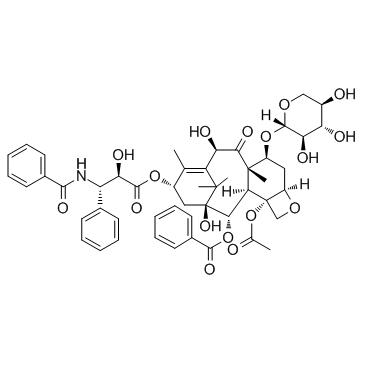
90332-63-1 structure
- Name: 10-Deacetyl-7-xylosyl paclitaxel
- Chemical Name: 7-Xylosyl-10-deacetyltaxol
- CAS Number: 90332-63-1
- Molecular Formula: C50H57NO17
- Molecular Weight: 943.984
- Catalog: Natural product Moss
- Create Date: 2019-01-09 22:15:46
- Modify Date: 2026-07-10 21:59:51
-
10-Deacetyl-7-xylosyl paclitaxel is a Paclitaxel derivative with improved pharmacological features and higher water solubility.IC50 value:Target: Microtubule inhibitor10-Deacetyl-7-xylosyl paclitaxel induced mitotic cell cycle arrest and apoptosis as measured by flow cytometry, DNA laddering, and transmission electron microscopy. Pro-apoptotic Bax and Bad protein expression was up-regulated and anti-apoptotic Bcl-2 and Bcl-XL expression down-regulated, which lead to a disturbance of the mitochondrial membrane permeability and to the activation of caspase-9. In turn, caspase-9 activated downstream caspases-3 and -6, but not caspase-8. Bid was also activated by caspase-3. Reversely, treatment with a caspase-10-specific inhibitor could not protect PC-3 cells from 7-xylosyl-10-deacetyl-paclitaxel-triggered apoptosis. Moreover, 7-xylosyl-10-deacetylpaclitaxel had no effect on the expression of CD95 and NF-kappaB proteins, indicating that apoptosis was induced through the mitochondrial-dependent pathway in PC-3 cells.
| Name | 7-Xylosyl-10-deacetyltaxol |
|---|---|
| Synonyms |
(2α,3β,5β,7β,10β,13α)-4-Acetoxy-13-{[(2R,3S)-3-(benzoylamino)-2-hydroxy-3-phenylpropanoyl]oxy}-1,10-dihydroxy-9-oxo-7-(β-D-xylopyranosyloxy)-5,20-epoxytax-11-en-2-yl benzoate
(2α,5β,7β,10β,13α)-4-Acetoxy-13-{[(2R,3S)-3-(benzoylamino)-2-hydroxy-3-phenylpropanoyl]oxy}-1,10-dihydroxy-9-oxo-7-(β-D-xylopyranosyloxy)-5,20-epoxytax-11-en-2-yl benzoate 10-Deacetyl-7-xylosyl paclitaxel |
| Description | 10-Deacetyl-7-xylosyl paclitaxel is a Paclitaxel derivative with improved pharmacological features and higher water solubility.IC50 value:Target: Microtubule inhibitor10-Deacetyl-7-xylosyl paclitaxel induced mitotic cell cycle arrest and apoptosis as measured by flow cytometry, DNA laddering, and transmission electron microscopy. Pro-apoptotic Bax and Bad protein expression was up-regulated and anti-apoptotic Bcl-2 and Bcl-XL expression down-regulated, which lead to a disturbance of the mitochondrial membrane permeability and to the activation of caspase-9. In turn, caspase-9 activated downstream caspases-3 and -6, but not caspase-8. Bid was also activated by caspase-3. Reversely, treatment with a caspase-10-specific inhibitor could not protect PC-3 cells from 7-xylosyl-10-deacetyl-paclitaxel-triggered apoptosis. Moreover, 7-xylosyl-10-deacetylpaclitaxel had no effect on the expression of CD95 and NF-kappaB proteins, indicating that apoptosis was induced through the mitochondrial-dependent pathway in PC-3 cells. |
|---|---|
| Related Catalog | |
| References |
| Density | 1.5±0.1 g/cm3 |
|---|---|
| Boiling Point | 1068.4±65.0 °C at 760 mmHg |
| Molecular Formula | C50H57NO17 |
| Molecular Weight | 943.984 |
| Flash Point | 599.9±34.3 °C |
| Exact Mass | 943.362671 |
| PSA | 274.14000 |
| LogP | 7.18 |
| Vapour Pressure | 0.0±0.3 mmHg at 25°C |
| Index of Refraction | 1.660 |
| Storage condition | 2-8℃ |