31362-50-2
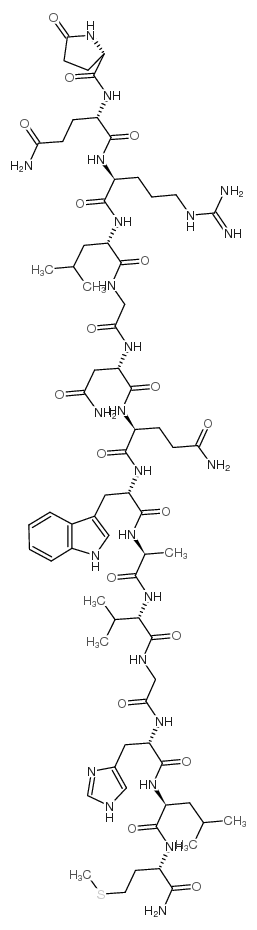
31362-50-2 structure
- Name: Bombesin
- Chemical Name: Bombesin
- CAS Number: 31362-50-2
- Molecular Formula: C71H110N24O18S
- Molecular Weight: 1619.85000
- Catalog: Biochemical Peptide
- Create Date: 2018-06-12 13:10:14
- Modify Date: 2026-06-30 17:06:35
-
Bombesin is a tetradecapeptide originally isolated from frog skin; plays an important role in the release of gastrin and the activation of G-protein receptors.
| Name | Bombesin |
|---|---|
| Synonyms |
PYROGLU-GLN-G-LEU-GLY-ASN-GLN-TRP-ALA-VAL-GLY-HIS-LEU-MET NH2
Bombesin hydrate acetate salt (S)-N1-((5S,8S,11S,17S,20S,23S,26S,29S,35S,38S)-11-((1H-Imidazol-5-yl)methyl)-23-((1H-indol-3-yl)methyl)-43-amino-29-(2-amino-2-oxoethyl)-26-(3-amino-3-oxopropyl)-5-cbamoyl-43-imino-8,35-diisobutyl-17-isopropyl-20-methyl-7,10,13,16,19,22,25,28,31,34,37 M.W. 1619.85 C71H110N24O18S BOMBESIN ACETATE SALT 2-l-glutamine-6-l-aspagine-alytesin MFCD00167514 Bombesin acetate salt hydrate BOMBESIN SYNTHETIC STIMULATES GASTR IN RE Bombesin acetate salt hydrate, (HPLC) bombesin acetate hydrate PYR-GLN-G-LEU-GLY-ASN-GLN-TRP-ALA-VAL-GLY-HIS-LEU-MET-NH2 ACOH 7H2O Bombesin trifluoroacetate salt Pyr-Gln-g-Leu-Gly-Asn-Gln-Trp-Ala-Val-Gly-His-Leu-Met-NH2 trifluoroacetate salt Alphaxalone 5-Oxo-L-Pro-L-Gln-L-g-L-Leu-Gly-L-Asn-L-Gln-L-Trp-L-Ala-L-Val-Gly-L-His-L-Leu-L-Met-NH2 PGLU-GLN-G-LEU-GLY-ASN-GLN-TRP-ALA-VAL-GLY-HIS-LEU-MET-NH2 H-PYR-GLN-G-LEU-GLY-ASN-GLN-TRP-ALA-VAL-GLY-HIS-LEU-MET-NH2 PYR-QRLGNQWAVGHLM-NH2 GLP-GLN-G-LEU-GLY-ASN-GLN-TRP-ALA-VAL-GLY-HIS-LEU-MET-NH2 (S)-N1-((5S,8S,11S,17S,20S,23S,26S,29S,35S,38S)-11-((1H-Imidazol-5-yl)methyl)-23-((1H-indol-3-yl)methyl)-43-amino-29-(2-amino-2-oxoethyl)-26-(3-amino-3-oxopropyl)-5-cbamoyl-43-imino-8,35-diisobutyl-17-isopropyl-20-methyl-7,10,13,16,19,22,25,28,31,34,37-undecaoxo-2-thia-6,9,12,15,18,21,24,27,30,33,36,42-dodecaazatritetracontan-38-yl)-2-((S)-5-oxopyrrolidine-2-cboxamido)pentanediamide Bombesin, Free Base bombesin acetate Bombesin //BP C71H110N24O18S 2-l-glutamine-6-l-aspagine-alytesi pGlu-Gln-Arg-Leu-Gly-Asn-Gln-Trp-Ala-Val-Gly-His-Leu-Met-NH2 Bastrin PYR-GLN-G-LEU-GLY-ASN-GLN-TRP-ALA-VAL-GLY-HIS-LEU-MET-NH2 BOMBESIN ACOH 7H2O |
| Description | Bombesin is a tetradecapeptide originally isolated from frog skin; plays an important role in the release of gastrin and the activation of G-protein receptors. |
|---|---|
| Related Catalog | |
| In Vitro | Bombesin is a tetradecapeptide with a COOH terminus ending in Gly-His-Leu-Met-NH2 and subsequently is shown to closely resemble two mammalian bombesin -related peptides, gastrin-releasing peptide (GRP) and neuromedin B (NMB)[1]. Bombesin is found to have stimulatory effects upon gastric and pancreatic secretions, release of gastrointestinal hormones, gallbladder contraction and bronchoconstriction. It is present in amphibian gastric endocrine cells, avian proventriculus endocrine cells and avian brain. In mammals it is present mainly in nerve cells and fibers. The only mammalian endocrine cell shown to date to have bombesin is the P-cell in fetal lung. Bombesin is also found in mammalian brain, with its highest concentration in the hypothalamus[2]. Bombesin is shown to be a potent mitogen for Swiss 3T3 cells. In the presence of a low concentration (3.5%) of serum, bombesin stimulates 3T3 cell proliferation. In serum-free medium, bombesin induces DNA synthesis in the absence of any other added growth factor (IC50=1 nM)[3]. |
| References |
[2]. Chejfec G, et al. Bombesin in human neuroendocrine (NE) neoplasms. Peptides. 1985;6 Suppl 3:107-12. |
| Density | 1.5g/cm3 |
|---|---|
| Molecular Formula | C71H110N24O18S |
| Molecular Weight | 1619.85000 |
| Exact Mass | 1618.82000 |
| PSA | 711.43000 |
| LogP | 2.59880 |
| Index of Refraction | 1.681 |
| Storage condition | −20°C |
| Water Solubility | 0.05 M acetic acid: 20 mg/mL, clear, colorless |
CHEMICAL IDENTIFICATION
HEALTH HAZARD DATAACUTE TOXICITY DATAMUTATION DATA
|