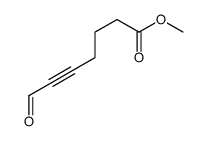
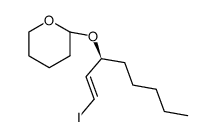
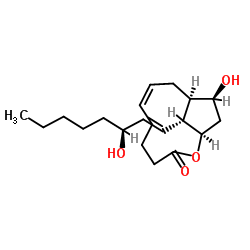
41598-07-6
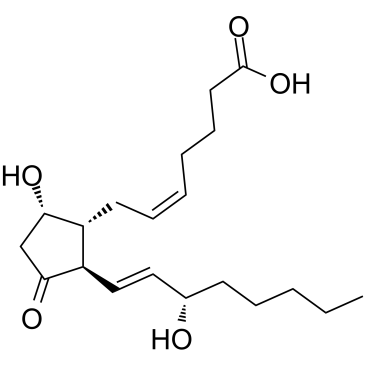
41598-07-6 structure
- Name: Prostaglandin D2
- Chemical Name: prostaglandin D2
- CAS Number: 41598-07-6
- Molecular Formula: C20H32O5
- Molecular Weight: 352.465
- Catalog: Research Areas Inflammation/Immunology
- Create Date: 2018-03-02 08:00:00
- Modify Date: 2026-07-16 17:22:35
-
Prostaglandin D2 (PGD2) is one of the major PGs actively produced in the brain of various mammals[1]. Prostaglandin D2 is one of the most potent endogenous sleep promoting substances[2]. PGD2 plays a protective role by suppressing inflammation[3].
| Name | prostaglandin D2 |
|---|---|
| Synonyms |
PGD2
Anti-Ptgds antibody produced in goat (5z,9α,13e,15s)-9,15-dihydroxy-11-oxoprosta-5,13-dien-1-oic-acid prostaglandin D2 cell culture tested Prostaglandin D - - Calbiochem (5Z,13E,15S)-9α,15-Dihydroxy-11-oxoprosta-5,13-dien-1-oic acid MFCD00077857 PGD2, (5Z,9α,13E,15S)-9,15-Dihydroxy-11-oxoprosta-5,13-dien-1-oic-acid Prostaglandin D2 Lipid Maps MS Standd 7-[(1R,2R,5S)-5-hydroxy-2-[(3S)-3-hydroxyoct-1-enyl]-3-oxocyclopentyl]ht-5-enoic acid 11-dehydroprostaglandinf2-alpha PROSTAGLANDINS D2 [5Z,9ALPHA,13E,15S]9,15-DIHYDROXY-11-OXOPROSTA-5,13-DIEN-1-OIC ACID (5Z,9α,13E,15S)-9,15-dihydroxy-11-oxo-prosta-5,13-dien-1-oic acid 9,15-dihydroxy-11-oxo-,(5z,9-alpha,13e,15s)-prosta-13-dien-1-oicacid PGD2 (Prostaglandin D2) Prostaglandin D2, HDP1 and CRTH2 rector agonist (Z)-7-((1R,2R,5S)-5-hydroxy-2-((S,E)-3-hydroxyoct-1-en-1-yl)-3-oxocyclopentyl)ht-5-enoic acid (5Z,9α,13E,15S)-9,15-Dihydroxy-11-oxoprosta-5,13-dien-1-oic acid Prosta-5,13-dien-1-oic acid, 9,15-dihydroxy-11-oxo-, (5Z,9α,13E,15S) prostaglandind2synthetichyoscopic 9ALPHA,15S-DIHYDROXY-11-OXO-PROSTA-5Z,13E-DIEN-1-OIC ACID Prostaglandin D2 MaxSpecStandd prostaglandin D2 synthase (brain) PROSTAGLANDIN D2 Prostaglandin D RP23-47P, 21kDa Prostaglandin D2,(5Z,9α,13E,15S)-9,15-Dihydroxy-11-oxoprosta-5,13-dien-1-oic-acid, PGD2 |
| Description | Prostaglandin D2 (PGD2) is one of the major PGs actively produced in the brain of various mammals[1]. Prostaglandin D2 is one of the most potent endogenous sleep promoting substances[2]. PGD2 plays a protective role by suppressing inflammation[3]. |
|---|---|
| Related Catalog | |
| Target |
Human Endogenous Metabolite |
| In Vivo | Prostaglandin D2 (PGD2; infused into the lateral ventricle; 5-50 pmol/min; for 6 hours between 20:00 and 2:00) induces sleep-wake profiles in A2AR KO mice[2]. Animal Model: Male WT and A2AR KO mice of the inbred C57BL/6 strain (weighing 23-27 g, 11-13 weeks old)[1] Dosage: 5, 10, 20, or 50 pmol/min Administration: Infused into the lateral ventricle; for 6 hours between 20:00 and 2:00 Result: Induced sleep-wake profiles. |
| References |
[1]. Suzuki F, et al. Transport of prostaglandin D2 into brain. Brain Res. 1986 Oct 22;385(2):321-8. |
| Density | 1.1±0.1 g/cm3 |
|---|---|
| Boiling Point | 549.6±50.0 °C at 760 mmHg |
| Molecular Formula | C20H32O5 |
| Molecular Weight | 352.465 |
| Flash Point | 300.3±26.6 °C |
| Exact Mass | 352.224976 |
| PSA | 94.83000 |
| LogP | 2.02 |
| Vapour Pressure | 0.0±3.4 mmHg at 25°C |
| Index of Refraction | 1.561 |
| Storage condition | 20°C |
CHEMICAL IDENTIFICATION
HEALTH HAZARD DATAACUTE TOXICITY DATA
MUTATION DATA
|
| Symbol |


GHS07, GHS08 |
|---|---|
| Signal Word | Danger |
| Hazard Statements | H302-H360 |
| Precautionary Statements | P201-P308 + P313 |
| Personal Protective Equipment | Eyeshields;full-face particle respirator type N100 (US);Gloves;respirator cartridge type N100 (US);type P1 (EN143) respirator filter;type P3 (EN 143) respirator cartridges |
| Hazard Codes | T: Toxic; |
| Risk Phrases | 60-22 |
| Safety Phrases | S22;S26;S36;S53 |
| RIDADR | NONH for all modes of transport |
| RTECS | UK7930000 |
| Precursor 4 | |
|---|---|
| DownStream 1 | |