104987-36-2
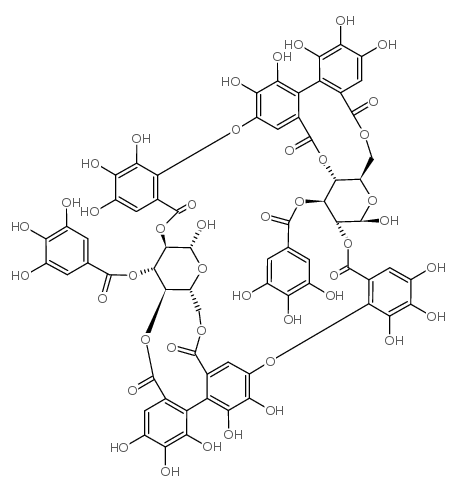
104987-36-2 structure
- Name: Oenothein B
- Chemical Name: oenothein B
- CAS Number: 104987-36-2
- Molecular Formula: C68H48O44
- Molecular Weight: 1569.08000
- Catalog: analytical chemistry Standard Analytical standard
- Create Date: 2017-10-07 21:44:11
- Modify Date: 2026-07-15 19:45:25
-
Oenothein B is a dimeric macrocyclic ellagitannin and has widely pharmacological activities, including antioxidant, anti-inflammatory, antifungal, anti-HCV, and antitumor properties. Oenothein B is a potent and specific inhibitor of poly(ADP-ribose) glycohydrolase[1][2].
| Name | oenothein B |
|---|---|
| Synonyms |
D-Glucose, cyclic 4,6-(4-(6-cboxy-2,3,4-trihydroxyphenoxy)-4',5,5',6,6'-pentahydroxy(1,1'-biphenyl)-2,2'-dicboxylate) 2-(2-((6,6'-dicboxy-2,2',3,3',4'-pentahydroxy(1,1'-biphenyl)-4-yl)oxy)-3,4,5-trihydroxybenzoate) 3-(3,4,5-trihydroxybenzoate), cyclic ester with D-glucose 3-(3,4,5-trihydroxybenzoate), (2(S),4(S))
D-Glucose, cyclic4,6-[(1S)-4-(6-cboxy-2,3,4-trihydroxyphenoxy)-4',5,5',6,6'-pentahydroxy[1,1'-biphenyl]-2,2'-dicboxylate]2-[2-[[(1S)-6,6'-dicboxy-2,2',3,3',4'-pentahydroxy[1,1'-biphenyl]-4-yl]ox Aids-085163 Aids085163 D-Glucose, cyclic 4,6-[(1S)-4-(6-cboxy-2,3,4-trihydroxyphenoxy)-4',5,5',6,6'-pentahydroxy[1,1'-biphenyl]-2,2'-dicboxylate] 2-[2-[[(1S)-6,6'-dicboxy-2,2',3,3',4'-pentahydroxy[1,1'-biphenyl]-4-yl]oxy]-3,4,5-trihydroxybenzoate] 3-(3,4,5-trihydroxybenzoate), cyclic ester with D-glucose 3-(3,4,5-tr antitumor,HCV,Hatitis C virus,ellagitannin,antifungal,antioxidant,Bacterial,inhibit,Oenothein B,Fungal,glycohydrolase,Inhibitor,macrocyclic,poly(ADP-ribose),Apoptosis,anti-HCV,anti-inflammatory |
| Description | Oenothein B is a dimeric macrocyclic ellagitannin and has widely pharmacological activities, including antioxidant, anti-inflammatory, antifungal, anti-HCV, and antitumor properties. Oenothein B is a potent and specific inhibitor of poly(ADP-ribose) glycohydrolase[1][2]. |
|---|---|
| Related Catalog | |
| In Vitro | Oenothein B (15-45 µM; 12-72 hours) has a dose- and time-dependent inhibition rate effect on A549 cells in the range of 12 hours, 24 hours, 36 hours, 48 hours, 60 hours and 72 hours of exposure[1]. Oenothein B (15-45 µM; 24 hours) effectively inhibits the proliferation of A549 cells by inducing apoptosis and arresting cells at G1 stage[1]. Oenothein B (15-45 µM; 24 hours) not only increases the level of intracellular reactive oxygen species (ROS), but also induces the upregulation of intracellular apoptotic triggers (cleavage caspase-3, PARP, cytochrome c level in the cytosol, Bax)[1]. A549 cells[1]15 µM, 30 µM and 45 µM24 hoursArrested cells in the G1 phase.A549 cells[1]15 µM, 30 µM and 45 µM24 hoursBAX, p53, cytochrome c (cytoplasm) and PARP were unregulated significantly; Anti-apoptotic Bcl-2 was decreased significantly in a concentration-dependent manner. Cell Viability Assay[1] Cell Line: A549 cells Concentration: 15 µM, 30 µM and 45 µM Incubation Time: 12 hours, 24 hours, 36 hours, 48 hours, 60 hours and 72 hours Result: Effectively inhibited the proliferation of A549 cells. Apoptosis Analysis[1] Cell Line: A549 cells Concentration: 15 µM, 30 µM and 45 µM Incubation Time: 24 hours Result: Induced apoptosis in A549 cells. Cell Cycle Analysis[1] Cell Line: A549 cells Concentration: 15 µM, 30 µM and 45 µM Incubation Time: 24 hours Result: Arrested cells in the G1 phase. Western Blot Analysis[1] Cell Line: A549 cells Concentration: 15 µM, 30 µM and 45 µM Incubation Time: 24 hours Result: BAX, p53, cytochrome c (cytoplasm) and PARP were unregulated significantly; Anti-apoptotic Bcl-2 was decreased significantly in a concentration-dependent manner. |
| In Vivo | Oenothein B (100-300 mg/kg; p.o.) has the ability to reduce neuroinflammation in the brain during systemic inflammation in ICR mice[3]. |
| References |
| Molecular Formula | C68H48O44 |
|---|---|
| Molecular Weight | 1569.08000 |
| Exact Mass | 1568.15000 |
| PSA | 732.84000 |
| LogP | 2.17020 |
| Storage condition | 2-8°C |
| Hazard Codes | Xi |
|---|---|
| RIDADR | NONH for all modes of transport |
| RTECS | LZ7000000 |