Dehydroepiandrosterone sulfate sodium salt
Modify Date: 2026-07-12 17:31:45

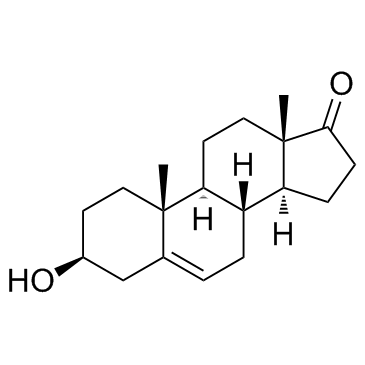
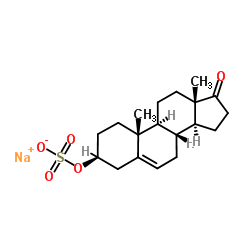
Dehydroepiandrosterone sulfate sodium salt Structure
Dehydroepiandrosterone sulfate sodium salt structure
Common Name Dehydroepiandrosterone sulfate sodium salt
CAS Number 1099-87-2 Molecular Weight 390.469
Density N/A Boiling Point N/A
Molecular Formula C19H27NaO5S Melting Point 148-149 °C (dec.)(lit.)
MSDS N/A Flash Point 48.2 °F
Symbol GHS02 GHS06 GHS08
GHS02, GHS06, GHS08
Signal Word Danger

 Use of Dehydroepiandrosterone sulfate sodium salt


Dehydroepiandrosterone sulfate sodium salt (DHEAS) is the most abundant circulating steroid in human. Dehydroepiandrosterone sulfate sodium salt (DHEAS) affects steroid hormone biosynthesis on a molecular level resulting in an increased formation of pregnenolone[1].

Summary: Sodium prasterone sulfate, Chinese name is 去氢表雄酮硫酸钠, CAS number is 1099-87-2, with molecular formula C19H27NaO5S and molecular weight 390.469. It is a white to gray-white powder with a melting point of 148-149 °C (dec.)(lit.). For research-use only, not for medical or clinical usage.


 Names

This table lists Chinese names, IUPAC names and various aliases of this chemical substance.

Name Sodium prasterone sulfate
Synonym More Synonyms

  Biological Activity

This table contains bioactivity, target information and biological‑assay experimental data of this compound.

Description Dehydroepiandrosterone sulfate sodium salt (DHEAS) is the most abundant circulating steroid in human. Dehydroepiandrosterone sulfate sodium salt (DHEAS) affects steroid hormone biosynthesis on a molecular level resulting in an increased formation of pregnenolone[1].
Related Catalog
Target

Human Endogenous Metabolite

References

[1]. Jens Neunzig, et al. Dehydroepiandrosterone Sulfate (DHEAS) Stimulates the First Step in the Biosynthesis of Steroid Hormones. PLoS One. 2014 Feb 21;9(2):e89727.

 Chemical & Physical Properties

This table shows physicochemical parameters including melting point, boiling point, density, solubility and optical rotation. Missing data is marked as N/A.

Melting Point 148-149 °C (dec.)(lit.)
Molecular Formula C19H27NaO5S
Molecular Weight 390.469
Exact Mass 390.147675
PSA 91.88000
LogP 4.44450
Index of Refraction 10 ° (C=4, MeOH)
InChIKey GFJWACFSUSFUOG-ZJTJBYBXSA-M
SMILES CC12CCC3C(CC=C4CC(OS(=O)(=O)[O-])CCC43C)C1CCC2=O.[Na+]
Storage condition ?20°C
Water Solubility methanol: clear to hazy

 Toxicological Information

This table summarizes toxicological test data, acute & chronic toxicity and ecological hazard parameters for this chemical.

CHEMICAL IDENTIFICATION

RTECS NUMBER :
BV8397400
CHEMICAL NAME :
Androst-5-en-17-one, 3-beta-hydroxy-, ester with sodium sulfate
CAS REGISTRY NUMBER :
1099-87-2
LAST UPDATED :
199806
DATA ITEMS CITED :
21
MOLECULAR FORMULA :
C19-H27-O5-S.Na
MOLECULAR WEIGHT :
390.51

HEALTH HAZARD DATA

ACUTE TOXICITY DATA

TYPE OF TEST :
TDLo - Lowest published toxic dose
ROUTE OF EXPOSURE :
Intravenous
SPECIES OBSERVED :
Human - woman
DOSE/DURATION :
4 mg/kg
TOXIC EFFECTS :
Gastrointestinal - nausea or vomiting Skin and Appendages - dermatitis, other (after systemic exposure)
REFERENCE :
JMGZAI Japan Medical Gazette. (Tokyo, Japan) V.1-18(?), 1964-81. Discontinued. Volume(issue)/page/year: 18(5),10,1981
TYPE OF TEST :
LD50 - Lethal dose, 50 percent kill
ROUTE OF EXPOSURE :
Oral
SPECIES OBSERVED :
Rodent - rat
DOSE/DURATION :
>10 gm/kg
TOXIC EFFECTS :
Details of toxic effects not reported other than lethal dose value
REFERENCE :
NIIRDN Drugs in Japan (Ethical Drugs). (Yakugyo Jiho Co., Ltd., Tokyo, Japan) Volume(issue)/page/year: 6,687,1982
TYPE OF TEST :
LD50 - Lethal dose, 50 percent kill
ROUTE OF EXPOSURE :
Intraperitoneal
SPECIES OBSERVED :
Rodent - rat
DOSE/DURATION :
523 mg/kg
TOXIC EFFECTS :
Behavioral - altered sleep time (including change in righting reflex) Behavioral - ataxia Nutritional and Gross Metabolic - body temperature decrease
REFERENCE :
KSRNAM Kiso to Rinsho. Clinical Report. (Yubunsha Co., Ltd., 1-5, Kanda Suda-Cho, Chiyoda-ku, KS Bldg., Tokyo 101, Japan) V.1- 1960- Volume(issue)/page/year: 10,1852,1976
TYPE OF TEST :
LD50 - Lethal dose, 50 percent kill
ROUTE OF EXPOSURE :
Subcutaneous
SPECIES OBSERVED :
Rodent - rat
DOSE/DURATION :
1005 mg/kg
TOXIC EFFECTS :
Behavioral - convulsions or effect on seizure threshold Behavioral - ataxia Nutritional and Gross Metabolic - body temperature decrease
REFERENCE :
KSRNAM Kiso to Rinsho. Clinical Report. (Yubunsha Co., Ltd., 1-5, Kanda Suda-Cho, Chiyoda-ku, KS Bldg., Tokyo 101, Japan) V.1- 1960- Volume(issue)/page/year: 10,1852,1976
TYPE OF TEST :
LD50 - Lethal dose, 50 percent kill
ROUTE OF EXPOSURE :
Intravenous
SPECIES OBSERVED :
Rodent - rat
DOSE/DURATION :
468 mg/kg
TOXIC EFFECTS :
Behavioral - convulsions or effect on seizure threshold Behavioral - ataxia Lungs, Thorax, or Respiration - dyspnea
REFERENCE :
KSRNAM Kiso to Rinsho. Clinical Report. (Yubunsha Co., Ltd., 1-5, Kanda Suda-Cho, Chiyoda-ku, KS Bldg., Tokyo 101, Japan) V.1- 1960- Volume(issue)/page/year: 10,1852,1976
TYPE OF TEST :
LD50 - Lethal dose, 50 percent kill
ROUTE OF EXPOSURE :
Intravaginal
SPECIES OBSERVED :
Rodent - rat
DOSE/DURATION :
>500 mg/kg
TOXIC EFFECTS :
Details of toxic effects not reported other than lethal dose value
REFERENCE :
OYYAA2 Oyo Yakuri. Pharmacometrics. (Oyo Yakuri Kenkyukai, CPO Box 180, Sendai 980-91, Japan) V.1- 1967- Volume(issue)/page/year: 48,189,1994
TYPE OF TEST :
LD50 - Lethal dose, 50 percent kill
ROUTE OF EXPOSURE :
Oral
SPECIES OBSERVED :
Rodent - mouse
DOSE/DURATION :
>10 gm/kg
TOXIC EFFECTS :
Details of toxic effects not reported other than lethal dose value
REFERENCE :
NIIRDN Drugs in Japan (Ethical Drugs). (Yakugyo Jiho Co., Ltd., Tokyo, Japan) Volume(issue)/page/year: 6,687,1982
TYPE OF TEST :
LD50 - Lethal dose, 50 percent kill
ROUTE OF EXPOSURE :
Intraperitoneal
SPECIES OBSERVED :
Rodent - mouse
DOSE/DURATION :
460 mg/kg
TOXIC EFFECTS :
Behavioral - altered sleep time (including change in righting reflex) Behavioral - ataxia Nutritional and Gross Metabolic - body temperature decrease
REFERENCE :
KSRNAM Kiso to Rinsho. Clinical Report. (Yubunsha Co., Ltd., 1-5, Kanda Suda-Cho, Chiyoda-ku, KS Bldg., Tokyo 101, Japan) V.1- 1960- Volume(issue)/page/year: 10,1852,1976
TYPE OF TEST :
LD50 - Lethal dose, 50 percent kill
ROUTE OF EXPOSURE :
Subcutaneous
SPECIES OBSERVED :
Rodent - mouse
DOSE/DURATION :
899 mg/kg
TOXIC EFFECTS :
Behavioral - convulsions or effect on seizure threshold Behavioral - ataxia Nutritional and Gross Metabolic - body temperature decrease
REFERENCE :
KSRNAM Kiso to Rinsho. Clinical Report. (Yubunsha Co., Ltd., 1-5, Kanda Suda-Cho, Chiyoda-ku, KS Bldg., Tokyo 101, Japan) V.1- 1960- Volume(issue)/page/year: 10,1852,1976
TYPE OF TEST :
LD50 - Lethal dose, 50 percent kill
ROUTE OF EXPOSURE :
Intravenous
SPECIES OBSERVED :
Rodent - mouse
DOSE/DURATION :
274 mg/kg
TOXIC EFFECTS :
Behavioral - convulsions or effect on seizure threshold Behavioral - ataxia Lungs, Thorax, or Respiration - dyspnea
REFERENCE :
KSRNAM Kiso to Rinsho. Clinical Report. (Yubunsha Co., Ltd., 1-5, Kanda Suda-Cho, Chiyoda-ku, KS Bldg., Tokyo 101, Japan) V.1- 1960- Volume(issue)/page/year: 10,1852,1976
TYPE OF TEST :
LD50 - Lethal dose, 50 percent kill
ROUTE OF EXPOSURE :
Intravaginal
SPECIES OBSERVED :
Rodent - mouse
DOSE/DURATION :
>500 mg/kg
TOXIC EFFECTS :
Details of toxic effects not reported other than lethal dose value
REFERENCE :
OYYAA2 Oyo Yakuri. Pharmacometrics. (Oyo Yakuri Kenkyukai, CPO Box 180, Sendai 980-91, Japan) V.1- 1967- Volume(issue)/page/year: 48,189,1994 ** OTHER MULTIPLE DOSE TOXICITY DATA **
TYPE OF TEST :
TDLo - Lowest published toxic dose
ROUTE OF EXPOSURE :
Intraperitoneal
SPECIES OBSERVED :
Rodent - rat
DOSE/DURATION :
3 gm/kg/30D-I
TOXIC EFFECTS :
Blood - changes in other cell count (unspecified) Nutritional and Gross Metabolic - weight loss or decreased weight gain Biochemical - Enzyme inhibition, induction, or change in blood or tissue levels - phosphatases
REFERENCE :
KSRNAM Kiso to Rinsho. Clinical Report. (Yubunsha Co., Ltd., 1-5, Kanda Suda-Cho, Chiyoda-ku, KS Bldg., Tokyo 101, Japan) V.1- 1960- Volume(issue)/page/year: 10,1857,1976
TYPE OF TEST :
TDLo - Lowest published toxic dose
ROUTE OF EXPOSURE :
Intraperitoneal
SPECIES OBSERVED :
Rodent - rat
DOSE/DURATION :
5460 mg/kg/26W-I
TOXIC EFFECTS :
Kidney, Ureter, Bladder - changes in bladder weight Blood - changes in erythrocyte (RBC) count Biochemical - Enzyme inhibition, induction, or change in blood or tissue levels - transaminases
REFERENCE :
KSRNAM Kiso to Rinsho. Clinical Report. (Yubunsha Co., Ltd., 1-5, Kanda Suda-Cho, Chiyoda-ku, KS Bldg., Tokyo 101, Japan) V.1- 1960- Volume(issue)/page/year: 10,3016,1976
TYPE OF TEST :
TDLo - Lowest published toxic dose
ROUTE OF EXPOSURE :
Intraperitoneal
SPECIES OBSERVED :
Rodent - mouse
DOSE/DURATION :
3200 mg/kg/32D-I
TOXIC EFFECTS :
Blood - changes in other cell count (unspecified) Biochemical - Enzyme inhibition, induction, or change in blood or tissue levels - transaminases Biochemical - Metabolism (Intermediary) - other proteins
REFERENCE :
KSRNAM Kiso to Rinsho. Clinical Report. (Yubunsha Co., Ltd., 1-5, Kanda Suda-Cho, Chiyoda-ku, KS Bldg., Tokyo 101, Japan) V.1- 1960- Volume(issue)/page/year: 10,2989,1976
TYPE OF TEST :
TDLo - Lowest published toxic dose
ROUTE OF EXPOSURE :
Intraperitoneal
SPECIES OBSERVED :
Rodent - mouse
DOSE/DURATION :
18200 mg/kg/26W-I
TOXIC EFFECTS :
Liver - changes in liver weight Kidney, Ureter, Bladder - changes in bladder weight Blood - changes in other cell count (unspecified)
REFERENCE :
KSRNAM Kiso to Rinsho. Clinical Report. (Yubunsha Co., Ltd., 1-5, Kanda Suda-Cho, Chiyoda-ku, KS Bldg., Tokyo 101, Japan) V.1- 1960- Volume(issue)/page/year: 10,3001,1976 ** REPRODUCTIVE DATA **
TYPE OF TEST :
TDLo - Lowest published toxic dose
ROUTE OF EXPOSURE :
Intraperitoneal
DOSE :
500 mg/kg
SEX/DURATION :
female 8-17 day(s) after conception
TOXIC EFFECTS :
Reproductive - Effects on Embryo or Fetus - fetotoxicity (except death, e.g., stunted fetus) Reproductive - Effects on Embryo or Fetus - fetal death Reproductive - Effects on Newborn - live birth index (measured after birth)
REFERENCE :
OYYAA2 Oyo Yakuri. Pharmacometrics. (Oyo Yakuri Kenkyukai, CPO Box 180, Sendai 980-91, Japan) V.1- 1967- Volume(issue)/page/year: 12,201,1976
TYPE OF TEST :
TDLo - Lowest published toxic dose
ROUTE OF EXPOSURE :
Intraperitoneal
DOSE :
1 gm/kg
SEX/DURATION :
female 8-17 day(s) after conception
TOXIC EFFECTS :
Reproductive - Specific Developmental Abnormalities - urogenital system
REFERENCE :
OYYAA2 Oyo Yakuri. Pharmacometrics. (Oyo Yakuri Kenkyukai, CPO Box 180, Sendai 980-91, Japan) V.1- 1967- Volume(issue)/page/year: 12,201,1976
TYPE OF TEST :
TDLo - Lowest published toxic dose
ROUTE OF EXPOSURE :
Intraperitoneal
DOSE :
100 mg/kg
SEX/DURATION :
female 8-17 day(s) after conception
TOXIC EFFECTS :
Reproductive - Specific Developmental Abnormalities - musculoskeletal system
REFERENCE :
OYYAA2 Oyo Yakuri. Pharmacometrics. (Oyo Yakuri Kenkyukai, CPO Box 180, Sendai 980-91, Japan) V.1- 1967- Volume(issue)/page/year: 12,201,1976
TYPE OF TEST :
TDLo - Lowest published toxic dose
ROUTE OF EXPOSURE :
Intraperitoneal
DOSE :
1 gm/kg
SEX/DURATION :
female 7-16 day(s) after conception
TOXIC EFFECTS :
Reproductive - Maternal Effects - parturition Reproductive - Specific Developmental Abnormalities - musculoskeletal system Reproductive - Specific Developmental Abnormalities - urogenital system
REFERENCE :
OYYAA2 Oyo Yakuri. Pharmacometrics. (Oyo Yakuri Kenkyukai, CPO Box 180, Sendai 980-91, Japan) V.1- 1967- Volume(issue)/page/year: 12,201,1976
TYPE OF TEST :
TDLo - Lowest published toxic dose
ROUTE OF EXPOSURE :
Intraperitoneal
DOSE :
3 gm/kg
SEX/DURATION :
female 7-16 day(s) after conception
TOXIC EFFECTS :
Reproductive - Effects on Embryo or Fetus - fetotoxicity (except death, e.g., stunted fetus) Reproductive - Effects on Newborn - sex ratio
REFERENCE :
OYYAA2 Oyo Yakuri. Pharmacometrics. (Oyo Yakuri Kenkyukai, CPO Box 180, Sendai 980-91, Japan) V.1- 1967- Volume(issue)/page/year: 12,201,1976
TYPE OF TEST :
TDLo - Lowest published toxic dose
ROUTE OF EXPOSURE :
Intraperitoneal
DOSE :
100 mg/kg
SEX/DURATION :
female 7-16 day(s) after conception
TOXIC EFFECTS :
Reproductive - Effects on Embryo or Fetus - fetal death
REFERENCE :
OYYAA2 Oyo Yakuri. Pharmacometrics. (Oyo Yakuri Kenkyukai, CPO Box 180, Sendai 980-91, Japan) V.1- 1967- Volume(issue)/page/year: 12,201,1976

 Safety Information

This table covers safety warnings, protective measures, incompatible substances and disposal guidelines for this compound.

Symbol GHS02 GHS06 GHS08
GHS02, GHS06, GHS08
Signal Word Danger
Hazard Statements H225-H301 + H311 + H331-H370
Precautionary Statements P210-P260-P280-P301 + P310-P311
Hazard Codes F,C
Risk Phrases R11
Safety Phrases 16-26-36/37/39-45
RIDADR UN1230 - class 3 - PG 2 - Methanol, solution
WGK Germany 3
RTECS BV8397400
Flash Point(F) 48.2 °F
Flash Point(C) 9 °C

 Synthetic Route

This table presents publicly reported synthetic routes, reaction conditions, reactants and product information of the compound.

~%

Dehydroepiandrosterone sulfate sodium salt Structure

Dehydroepiandro...

CAS#:1099-87-2

Learn More
Literature: Chemistry and Biodiversity, , vol. 10, # 12 p. 2197 - 2208

 Precursor & DownStream

This table lists upstream starting materials and downstream derivative products related to this chemical.

Precursor  1

DownStream  1

 Bioassay

View more

This table contains target information, in‑vitro & in‑vivo assay data for this compound.

Name: 96-well format Chlamydomonas reinhardtii Algae Gravitaxis Assay to measure the differ...
Source: University of Pittsburgh Molecular Library Screening Center
Target: N/A
External Id: MH081217, Chlamydomonas reinhardtii Gravitaxis Assay to Identify Small Molecule Inhibitors of Cilia.
Total 1, Current Page 1 of 1
1

 Synonyms

This table collects all English aliases, systematic names and CAS‑related synonyms of the compound.

Teloin
Sodium dehydroepiandrosterone sulfate
SODIUM PRASTERONR SULFATE
Androst-5-en-17-one, 3-(sulfooxy)-, sodium salt, (3β)- (1:1)
Sodium (3β)-17-oxoandrost-5-en-3-yl sulfate
sodiumprasteronesulfate
(3b)-3-(Sulfooxy)androst-5-en-17-one Sodium Salt
Sodium dehydroepiandrosterone-3-sulfate
prasterone sulfate sodium salt
MFCD00010470
Dehydroepiandrosterone sulfate sodium salt
Sodium prasterone sulfate
EINECS 214-152-2
sodiumdehydroepiandrosteronesulfate
dha-s
Prasterone sulfate sodium
Dehydroepiandrosterone sulfate sodium
Astenile
PRASTERONE SODIUM SULFATE
3b-Hydroxy-5-androsten-17-one Sodium Sulfate
3b-Hydroxyandrost-5-en-17-one Hydrogen Sulfate Sodium Salt
prasterone sodium sulphate
Dehydroepiandrosterone-3-sulfate sodium salt
Mylis

  | FAQ

This section contains frequently‑asked‑questions about this compound, including basic parameters, properties, storage conditions and corresponding answers.

Q: What is the safety information for Sodium prasterone sulfate?
A: Safety information for Sodium prasterone sulfate: 16-26-36/37/39-45.
Q: What are the upstream materials of Sodium prasterone sulfate?
A: Related upstream materials(CAS) of Sodium prasterone sulfate: 53-43-0.
Q: What are the storage conditions for Sodium prasterone sulfate?
A: Storage conditions for Sodium prasterone sulfate: ?20°C.
Q: What is the melting point of Sodium prasterone sulfate?
A: Melting point of Sodium prasterone sulfate is 148-149 °C (dec.)(lit.).
Q: What is the English name of Sodium prasterone sulfate?
A: The English name of Sodium prasterone sulfate is Sodium prasterone sulfate.
Q: What is the CAS number of Sodium prasterone sulfate?
A: CAS number of Sodium prasterone sulfate is 1099-87-2.
Q: What is the LogP of Sodium prasterone sulfate?
A: LogP of Sodium prasterone sulfate is 4.44450.
Q: What are the downstream products of Sodium prasterone sulfate?
A: Related downstream products(CAS) of Sodium prasterone sulfate: 53-43-0.
Q: What is the InChIKey of Sodium prasterone sulfate?
A: InChIKey of Sodium prasterone sulfate is GFJWACFSUSFUOG-ZJTJBYBXSA-M.
Q: What are the uses of Sodium prasterone sulfate?
A: Main uses of Sodium prasterone sulfate: Dehydroepiandrosterone sulfate sodium salt (DHEAS) is the most abundant circulating steroid in human. Dehydroepiandrosterone sulfate sodium salt (DHEAS) affects steroid hormone biosynthesis on a molecular level resulting in an increased formation of pregnenolone[1].

 factory

This table lists manufacturers and suppliers of this compound, including vendor names and product supply reference information.

Shanghai Nianxing Industrial Co., Ltd
Henan Tianfu Chemical Co., Ltd.
The content on this webpage is sourced from various professional data sources. If you have any questions or concerns regarding the content, please feel free to contact service1@chemsrc.com.