Caryophyllene oxide

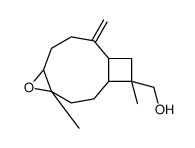
Caryophyllene oxide structure
|
Common Name | Caryophyllene oxide | ||
|---|---|---|---|---|
| CAS Number | 1139-30-6 | Molecular Weight | 220.350 | |
| Density | 1.0±0.1 g/cm3 | Boiling Point | 279.7±19.0 °C at 760 mmHg | |
| Molecular Formula | C15H24O | Melting Point | 62-63ºC(lit.) | |
| MSDS | Chinese USA | Flash Point | 119.7±19.5 °C | |
| Symbol |

GHS07 |
Signal Word | Warning | |
Use of Caryophyllene oxideCaryophyllene oxide, isolated from from Annona squamosa L. bark., possesses analgesic and anti-inflammatory activity[1]. |
This table lists Chinese names, IUPAC names and various aliases of this chemical substance.
| Name | (-)-Caryophyllene oxide |
|---|---|
| Synonym | More Synonyms |
This table contains bioactivity, target information and biological‑assay experimental data of this compound.
| Description | Caryophyllene oxide, isolated from from Annona squamosa L. bark., possesses analgesic and anti-inflammatory activity[1]. |
|---|---|
| Related Catalog | |
| References |
This table shows physicochemical parameters including melting point, boiling point, density, solubility and optical rotation. Missing data is marked as N/A.
| Density | 1.0±0.1 g/cm3 |
|---|---|
| Boiling Point | 279.7±19.0 °C at 760 mmHg |
| Melting Point | 62-63ºC(lit.) |
| Molecular Formula | C15H24O |
| Molecular Weight | 220.350 |
| Flash Point | 119.7±19.5 °C |
| Exact Mass | 220.182709 |
| PSA | 12.53000 |
| LogP | 4.57 |
| Vapour Pressure | 0.0±0.6 mmHg at 25°C |
| Index of Refraction | 1.507 |
| InChIKey | NVEQFIOZRFFVFW-RGCMKSIDSA-N |
| SMILES | C=C1CCC2OC2(C)CCC2C1CC2(C)C |
This table provides MSDS information including hazard classification, first‑aid, fire‑fighting, spill handling, operation and storage instructions.
This table summarizes toxicological test data, acute & chronic toxicity and ecological hazard parameters for this chemical.
CHEMICAL IDENTIFICATION
HEALTH HAZARD DATAACUTE TOXICITY DATA
|
This table covers safety warnings, protective measures, incompatible substances and disposal guidelines for this compound.
| Symbol |
GHS07 |
|---|---|
| Signal Word | Warning |
| Hazard Statements | H315-H319 |
| Precautionary Statements | P305 + P351 + P338 |
| Personal Protective Equipment | dust mask type N95 (US);Eyeshields;Gloves |
| Hazard Codes | Xi |
| Risk Phrases | R36/38 |
| Safety Phrases | 26 |
| RIDADR | NONH for all modes of transport |
| WGK Germany | 2 |
| RTECS | RP5530000 |
| HS Code | 29109000 |
This table presents publicly reported synthetic routes, reaction conditions, reactants and product information of the compound.
|
~%
Caryophyllene oxide CAS#:1139-30-6
Learn More
|
| Literature: Helvetica Chimica Acta, , vol. 77, # 1 p. 36 - 40 |
|
~%
Caryophyllene oxide CAS#:1139-30-6 |
| Literature: Helvetica Chimica Acta, , vol. 66, # 7 p. 2223 - 2235 |
|
~%
Caryophyllene oxide CAS#:1139-30-6 |
| Literature: Chemische Berichte, , vol. 80, p. 56,62 Journal of the Chemical Society, , p. 537,539 |
|
~%
Caryophyllene oxide CAS#:1139-30-6 |
| Literature: Journal of the Chemical Society, , p. 4336,4339 |
|
~53%
Caryophyllene oxide CAS#:1139-30-6
Learn More
|
| Literature: Bulletin de la Societe Chimique de France, , vol. 132, # 8 p. 836 - 842 |
|
~%
Detail
Learn More
|
| Literature: Phytochemistry (Elsevier), , vol. 29, # 1 p. 115 - 120 |


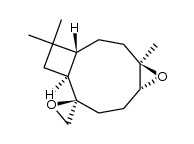
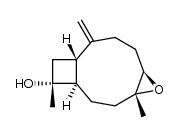
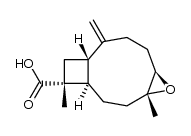
![(1R,4R,6R,9S,10S)-4,12,12-trimethylspiro(5-oxatricyclo[8.2.0.04,6]dodecane-9,2'-oxirane) structure](https://image.chemsrc.com/caspic/312/60479-10-9.png)
This table lists upstream starting materials and downstream derivative products related to this chemical.
| Precursor 3 | |
|---|---|
| DownStream 1 | |
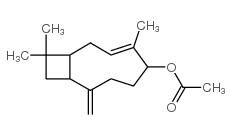 CAS#:32214-91-8
This table lists relevant public references with title, journal and publication metadata for this compound.
|
Antiparasitic compounds from Cupania cinerea with activities against Plasmodium falciparum and Trypanosoma brucei rhodesiense.
J. Nat. Prod. 74 , 559-66, (2011) In a survey of plants from Ecuador with antiprotozoal activity, Cupania cinerea was found to show significant in vitro activity against the Plasmodium falciparum K1 strain and Trypanosoma brucei rhode... |
|
|
Microbial transformation and butyrylcholinesterase inhibitory activity of (-)-caryophyllene oxide and its derivatives.
J. Nat. Prod. 69 , 1429-34, (2006) Microbial transformation of the sesquiterpene (-)-caryophyllene oxide (1) [(1R,4R,5R,9S)-4,5-epoxycaryophyllan-8(13)-ene] by a number of fungi, using a standard two-stage fermentation technique, has a... |
|
|
H.M.R. Hoffmann, U. Vogt
Synlett , 581, (1990)
|
This table contains target information, in‑vitro & in‑vivo assay data for this compound.
This table collects all English aliases, systematic names and CAS‑related synonyms of the compound.
| (1R,4R,6R,10S)-4,12,12-trimethyl-9-methylene-5-oxatricyclo[8.2.0.04,6]dodecane |
| (-)-b-Caryophyllene oxide |
| 6,7-Epoxy-3(15)-caryophyllene |
| (−)-Caryophyllene oxide |
| 4b,5a-Epoxycaryophyllene |
| (-)-b-Caryophyllene epoxide |
| (1R,4R,6R,10S)-4,12,12-Trimethyl-9-methylene-5-oxatricyclo[8.2.0.0]dodecane |
| (-)-Epoxydihydrocaryophyllene |
| (-)-caryophyllene oxide |
| b-Caryophyllene oxide |
| Caryophyllene 4b,5a-oxide |
| β-Caryophyllene oxide |
| EINECS 214-519-7 |
| MFCD00134216 |
| b-Caryophyllene epoxide |
| trans-caryophyllene oxide |
| caryophyllene oxide |
| (−)-Epoxycaryophyllene |
This section contains frequently‑asked‑questions about this compound, including basic parameters, properties, storage conditions and corresponding answers.
| Q: What is the InChIKey of (-)-Caryophyllene oxide? |
| A: InChIKey of (-)-Caryophyllene oxide is NVEQFIOZRFFVFW-RGCMKSIDSA-N. |
| Q: What is the CAS number of (-)-Caryophyllene oxide? |
| A: CAS number of (-)-Caryophyllene oxide is 1139-30-6. |
| Q: What is the English name of (-)-Caryophyllene oxide? |
| A: The English name of (-)-Caryophyllene oxide is (-)-Caryophyllene oxide. |
| Q: What is the melting point of (-)-Caryophyllene oxide? |
| A: Melting point of (-)-Caryophyllene oxide is 62-63ºC(lit.). |
| Q: What is the boiling point of (-)-Caryophyllene oxide? |
| A: Boiling point of (-)-Caryophyllene oxide is 279.7±19.0 °C at 760 mmHg. |
| Q: What is the safety information for (-)-Caryophyllene oxide? |
| A: Safety information for (-)-Caryophyllene oxide: 26. |
| Q: What are the uses of (-)-Caryophyllene oxide? |
| A: Main uses of (-)-Caryophyllene oxide: Caryophyllene oxide, isolated from from Annona squamosa L. bark., possesses analgesic and anti-inflammatory activity[1]. |
| Q: What is the SMILES notation of (-)-Caryophyllene oxide? |
| A: SMILES notation of (-)-Caryophyllene oxide is C=C1CCC2OC2(C)CCC2C1CC2(C)C. |
| Q: What is the LogP of (-)-Caryophyllene oxide? |
| A: LogP of (-)-Caryophyllene oxide is 4.57. |
| Q: What are the downstream products of (-)-Caryophyllene oxide? |
| A: Related downstream products(CAS) of (-)-Caryophyllene oxide: 32214-91-8. |
This table lists manufacturers and suppliers of this compound, including vendor names and product supply reference information.
| Shanghai Nianxing Industrial Co., Ltd |
| BioBioPha |
| Dayang Chem (Hangzhou) Co., Ltd. |
| naturewill |