Docetaxel
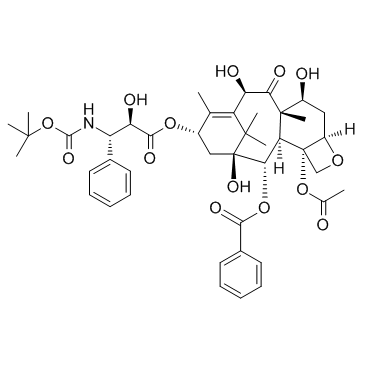
Docetaxel structure
|
Common Name | Docetaxel | ||
|---|---|---|---|---|
| CAS Number | 114977-28-5 | Molecular Weight | 807.879 | |
| Density | 1.4±0.1 g/cm3 | Boiling Point | 900.5±65.0 °C at 760 mmHg | |
| Molecular Formula | C43H53NO14 | Melting Point | 186-192 °C (dec.) | |
| MSDS | USA | Flash Point | 498.4±34.3 °C | |
Use of DocetaxelDocetaxel is an antineoplastic drug by inhibiting microtubule depolymerization, and attenuating of the effects of bcl-2 and bcl-xL gene expression. |
This table lists Chinese names, IUPAC names and various aliases of this chemical substance.
| Name | docetaxel anhydrous |
|---|---|
| Synonym | More Synonyms |
This table contains bioactivity, target information and biological‑assay experimental data of this compound.
| Description | Docetaxel is an antineoplastic drug by inhibiting microtubule depolymerization, and attenuating of the effects of bcl-2 and bcl-xL gene expression. |
|---|---|
| Related Catalog | |
| Target |
Microtubule[1] |
| In Vitro | Docetaxel (DOC) and Glufosfamide (GLU) single and combined treatments affect the cells viability in a dose-dependent manner. The IC50 of GLU are 70±4 µM and 86.8±8 µM in PC-3 and LNCaP cells; respectively. While, the IC50 of Docetaxel alone is found to be 3.08±0.4 nM and 1.46±0.2 nM in PC-3 and LNCaP cells; respectively. The co-treatment of GLU with Docetaxel is found to synergize the cytotoxicity and the IC50 values are decreased to be 2.7±0.1 nM and 0.75±0.3 nM in PC-3 and LNCaP cells; respectively[1]. IC50 of NCI-H460 to Docetaxel at 24 h is 116 nM and at 72 h is 30 nM. According to data reported in DTP Data Search, the mean IC50 of NCI-60 cell panel to Docetaxel is 14-34 nM[2]. |
| In Vivo | In female mice, the Docetaxel-induced intestinal apoptosis in the 14-hours after light on (HALO) group is significantly greater than that in the 2-HALO group. Bax expression is significantly elevated by Docetaxel in the 2-HALO group, but not in the 14-HALO group. On the other hand, cleaved Caspase-3 expression is significantly elevated by Docetaxel in the 14-HALO group, but not in the 2-HALO group. The expressions of Wee1 and phosphorylated CKD1 are significantly elevated after dosing of Docetaxel at 14 HALO, but not at 2 HALO. In addition, Docetaxel significantly reduces survivin expression in the 14-HALO group but not in the 2-HALO group. The survivin expression level in the Docetaxel-treated 14-HALO group is significantly smaller than that in the drug-treated 2-HALO group[3]. Piperine (PIP) is administrated via intravenous bolus at 3.5 mg/kg and via oral administration at 35 mg/kg and 3.5 mg/kg, while Docetaxel (DOX) is intravenously administrated at 7 mg/kg to Sprague-Daley rats. The co-administrations of PIP at 35 mg/kg via oral administration and Docetaxel at 7 mg/kg via intravenous bolus administration in Sprague-Dawley rats. The combination use of PIP and Docetaxel results in a synergic increase of both their in vivo exposure[4]. |
| Cell Assay | Single-drug concentration-response curves are assessed. Seeding is done at a density of 2,000 cells/well for PC-3 and LNCaP, in 96-well plates. Cells are treated with each single drug and their combination for 72 h at different drug concentrations. Docetaxel is used at concentrations of 0.1-1,000 nM. GLU is used at concentrations of 0.1-300 µm. Cytotoxicity is assessed at the end of drug exposure using SRB assay. Following 72 h exposure the cells are fixed with 10% trichloroacetic acid (150 µL) for 1 h at 4°C. Then, cells are stained for 10 min at room temperature with 0.4% SRB dissolved in 1% acetic acid. The plates are then air dried for 24 h and the dye is made soluble with 150 µL Tris (10 mM, PH 7.4) for 5 min on a shaker at 1,600 rpm. Absorbance is then measured at 545 nM using microplate reader. Results are expressed as the relative percentage of absorbance compared to control[1]. |
| Animal Admin | Mice[3] Five-week-old male Balb/c mice are used. Docetaxel (0, 10, 20, 30, 40, 60, and 80 mg/kg per week) is given once a week for 3 weeks for mice. Because more than 30 mg/kg per week of Docetaxel causes body weight loss in mice, 20 mg/kg per week of Docetaxel is judged to be the maximum nontoxic dose. Docetaxel (20 mg/kg per week) is given to mice once a week for 3 weeks at one of the following different points (2, 10, 14, or 22 HALO). Seventy-two hours after the final dosing of the agent, the intestinal mucosa of the small intestine (proximal 8 cm) is removed, fixed in 20 N Mildform solution (containing 8% formaldehyde in a buffered solution), and embedded in paraffin blocks, and sections of 5 μm are put on glass slides. Apoptosis is detected using the terminal deoxynucleotidyl transferase-mediated dUTP nick-end labeling (TUNEL) method, using the Apop Tag Peroxidase In Situ Apoptosis Detection Kit. Rats[4] Male Sprague-Dawley rats with body weight between 230-250 g and age between 6-7 weeks are used. About 25 SD rats are divided into five groups receiving Docetaxel (7 mg/kg, i.v.), PIP (35 mg/kg, p.o.) and their combined administration (DOX+PIP) as well as PIP (3.5 mg/kg, p.o.) and PIP (3.5 mg/kg, i.v.). A day before the drug administrations, the rats are anesthetized with an intramuscular injection of a cocktail containing 60 mg/kg ketamine and 6 mg/kg xylazine (injection volume, 0.2 mL). Right jugular vein is cannulated with a polyethylene tubing (0.5 mm ID, 1 mm) for blood collection. |
| References |
This table shows physicochemical parameters including melting point, boiling point, density, solubility and optical rotation. Missing data is marked as N/A.
| Density | 1.4±0.1 g/cm3 |
|---|---|
| Boiling Point | 900.5±65.0 °C at 760 mmHg |
| Melting Point | 186-192 °C (dec.) |
| Molecular Formula | C43H53NO14 |
| Molecular Weight | 807.879 |
| Flash Point | 498.4±34.3 °C |
| Exact Mass | 807.346619 |
| PSA | 224.45000 |
| LogP | 6.55 |
| Vapour Pressure | 0.0±0.3 mmHg at 25°C |
| Index of Refraction | 1.618 |
| InChIKey | ZDZOTLJHXYCWBA-VCVYQWHSSA-N |
| SMILES | CC(=O)OC12COC1CC(O)C1(C)C(=O)C(O)C3=C(C)C(OC(=O)C(O)C(NC(=O)OC(C)(C)C)c4ccccc4)CC(O)(C(OC(=O)c4ccccc4)C21)C3(C)C |
| Storage condition | 2~8°C |
This table provides MSDS information including hazard classification, first‑aid, fire‑fighting, spill handling, operation and storage instructions.
This table covers safety warnings, protective measures, incompatible substances and disposal guidelines for this compound.
| Personal Protective Equipment | Eyeshields;Gloves;type N95 (US);type P1 (EN143) respirator filter |
|---|---|
| Hazard Codes | Xi:Irritant |
| Risk Phrases | R36/37/38 |
| Safety Phrases | 26-36/37 |
| RIDADR | 1544 |
| RTECS | DA4172750 |
| Packaging Group | III |
| Hazard Class | 6.1(b) |
| HS Code | 2932999099 |
This table shows customs‑related data including HS‑code, tariff and regulatory conditions for import and export.
| HS Code | 2932999099 |
|---|---|
| Summary | 2932999099. other heterocyclic compounds with oxygen hetero-atom(s) only. VAT:17.0%. Tax rebate rate:13.0%. . MFN tariff:6.5%. General tariff:20.0% |
This table lists relevant public references with title, journal and publication metadata for this compound.
|
Androgen receptor (AR) inhibitor ErbB3-binding protein-1 (Ebp1) is not targeted by the newly identified AR controlling signaling axis heat-shock protein HSP27 and microRNA miR-1 in prostate cancer cells.
World J. Urol. 33(3) , 323-7, (2015) Androgen receptor (AR) networks are predominantly involved in prostate cancer (PCa) progression; consequently, factors of AR regulation represent promising targets for PCa therapy. The ErbB3-binding p... |
|
|
Immediate and transient phosphorylation of the heat shock protein 27 initiates chemoresistance in prostate cancer cells.
Oncol. Rep. 32(6) , 2380-6, (2014) Drug resistance minimizes the effects of prostate cancer (PC) chemotherapy with docetaxel and is generally considered to be associated with the expression of heat shock protein (HSP) 27 including vari... |
|
|
Inhibition of PI3Kβ signaling with AZD8186 inhibits growth of PTEN-deficient breast and prostate tumors alone and in combination with docetaxel.
Mol. Cancer Ther. 14(1) , 48-58, (2015) Loss of PTEN protein results in upregulation of the PI3K/AKT pathway, which appears dependent on the PI3Kβ isoform. Inhibitors of PI3Kβ have potential to reduce growth of tumors in which loss of PTEN ... |
This table collects all English aliases, systematic names and CAS‑related synonyms of the compound.
| (5β,7β,10β,13α)-4-Acetoxy-13-({(2R,3S)-3-[(tert-butoxycarbonyl)amino]-2-hydroxy-3-phenylpropanoyl}oxy)-1,7,10-trihydroxy-9-oxo-5,20-epoxytax-11-en-2-yl benzoate |
| D-2-amino-5-phosphonovaleric acid |
| APV |
| AP-5 |
| DL-APV |
| (2α,5β,7β,10β,13α)-4-Acetoxy-13-({(2R,3S)-3-[(tert-butoxycarbonyl)amino]-2-hydroxy-3-phenylpropanoyl}oxy)-1,7,10-trihydroxy-9-oxo-5,20-epoxytax-11-en-2-yl benzoate |
| MFCD00800737 |
| DOCETAXEL TRIHYDRATE |
| Docetaxol |
| 5-PHOSPHONO-DL-NORVALINE |
| Taxotere |
| (2α,5β,7β,10β,13α)-4-Acetoxy-1,7,10-trihydroxy-13-{[(2R,3S)-2-hydroxy-3-({[(2-methyl-2-propanyl)oxy]carbonyl}amino)-3-phenylpropanoyl]oxy}-9-oxo-5,20-epoxytax-11-en-2-yl benzoate |
| DL-2-amino-5-phosphonovaleric acid |
| DOCETAXEL(TAXOTERE) |
| N-Debenzoyl-N-tert-butoxycarbonyl-10-deacetyltaxol |
| Docetaxel |
| N-DEBENZOYL-N-TERT-BUTOXYCARBONYL-10-DEACETYL |
| DOCETAXEL(TAXOTERE) UK 427857 |
| N-debenzoyl-N-Boc-10-deacetyl taxol |
| TAXOTERE, DOCETAXEL |
| (2α,5β,7β,10β,13α)-4-(acetyloxy)-13-({(2R,3S)-3-[(tert-butoxycarbonyl)amino]-2-hydroxy-3-phenylpropanoyl}oxy)-1,7,10-trihydroxy-9-oxo-5,20-epoxytax-11-en-2-yl benzoate |
| 2-amino-5-phosphopentanoicacid |
| N-debenzoyl-N-tert-butoxycarbonyl-10-deacetyl taxol |
| 2-amino-5-phosphonovaleric acid |
| acide amino-6 carboxy-6 hexylphosphonique |
| 2-amino-5-phosphovaleric acid |
This section contains frequently‑asked‑questions about this compound, including basic parameters, properties, storage conditions and corresponding answers.
| Q: What is the safety information for docetaxel anhydrous? |
| A: Safety information for docetaxel anhydrous: 26-36/37. |
| Q: What is the molecular weight of docetaxel anhydrous? |
| A: Molecular weight of docetaxel anhydrous is 807.879. |
| Q: What is the InChIKey of docetaxel anhydrous? |
| A: InChIKey of docetaxel anhydrous is ZDZOTLJHXYCWBA-VCVYQWHSSA-N. |
| Q: What is the melting point of docetaxel anhydrous? |
| A: Melting point of docetaxel anhydrous is 186-192 °C (dec.). |
| Q: What is the CAS number of docetaxel anhydrous? |
| A: CAS number of docetaxel anhydrous is 114977-28-5. |
| Q: What is the polar surface area (PSA) of docetaxel anhydrous? |
| A: Polar surface area (PSA) of docetaxel anhydrous is 224.45000. |
| Q: What is the LogP of docetaxel anhydrous? |
| A: LogP of docetaxel anhydrous is 6.55. |
| Q: What is the molecular formula of docetaxel anhydrous? |
| A: Molecular formula of docetaxel anhydrous is C43H53NO14. |
| Q: What is the SMILES notation of docetaxel anhydrous? |
| A: SMILES notation of docetaxel anhydrous is CC(=O)OC12COC1CC(O)C1(C)C(=O)C(O)C3=C(C)C(OC(=O)C(O)C(NC(=O)OC(C)(C)C)c4ccccc4)CC(O)(C(OC(=O)c4ccccc4)C21)C3(C)C. |
| Q: What are the uses of docetaxel anhydrous? |
| A: Main uses of docetaxel anhydrous: Docetaxel is an antineoplastic drug by inhibiting microtubule depolymerization, and attenuating of the effects of bcl-2 and bcl-xL gene expression. |
This table lists manufacturers and suppliers of this compound, including vendor names and product supply reference information.
| Shanghai Nianxing Industrial Co., Ltd |
| Henan Tianfu Chemical Co., Ltd. |