Triisopropanolamine
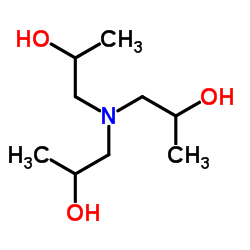
Triisopropanolamine structure
|
Common Name | Triisopropanolamine | ||
|---|---|---|---|---|
| CAS Number | 122-20-3 | Molecular Weight | 191.268 | |
| Density | 1.1±0.1 g/cm3 | Boiling Point | 296.4±0.0 °C at 760 mmHg | |
| Molecular Formula | C9H21NO3 | Melting Point | 48-52 °C(lit.) | |
| MSDS | Chinese USA | Flash Point | 167.0±21.0 °C | |
| Symbol |

GHS07 |
Signal Word | Warning | |
| Name | Triisopropanolamine |
|---|---|
| Synonym | More Synonyms |
| Density | 1.1±0.1 g/cm3 |
|---|---|
| Boiling Point | 296.4±0.0 °C at 760 mmHg |
| Melting Point | 48-52 °C(lit.) |
| Molecular Formula | C9H21NO3 |
| Molecular Weight | 191.268 |
| Flash Point | 167.0±21.0 °C |
| Exact Mass | 191.152145 |
| PSA | 63.93000 |
| LogP | -0.07 |
| Vapour Pressure | 0.0±1.4 mmHg at 25°C |
| Index of Refraction | 1.495 |
| InChIKey | SLINHMUFWFWBMU-UHFFFAOYSA-N |
| SMILES | CC(O)CN(CC(C)O)CC(C)O |
| Freezing Point | 52℃ |
CHEMICAL IDENTIFICATION
HEALTH HAZARD DATAACUTE TOXICITY DATA
|
| Symbol |
GHS07 |
|---|---|
| Signal Word | Warning |
| Hazard Statements | H319-H412 |
| Precautionary Statements | P273-P305 + P351 + P338 |
| Personal Protective Equipment | dust mask type N95 (US);Eyeshields;Gloves |
| Hazard Codes | Xi:Irritant; |
| Risk Phrases | R36;R52/53 |
| Safety Phrases | S26-S61 |
| RIDADR | UN 3259 8/PG 2 |
| WGK Germany | 1 |
| RTECS | UB8750000 |
| Packaging Group | III |
| Hazard Class | 8.0 |
| HS Code | 2922199090 |
|
~%
Triisopropanolamine CAS#:122-20-3 |
| Literature: US2823236 , ; Chim.et Ind.Sonderband 21.Congr.int.Chim.ind.Bruessel 1948 S.492 |
|
~%
Triisopropanolamine CAS#:122-20-3 |
| Literature: Bulletin of the Academy of Sciences of the USSR, Division of Chemical Science (English Translation), , vol. 33, # 12 p. 2447 - 2450 Izvestiya Akademii Nauk SSSR, Seriya Khimicheskaya, , # 12 p. 2673 - 2676 |

| HS Code | 2922199090 |
|---|---|
| Summary | 2922199090. other amino-alcohols, other than those containing more than one kind of oxygen function, their ethers and esters; salts thereof. VAT:17.0%. Tax rebate rate:13.0%. . MFN tariff:6.5%. General tariff:30.0% |
|
Initiation activity of endogenously synthesized N-nitrosobis(2-hydroxypropyl)amine in the rat liver.
Cancer Lett. 45(3) , 221-5, (1989) The initiation potential of N-nitrosobis(2-hydroxypropyl)amine (NDHPA) endogenously synthesized from bis(2-hydroxypropyl)amine (DHPA) or tris(2-hydroxypropyl)amine (THPA) in the presence of sodium nit... |
|
|
Autoclavable highly cross-linked polyurethane networks in ophthalmology.
Biomaterials 14(14) , 1089-97, (1993) Highly cross-linked aliphatic polyurethane networks have been prepared by the bulk step reaction of low molecular weight polyols and hexamethylenediisocyanate (HDI). These polyurethane networks are op... |
|
|
Gas chromatographic determination of N-nitrosodialkanolamines in herbicide Di- or trialkanolamine formulations.
J. Assoc. Off. Anal. Chem. 71(2) , 328-33, (1988) A modified method is presented to determine trace quantities of N-nitrosodiethanolamine (NDElA) and N-nitrosodiisopropanolamine (NDiPlA) in the triisopropanolamine (TiPlA) formulation of a mixture of ... |
| Nitrilotripropanol |
| 1,1',1''-Nitrilotripropan-2-ol |
| 1,1',1''-Nitrilotri(2-propanol) |
| UNII:W9EN9DLM98 |
| Triisopropanolamine |
| 2-Propanol, 1,1',1''-nitrilotris- |
| EINECS 204-528-4 |
| MFCD00004533 |
| 1,1',1''-Nitrilotris-2-propanol |
| 1-[bis(2-hydroxypropyl)amino]propan-2-ol |
| 1,1',1''-Nitrilotri(-2-propanol) |
The content on this webpage is sourced from various professional data sources. If you have any questions or concerns regarding the content, please feel free to contact service1@chemsrc.com.
- Shanghai Nianxing Industrial Co., Ltd
- China
- Product Name: Triisopropanolamine
- Price: Check
- Purity: 95.0%
- Delivery: 10 Day
- Contact: Yang
- Email: sales@echemcloud.com
- Shanghai Jizhi Biochemical Technology Co., Ltd
- China
- Product Name: Triisopropanolamine
- Price: ¥118.0/500g
- Purity: 95.0%
- Delivery: Inquiry
- Contact: Liu jia


- Email: 2130147988@qq.com
- Dayang Chem (Hangzhou) Co., Ltd.
- China
- Product Name: Triisopropanolamine
- Price: $Inquiry/100g $Inquiry/1kg $Inquiry/100kg $Inquiry/1000kg
- Purity: 98.0%
- Delivery: Inquiry
- Contact: Ms Wang
- Email: enquiry@dycnchem.com
- Henan Tianfu Chemical Co., Ltd.
- China
- Product Name: Triisopropanolamine
- Price: $Inquiry/1kg $Inquiry/25kg $Inquiry/1000kg $Inquiry/10ton
- Purity: 99.0%
- Delivery: Inquiry
- Contact: Anson
- Email: info@tianfuchem.com
Get all suppliers and price by the below link: