L-Palmitoylcarnitine chloride
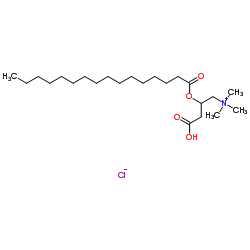
L-Palmitoylcarnitine chloride structure
|
Common Name | L-Palmitoylcarnitine chloride | ||
|---|---|---|---|---|
| CAS Number | 18877-64-0 | Molecular Weight | 436.069 | |
| Density | N/A | Boiling Point | N/A | |
| Molecular Formula | C23H46ClNO4 | Melting Point | 168-172ºC(lit.) | |
| MSDS | Chinese USA | Flash Point | N/A | |
| Symbol |

GHS07 |
Signal Word | Warning | |
Use of L-Palmitoylcarnitine chlorideL-Palmitoylcarnitine chloride, a long-chain acylcarnitine and a fatty acid metabolite, accumulates in the sarcolemma and deranges the membrane lipid environment during ischaemia. L-Palmitoylcarnitine chloride inhibits KATP channel activity, without affecting the single channel conductance, through interaction with Kir6.2[1]. |
| Name | palmitoyl-l-carnitine chloride |
|---|---|
| Synonym | More Synonyms |
| Description | L-Palmitoylcarnitine chloride, a long-chain acylcarnitine and a fatty acid metabolite, accumulates in the sarcolemma and deranges the membrane lipid environment during ischaemia. L-Palmitoylcarnitine chloride inhibits KATP channel activity, without affecting the single channel conductance, through interaction with Kir6.2[1]. |
|---|---|
| Related Catalog | |
| Target |
Kir6.2 Human Endogenous Metabolite |
| In Vitro | L-Palmitoylcarnitine (1 µM) inhibits KATP channel activity, without affecting the single channel conductance, through interaction with Kir6.2. L-Palmitoylcarnitine simultaneously enhances the ATP sensitivity of the channel (IC50 fell from 62 to 30 µM)[1]. Modulation of the membrane lipid environment caused by L-Palmitoylcarnitine alters the KATP channel function mainly through the interaction with endogenous PI cascade, especially PIP2[1]. |
| References |
| Melting Point | 168-172ºC(lit.) |
|---|---|
| Molecular Formula | C23H46ClNO4 |
| Molecular Weight | 436.069 |
| Exact Mass | 435.311523 |
| PSA | 63.60000 |
| LogP | 2.56440 |
| InChIKey | GAMKNLFIHBMGQT-ZMBIFBSDSA-N |
| SMILES | CCCCCCCCCCCCCCCC(=O)OC(CC(=O)O)C[N+](C)(C)C.[Cl-] |
| Storage condition | -20°C |
| Symbol |
GHS07 |
|---|---|
| Signal Word | Warning |
| Hazard Statements | H315-H319-H335 |
| Precautionary Statements | P261-P305 + P351 + P338 |
| Personal Protective Equipment | dust mask type N95 (US);Eyeshields;Gloves |
| Hazard Codes | Xi: Irritant; |
| Risk Phrases | R36/37/38 |
| Safety Phrases | 26-36 |
| RIDADR | NONH for all modes of transport |
|
Modulation by palmitoylcarnitine of protein kinase C activation.
Cancer Res. 47 , 6537-6542, (1987) Palmitoylcarnitine, a reported protein kinase C inhibitor, enhanced the phorbol ester dependency of the enzyme, augmenting protein kinase C activity in the presence of phorbol esters such as phorbol 1... |
|
|
Palmitoyl-DL-carnitine has calcium-dependent effects on cultured neurones from rat dorsal root ganglia.
Br. J. Pharmacol. 107 , 1192-1197, (1992) 1. The effects of palmitoyl-DL-carnitine (0.01 to 1 mM) on whole cell voltage-activated calcium channel currents carried by calcium or barium and Ca(2+)-activated chloride currents were studied in cul... |
|
|
Palmitoyl-L-carnitine modifies the function of vascular endothelium.
Cardiovasc. Res. 28 , 129-134, (1994) Palmitoyl-L-carnitine, which accumulates in ischaemic myocardium, may influence the function of vascular endothelium in the ischaemic area. The aim of the study was therefore to examine the effect of ... |
| MFCD00070346 |
| Palmitoyl-L-carnitine chloride |
| 3-carboxy-n,n,n-trimethyl-2-(palmitoyloxy)propan-1-aminium chloride |
| UNII:EIL57224QR |
| 1-Propanaminium, 3-carboxy-N,N,N-trimethyl-2-[(1-oxohexadecyl)oxy]-, chloride (1:1) |
| EINECS 242-642-6 |
| 3-Carboxy-N,N,N-trimethyl-2-(palmitoyloxy)-1-propanaminium chloride |