BI-9321 trihydrochloride
Modify Date: 2025-08-25 11:02:55
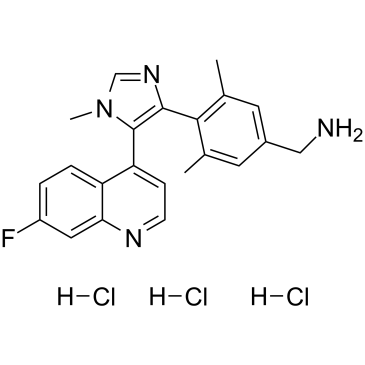
BI-9321 trihydrochloride structure
|
Common Name | BI-9321 trihydrochloride | ||
|---|---|---|---|---|
| CAS Number | 2387510-87-2 | Molecular Weight | 469.81 | |
| Density | N/A | Boiling Point | N/A | |
| Molecular Formula | C22H24Cl3FN4 | Melting Point | N/A | |
| MSDS | N/A | Flash Point | N/A | |
Use of BI-9321 trihydrochlorideBI-9321 trihydrochloride is a potent, selective and cellular active nuclear receptor-binding SET domain 3 (NSD3)-PWWP1 domain antagonist with a Kd value of 166 nM. BI-9321 trihydrochloride is inactive against NSD2-PWWP1 and NSD3-PWWP2. BI-9321 trihydrochloride specifically disrupts histone interactions of the NSD3-PWWP1 domain with an IC50 of 1.2 μM in U2OS cells[1]. |
| Name | BI-9321 trihydrochloride |
|---|
| Description | BI-9321 trihydrochloride is a potent, selective and cellular active nuclear receptor-binding SET domain 3 (NSD3)-PWWP1 domain antagonist with a Kd value of 166 nM. BI-9321 trihydrochloride is inactive against NSD2-PWWP1 and NSD3-PWWP2. BI-9321 trihydrochloride specifically disrupts histone interactions of the NSD3-PWWP1 domain with an IC50 of 1.2 μM in U2OS cells[1]. |
|---|---|
| Related Catalog | |
| Target |
Kd: 166 nM (NSD3-PWWP1)[1] |
| In Vitro | BI-9321 trihydrochloride is targeting the methyl-lysine binding site of the PWWP1 domain with sub-micromolar in vitro activity and cellular target engagement at 1 µM. As a single agent, BI-9321 trihydrochloride downregulates Myc messenger RNA expression and reduces proliferation in MOLM-13 cells[1]. |
| References |
| Molecular Formula | C22H24Cl3FN4 |
|---|---|
| Molecular Weight | 469.81 |
| InChIKey | DCDXMBVQCRHZMW-UHFFFAOYSA-N |
| SMILES | Cc1cc(CN)cc(C)c1-c1ncn(C)c1-c1ccnc2cc(F)ccc12.Cl.Cl.Cl |