9-cis-Retinal

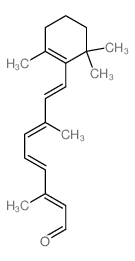
9-cis-Retinal structure
|
Common Name | 9-cis-Retinal | ||
|---|---|---|---|---|
| CAS Number | 514-85-2 | Molecular Weight | 284.436 | |
| Density | 0.9±0.1 g/cm3 | Boiling Point | 421.4±14.0 °C at 760 mmHg | |
| Molecular Formula | C20H28O | Melting Point | 56-58ºC(lit.) | |
| MSDS | USA | Flash Point | 205.4±12.4 °C | |
| Symbol |

GHS07 |
Signal Word | Warning | |
Use of 9-cis-Retinal9-cis-Retinal is a natural retinoid. Dietary 9-cis-β-carotene generates 9-cis-retinoids via cleavage into 9-cis-retinal. 9-cis Retinal binds to cellular retinol-binding protein-I (CRBP-I) and CRBP-II with Kds of 8 nM and 5 nM, respectively. 9-cis-Retinal expedites differentiation and maturation of rod photoreceptors in retinal organoids[1][2][3]. |
This table lists Chinese names, IUPAC names and various aliases of this chemical substance.
| Name | 9-cis-retinal |
|---|---|
| Synonym | More Synonyms |
This table contains bioactivity, target information and biological‑assay experimental data of this compound.
| Description | 9-cis-Retinal is a natural retinoid. Dietary 9-cis-β-carotene generates 9-cis-retinoids via cleavage into 9-cis-retinal. 9-cis Retinal binds to cellular retinol-binding protein-I (CRBP-I) and CRBP-II with Kds of 8 nM and 5 nM, respectively. 9-cis-Retinal expedites differentiation and maturation of rod photoreceptors in retinal organoids[1][2][3]. |
|---|---|
| Related Catalog | |
| Target |
Human Endogenous Metabolite |
| In Vitro | The addition of 9-cis-Retinal, instead of the widely used all-trans retinoic acid, accelerates rod photoreceptor differentiation in organoid cultures, with higher rhodopsin expression and more mature mitochondrial morphology evident by day. 9-cis-Retinal can bind opsin to form functioning rhodopsin[3]. |
| In Vivo | Treatment with 9-cis-retinal produced a significant recovery of the cone response in interphotoreceptor retinoid-binding protein (IRBP)-/- mice and shows that retinoid deficiency underlies cone dysfunction[4]. |
| References |
This table shows physicochemical parameters including melting point, boiling point, density, solubility and optical rotation. Missing data is marked as N/A.
| Density | 0.9±0.1 g/cm3 |
|---|---|
| Boiling Point | 421.4±14.0 °C at 760 mmHg |
| Melting Point | 56-58ºC(lit.) |
| Molecular Formula | C20H28O |
| Molecular Weight | 284.436 |
| Flash Point | 205.4±12.4 °C |
| Exact Mass | 284.214020 |
| PSA | 17.07000 |
| LogP | 6.54 |
| Vapour Pressure | 0.0±1.0 mmHg at 25°C |
| Index of Refraction | 1.541 |
| InChIKey | NCYCYZXNIZJOKI-MKOSUFFBSA-N |
| SMILES | CC(C=CC=C(C)C=CC1=C(C)CCCC1(C)C)=CC=O |
| Storage condition | -20°C |
This table provides MSDS information including hazard classification, first‑aid, fire‑fighting, spill handling, operation and storage instructions.
This table summarizes toxicological test data, acute & chronic toxicity and ecological hazard parameters for this chemical.
CHEMICAL IDENTIFICATION
HEALTH HAZARD DATAACUTE TOXICITY DATA
|
This table covers safety warnings, protective measures, incompatible substances and disposal guidelines for this compound.
| Symbol |
GHS07 |
|---|---|
| Signal Word | Warning |
| Hazard Statements | H302-H312-H315-H332 |
| Precautionary Statements | P280 |
| Personal Protective Equipment | dust mask type N95 (US);Eyeshields;Gloves |
| Hazard Codes | Xn |
| Risk Phrases | 20/21/22-38 |
| RIDADR | NONH for all modes of transport |
| WGK Germany | 3 |
| RTECS | VH6406500 |
| HS Code | 2912299000 |
This table presents publicly reported synthetic routes, reaction conditions, reactants and product information of the compound.
This table lists upstream starting materials and downstream derivative products related to this chemical.
| Precursor 9 | |
|---|---|
| DownStream 4 | |
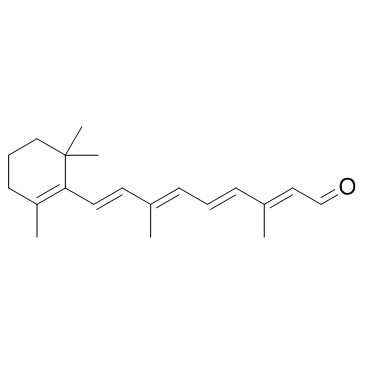 CAS#:116-31-4
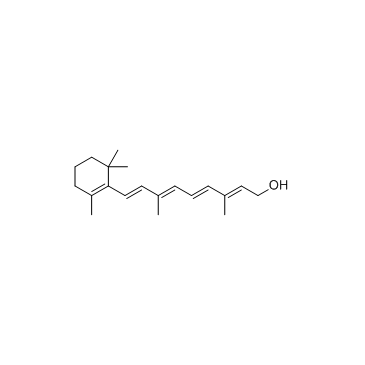 CAS#:68-26-8
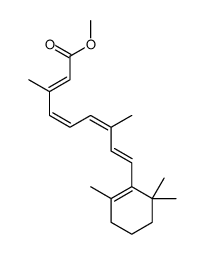 CAS#:58526-50-4
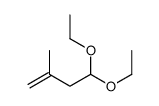 CAS#:54340-95-3
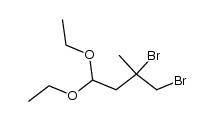 CAS#:145572-38-9
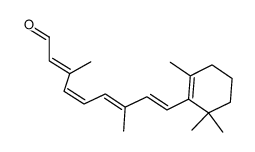 CAS#:564-87-4
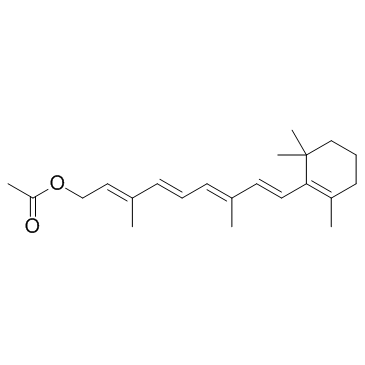 CAS#:127-47-9
 CAS#:25529-00-4
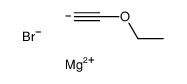 CAS#:36678-63-4
 CAS#:472-86-6
This table shows customs‑related data including HS‑code, tariff and regulatory conditions for import and export.
| HS Code | 2912299000 |
|---|---|
| Summary | 2912299000. other cyclic aldehydes without other oxygen function. VAT:17.0%. Tax rebate rate:13.0%. . MFN tariff:5.5%. General tariff:30.0% |
This table lists relevant public references with title, journal and publication metadata for this compound.
|
A High-Throughput Drug Screening Strategy for Detecting Rhodopsin P23H Mutant Rescue and Degradation.
Invest. Ophthalmol. Vis. Sci. 56 , 2553-67, (2015) Inherent instability of the P23H mutant opsin accounts for approximately 10% of autosomal dominant retinitis pigmentosa cases. Our purpose was to develop an overall set of reliable screening strategie... |
|
|
Cubozoan genome illuminates functional diversification of opsins and photoreceptor evolution.
Sci. Rep. 5 , 11885, (2015) Animals sense light primarily by an opsin-based photopigment present in a photoreceptor cell. Cnidaria are arguably the most basal phylum containing a well-developed visual system. The evolutionary hi... |
|
|
Constitutive phospholipid scramblase activity of a G protein-coupled receptor.
Nat. Commun. 5 , 5115, (2014) Opsin, the rhodopsin apoprotein, was recently shown to be an ATP-independent flippase (or scramblase) that equilibrates phospholipids across photoreceptor disc membranes in mammalian retina, a process... |
This table contains target information, in‑vitro & in‑vivo assay data for this compound.
|
Name: Agonist activity at bovine rhodopsin assessed as opsin mediated cognate G protein tra...
Source: ChEMBL
Target: Rhodopsin
External Id: CHEMBL1769973
|
|
Name: Ratio of Kcat to Km for human AKR1B10 K125L/V301L mutant
Source: ChEMBL
Target: Aldo-keto reductase family 1 member B10
External Id: CHEMBL921558
|
|
Name: Ratio of Kcat to Km for human AKR1B10 K125L mutant
Source: ChEMBL
Target: Aldo-keto reductase family 1 member B10
External Id: CHEMBL921554
|
|
Name: Ratio of Kcat to Km for human AKR1B10 V301L mutant
Source: ChEMBL
Target: Aldo-keto reductase family 1 member B10
External Id: CHEMBL921556
|
|
Name: Ratio of Kcat to Km for human AKR1B1
Source: ChEMBL
Target: Aldo-keto reductase family 1 member B1
External Id: CHEMBL921550
|
|
Name: Upregulation of HA-tagged rhodopsin P23H expression in HEK293 cell surface by ELISA
Source: ChEMBL
Target: HEK293
External Id: CHEMBL1251197
|
|
Name: Cytotoxicity against HEK293 cells by WST-1 assay
Source: ChEMBL
Target: HEK293
External Id: CHEMBL1251196
|
|
Name: Ratio of Kcat to Km for human wild type AKR1B10
Source: ChEMBL
Target: Aldo-keto reductase family 1 member B10
External Id: CHEMBL921552
|
|
Name: Induction of subcellular localization of HA-tagged human rhodopsin P23H mutant on HEK...
Source: ChEMBL
Target: Rhodopsin
External Id: CHEMBL1251195
|
This table collects all English aliases, systematic names and CAS‑related synonyms of the compound.
| (2E,4E,6Z,8E)-3,7-dimethyl-9-(2,6,6-trimethylcyclohexen-1-yl)nona-2,4,6,8-tetraenal |
| all-trans-Retinene |
| 9-cis-Vitamin A aldehyde |
| Retinal,9-cis |
| Isoretinene A |
| all-trans-retinal |
| all-trans-Vitamin A aldehyde |
| 9-cis-Retinal |
| 9-C-Retinal |
| all-trans-retinaldehyde |
| EINECS 208-188-8 |
| (9cis)-Retinal |
| 9-cis-7,11,13-trans retinal |
| 11-cis-retinal |
This section contains frequently‑asked‑questions about this compound, including basic parameters, properties, storage conditions and corresponding answers.
| Q: What are the uses of 9-cis-retinal? |
| A: Main uses of 9-cis-retinal: 9-cis-Retinal is a natural retinoid. Dietary 9-cis-β-carotene generates 9-cis-retinoids via cleavage into 9-cis-retinal. 9-cis Retinal binds to cellular retinol-binding protein-I (CRBP-I) and CRBP-II with Kds of 8 nM and 5 nM, respectively. 9-cis-Retinal expedites differentiation and maturation of rod photoreceptors in retinal organoids[1][2][3]. |
| Q: What are the downstream products of 9-cis-retinal? |
| A: Related downstream products(CAS) of 9-cis-retinal: 472-86-6;116-31-4;564-87-4;68-26-8. |
| Q: What is the molecular weight of 9-cis-retinal? |
| A: Molecular weight of 9-cis-retinal is 284.436. |
| Q: What are the storage conditions for 9-cis-retinal? |
| A: Storage conditions for 9-cis-retinal: -20°C. |
| Q: What is the molecular formula of 9-cis-retinal? |
| A: Molecular formula of 9-cis-retinal is C20H28O. |
| Q: What is the LogP of 9-cis-retinal? |
| A: LogP of 9-cis-retinal is 6.54. |
| Q: What is the boiling point of 9-cis-retinal? |
| A: Boiling point of 9-cis-retinal is 421.4±14.0 °C at 760 mmHg. |
| Q: What is the English name of 9-cis-retinal? |
| A: The English name of 9-cis-retinal is 9-cis-retinal. |
| Q: What is the InChIKey of 9-cis-retinal? |
| A: InChIKey of 9-cis-retinal is NCYCYZXNIZJOKI-MKOSUFFBSA-N. |
| Q: What are the upstream materials of 9-cis-retinal? |
| A: Related upstream materials(CAS) of 9-cis-retinal: 116-31-4;68-26-8;58526-50-4;54340-95-3;145572-38-9;564-87-4;127-47-9;25529-00-4;36678-63-4. |
This table lists manufacturers and suppliers of this compound, including vendor names and product supply reference information.
| Shanghai Nianxing Industrial Co., Ltd |
| Dayang Chem (Hangzhou) Co., Ltd. |