Dequalinium Chloride
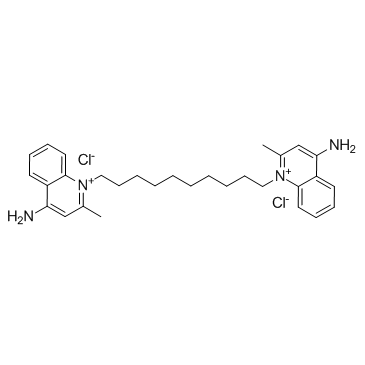
Dequalinium Chloride structure
|
Common Name | Dequalinium Chloride | ||
|---|---|---|---|---|
| CAS Number | 522-51-0 | Molecular Weight | 527.571 | |
| Density | N/A | Boiling Point | N/A | |
| Molecular Formula | C30H40Cl2N4 | Melting Point | ≥300 °C(lit.) | |
| MSDS | Chinese USA | Flash Point | N/A | |
Use of Dequalinium ChlorideDequalinium Chloride is a selective blocker of apamin-sensitive K+ channels.Target: Potassium ChannelDequalinium Chloride is a selective blocker of apamin-sensitive K+ channels. Treatment with Dequalinium chloride did not influence conditions caused by haemolytic streptococci -- verified by bacteriological examinations of pharyngeal smears -- inspite of its efficiency in vitro [1]. Dequalinium chloride (DECA), a cationic, lipophilic mitochondrial poison, selectively targets the mitochondrial membrane of certain epithelial carcinoma cells, in which it inhibits cellular energy production. Higher DECA doses under either regimen induced severe toxic effects and mortality [2]. |
This table lists Chinese names, IUPAC names and various aliases of this chemical substance.
| Name | dequalinium chloride |
|---|---|
| Synonym | More Synonyms |
This table contains bioactivity, target information and biological‑assay experimental data of this compound.
| Description | Dequalinium Chloride is a selective blocker of apamin-sensitive K+ channels.Target: Potassium ChannelDequalinium Chloride is a selective blocker of apamin-sensitive K+ channels. Treatment with Dequalinium chloride did not influence conditions caused by haemolytic streptococci -- verified by bacteriological examinations of pharyngeal smears -- inspite of its efficiency in vitro [1]. Dequalinium chloride (DECA), a cationic, lipophilic mitochondrial poison, selectively targets the mitochondrial membrane of certain epithelial carcinoma cells, in which it inhibits cellular energy production. Higher DECA doses under either regimen induced severe toxic effects and mortality [2]. |
|---|---|
| Related Catalog | |
| References |
This table shows physicochemical parameters including melting point, boiling point, density, solubility and optical rotation. Missing data is marked as N/A.
| Melting Point | ≥300 °C(lit.) |
|---|---|
| Molecular Formula | C30H40Cl2N4 |
| Molecular Weight | 527.571 |
| Exact Mass | 526.263000 |
| PSA | 59.80000 |
| LogP | 1.34060 |
| InChIKey | LTNZEXKYNRNOGT-UHFFFAOYSA-N |
| SMILES | Cc1cc(N)c2ccccc2[n+]1CCCCCCCCCC[n+]1c(C)cc(N)c2ccccc21.[Cl-].[Cl-] |
| Storage condition | 2-8°C |
This table provides MSDS information including hazard classification, first‑aid, fire‑fighting, spill handling, operation and storage instructions.
This table summarizes toxicological test data, acute & chronic toxicity and ecological hazard parameters for this chemical.
CHEMICAL IDENTIFICATION
HEALTH HAZARD DATAACUTE TOXICITY DATA
|
This table covers safety warnings, protective measures, incompatible substances and disposal guidelines for this compound.
| Hazard Codes | Xi:Irritant; |
|---|---|
| Risk Phrases | R36/37/38 |
| Safety Phrases | S26-S36 |
| RIDADR | NONH for all modes of transport |
| WGK Germany | 3 |
| RTECS | VA0700000 |
| HS Code | 2933499090 |
This table shows customs‑related data including HS‑code, tariff and regulatory conditions for import and export.
| HS Code | 2933499090 |
|---|---|
| Summary | 2933499090. other compounds containing in the structure a quinoline or isoquinoline ring-system (whether or not hydrogenated), not further fused. VAT:17.0%. Tax rebate rate:13.0%. . MFN tariff:6.5%. General tariff:20.0% |
This table lists relevant public references with title, journal and publication metadata for this compound.
|
Antimicrobial topical agents used in the vagina.
Curr. Probl. Dermatol. 40 , 36-47, (2011) Vaginally applied antimicrobial agents are widely used in the vagina in women with lower genital tract infections. An 'antimicrobial' is a general term that refers to a group of drugs that are effecti... |
|
|
Dequalinium induces cytotoxicity in human leukemia NB4 cells by downregulation of Raf/MEK/ERK and PI3K/Akt signaling pathways and potentiation of specific inhibitors of these pathways.
Leuk. Res. 38(7) , 795-803, (2014) Delocalized lipophilic cation dequalinium (DQA) selectively accumulates in mitochondria and displays anticancer activity in different malignancies. Our previous studies indicate a DQA-induced cytotoxi... |
|
|
N-palmitoyl-ethanolamine (PEA) induces peripheral antinociceptive effect by ATP-sensitive K+-channel activation.
J. Pharmacol. Sci. 118(2) , 156-60, (2012) Although the antinociceptive effects of N-palmitoyl-ethanolamine (PEA) were first characterized nearly 50 years ago, the identity of the mechanism that mediates these actions has not been elucidated. ... |
This table contains target information, in‑vitro & in‑vivo assay data for this compound.
This table collects all English aliases, systematic names and CAS‑related synonyms of the compound.
| Quinolinium, 1,1'-(1,10-decanediyl)bis[4-amino-2-methyl-, dichloride |
| DECA |
| efisol |
| dekamin |
| evazol |
| le chlorure de dequalinium |
| dekadin |
| EINECS 208-330-9 |
| 1,1'-Decan-1,10-diylbis(4-amino-2-methylchinolinium)dichlorid |
| BADQ-10 |
| 1,1'-(1,10-Decanediyl)bis(4-amino-2-methylquinolinium) dichloride |
| dequadin |
| eriosept |
| 1,1'-Decane-1,10-diylbis(4-amino-2-methylquinolinium) dichloride |
| Dequalinium Chloride |
| dequavet |
| baqd10 |
| Dequadin chloride |
| Quinolinium, 1,1'-(1,10-decanediyl)bis[4-amino-2-methyl-, chloride (1:2) |
| MFCD00063502 |
| Dequalinium (Chloride) |
This section contains frequently‑asked‑questions about this compound, including basic parameters, properties, storage conditions and corresponding answers.
| Q: What are the storage conditions for dequalinium chloride? |
| A: Storage conditions for dequalinium chloride: 2-8°C. |
| Q: What is the SMILES notation of dequalinium chloride? |
| A: SMILES notation of dequalinium chloride is Cc1cc(N)c2ccccc2[n+]1CCCCCCCCCC[n+]1c(C)cc(N)c2ccccc21.[Cl-].[Cl-]. |
| Q: What is the polar surface area (PSA) of dequalinium chloride? |
| A: Polar surface area (PSA) of dequalinium chloride is 59.80000. |
| Q: What is the molecular formula of dequalinium chloride? |
| A: Molecular formula of dequalinium chloride is C30H40Cl2N4. |
| Q: What is the CAS number of dequalinium chloride? |
| A: CAS number of dequalinium chloride is 522-51-0. |
| Q: What is the InChIKey of dequalinium chloride? |
| A: InChIKey of dequalinium chloride is LTNZEXKYNRNOGT-UHFFFAOYSA-N. |
| Q: What is the melting point of dequalinium chloride? |
| A: Melting point of dequalinium chloride is ≥300 °C(lit.). |
| Q: What is the LogP of dequalinium chloride? |
| A: LogP of dequalinium chloride is 1.34060. |
| Q: What is the English name of dequalinium chloride? |
| A: The English name of dequalinium chloride is dequalinium chloride. |
| Q: What is the safety information for dequalinium chloride? |
| A: Safety information for dequalinium chloride: S26-S36. |
This table lists manufacturers and suppliers of this compound, including vendor names and product supply reference information.
| Shanghai Nianxing Industrial Co., Ltd |
| Dayang Chem (Hangzhou) Co., Ltd. |
| Henan Tianfu Chemical Co., Ltd. |