Hydroxyzine
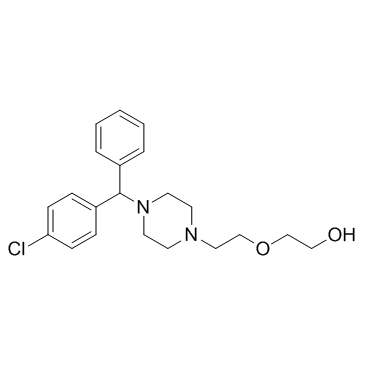
Hydroxyzine structure
|
Common Name | Hydroxyzine | ||
|---|---|---|---|---|
| CAS Number | 68-88-2 | Molecular Weight | 374.90400 | |
| Density | N/A | Boiling Point | 220 (0.5 torr) | |
| Molecular Formula | C21H27ClN2O2 | Melting Point | 190°C | |
| MSDS | N/A | Flash Point | N/A | |
Use of HydroxyzineHydroxyzine is a histamine H1-receptor antagonist.Target: Histamine H1-ReceptorHydroxyzine inhibits carbachol (10 μM)-induced serotonin release by 34% at 10 μM, by 25% 1 μM and by 17% 0.1 μM in pretreated bladder slices for 60 min [1]. Hydroxyzine (0.1 mM) treatment inhibits the progression and severity of EAE by 50% and the extent of mast cell degranulation by 70% in Lewis rats with allergic encephalomyelitis (EAE) [2]. Hydroxyzine (500 ?M) significantly increases transport of etoposide to the serosal site in the jejunal everted sacs. Hydroxyzine significantly reduces the efflux and approximately 2.4 ?g/mL of etoposide in the jejunum and ileum. Hydroxyzine (0.2 μg/mL) significantly enhances the efflux of RH123 to the lumen [3].Hydroxyzine (500 μM) significantly decreases the steady-state etoposide concentration 2-fold, where the steady-state concentration reached about 0.055 μM/mL in Sprague-Dawley rats [3]. Hydroxyzine (12.5 mg/kg, 25 mg/kg and 50 mg/kg i.p.) shows little direct analgesic activity but markedly potentiates only the effect of morphine on the vocalization after-discharge which represents the affective component of pain in rats. Hydroxyzine (50 mg/kg i.p.) potentiates morphine on the tail-flick test, while Hydroxyzine (12.5 mg/kg i.p.) decreases morphine antinociception in rats [4]. |
This table lists Chinese names, IUPAC names and various aliases of this chemical substance.
| Name | hydroxyzine |
|---|---|
| Synonym | More Synonyms |
This table contains bioactivity, target information and biological‑assay experimental data of this compound.
| Description | Hydroxyzine is a histamine H1-receptor antagonist.Target: Histamine H1-ReceptorHydroxyzine inhibits carbachol (10 μM)-induced serotonin release by 34% at 10 μM, by 25% 1 μM and by 17% 0.1 μM in pretreated bladder slices for 60 min [1]. Hydroxyzine (0.1 mM) treatment inhibits the progression and severity of EAE by 50% and the extent of mast cell degranulation by 70% in Lewis rats with allergic encephalomyelitis (EAE) [2]. Hydroxyzine (500 ?M) significantly increases transport of etoposide to the serosal site in the jejunal everted sacs. Hydroxyzine significantly reduces the efflux and approximately 2.4 ?g/mL of etoposide in the jejunum and ileum. Hydroxyzine (0.2 μg/mL) significantly enhances the efflux of RH123 to the lumen [3].Hydroxyzine (500 μM) significantly decreases the steady-state etoposide concentration 2-fold, where the steady-state concentration reached about 0.055 μM/mL in Sprague-Dawley rats [3]. Hydroxyzine (12.5 mg/kg, 25 mg/kg and 50 mg/kg i.p.) shows little direct analgesic activity but markedly potentiates only the effect of morphine on the vocalization after-discharge which represents the affective component of pain in rats. Hydroxyzine (50 mg/kg i.p.) potentiates morphine on the tail-flick test, while Hydroxyzine (12.5 mg/kg i.p.) decreases morphine antinociception in rats [4]. |
|---|---|
| Related Catalog | |
| References |
This table shows physicochemical parameters including melting point, boiling point, density, solubility and optical rotation. Missing data is marked as N/A.
| Boiling Point | 220 (0.5 torr) |
|---|---|
| Melting Point | 190°C |
| Molecular Formula | C21H27ClN2O2 |
| Molecular Weight | 374.90400 |
| Exact Mass | 374.17600 |
| PSA | 35.94000 |
| LogP | 2.93170 |
| InChIKey | ZQDWXGKKHFNSQK-UHFFFAOYSA-N |
| SMILES | OCCOCCN1CCN(C(c2ccccc2)c2ccc(Cl)cc2)CC1 |
| Storage condition | 2-8℃ |
| Water Solubility | < 700 MG/ML |
This table summarizes toxicological test data, acute & chronic toxicity and ecological hazard parameters for this chemical.
CHEMICAL IDENTIFICATION
HEALTH HAZARD DATAACUTE TOXICITY DATA
|
This table covers safety warnings, protective measures, incompatible substances and disposal guidelines for this compound.
This table presents publicly reported synthetic routes, reaction conditions, reactants and product information of the compound.
|
~%
Hydroxyzine CAS#:68-88-2 |
| Literature: Industrie Chimique Belge, , vol. 19, p. 1176,1181 |

This table lists upstream starting materials and downstream derivative products related to this chemical.
| Precursor 1 | |
|---|---|
| DownStream 0 | |
This table shows customs‑related data including HS‑code, tariff and regulatory conditions for import and export.
| HS Code | 2933599090 |
|---|---|
| Summary | 2933599090. other compounds containing a pyrimidine ring (whether or not hydrogenated) or piperazine ring in the structure. VAT:17.0%. Tax rebate rate:13.0%. . MFN tariff:6.5%. General tariff:20.0% |
This table contains target information, in‑vitro & in‑vivo assay data for this compound.
This table collects all English aliases, systematic names and CAS‑related synonyms of the compound.
| Hydroxyzine |
| EINECS 200-693-1 |
| 2-[2-[4-[(4-chlorophenyl)-phenylmethyl]piperazin-1-yl]ethoxy]ethanol |
This section contains frequently‑asked‑questions about this compound, including basic parameters, properties, storage conditions and corresponding answers.
| Q: What are the upstream materials of hydroxyzine? |
| A: Related upstream materials(CAS) of hydroxyzine: 75-21-8. |
| Q: What English synonyms does hydroxyzine have? |
| A: English synonyms of hydroxyzine: Hydroxyzine, EINECS 200-693-1, 2-[2-[4-[(4-chlorophenyl)-phenylmethyl]piperazin-1-yl]ethoxy]ethanol. |
| Q: What is the CAS number of hydroxyzine? |
| A: CAS number of hydroxyzine is 68-88-2. |
| Q: What is the molecular formula of hydroxyzine? |
| A: Molecular formula of hydroxyzine is C21H27ClN2O2. |
| Q: What are the storage conditions for hydroxyzine? |
| A: Storage conditions for hydroxyzine: 2-8℃. |
| Q: What is the polar surface area (PSA) of hydroxyzine? |
| A: Polar surface area (PSA) of hydroxyzine is 35.94000. |
| Q: What is the safety information for hydroxyzine? |
| A: Safety information for hydroxyzine: S3:Keep in a cool place . S16:Keep away from sources of ignition - No smoking . S23:Do not breathe gas/fumes/vapor/spray (appropriate wording to be specified by the manufacturer) . S26:In case of contact with eyes, rinse immediately with plenty of water an. |
| Q: What is the molecular weight of hydroxyzine? |
| A: Molecular weight of hydroxyzine is 374.90400. |
| Q: What is the LogP of hydroxyzine? |
| A: LogP of hydroxyzine is 2.93170. |
| Q: What is the SMILES notation of hydroxyzine? |
| A: SMILES notation of hydroxyzine is OCCOCCN1CCN(C(c2ccccc2)c2ccc(Cl)cc2)CC1. |
This table lists manufacturers and suppliers of this compound, including vendor names and product supply reference information.
| Shanghai Nianxing Industrial Co., Ltd |
| Dayang Chem (Hangzhou) Co., Ltd. |
| Henan Tianfu Chemical Co., Ltd. |