Conglobatin
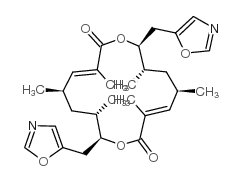
Conglobatin structure
|
Common Name | Conglobatin | ||
|---|---|---|---|---|
| CAS Number | 72263-05-9 | Molecular Weight | 498.61100 | |
| Density | 1.06 g/cm3 | Boiling Point | 673.4ºC at 760 mmHg | |
| Molecular Formula | C28H38N2O6 | Melting Point | N/A | |
| MSDS | N/A | Flash Point | 361.1ºC | |
Use of ConglobatinConglobatin (FW-04-806), a macrolide dilactone, is isolated from the culture of Streptomyces conglobatus. Conglobatin is an orally active Hsp90 inhibitor. Conglobatin can bind to the N-terminal domain of Hsp90 and disrupt Hsp90-Cdc37 complex formation. Conglobatin induces apoptosis in human breast cancer cells and esophageal squamous cell carcinoma cells, and exhibits antitumor activity in vivo[1][2][3]. |
Summary: Conglobatin (Chinese name: Conglobatin) is a white to grayish-white solid with CAS number 72263-05-9, molecular formula C28H38N2O6, and molecular weight 498.61100. For research-use only, not for medical or clinical usage.
This table lists Chinese names, IUPAC names and various aliases of this chemical substance.
| Name | conglobatin |
|---|---|
| Synonym | More Synonyms |
This table contains bioactivity, target information and biological‑assay experimental data of this compound.
| Description | Conglobatin (FW-04-806), a macrolide dilactone, is isolated from the culture of Streptomyces conglobatus. Conglobatin is an orally active Hsp90 inhibitor. Conglobatin can bind to the N-terminal domain of Hsp90 and disrupt Hsp90-Cdc37 complex formation. Conglobatin induces apoptosis in human breast cancer cells and esophageal squamous cell carcinoma cells, and exhibits antitumor activity in vivo[1][2][3]. |
|---|---|
| Related Catalog | |
| Target |
HSP90 |
| In Vitro | Conglobatin (6.25-100 μM; 48 h) markedly inhibits the proliferation of SKBR3 and MCF-7 cells, with IC50s of 12.11 and 39.44 μM, respectively[2]. Conglobatin inhibits cell proliferation in EC109, KYSE70, KYSE450, KYSE150, KYSE180, and KYSE510 cells, with IC50s of 16.43, 15.89, 10.94, 10.50, 10.28, and 9.31 μM, respectively[3]. Conglobatin (10-40 μM; 24 h) displays obvious arrest of SKBR3 and MCF-7 cells in the G2/M phase. Conglobatin induces apoptosis through caspase-dependent pathways in SKBR3 and MCF-7 cells[2]. Conglobatin (10-40 μM; 3-24 h) reduces Hsp90 client protein levels and induces proteasome-dependent degradation[2]. Conglobatin binds to the N-terminal of Hsp90, does not affect ATP-binding capability of Hsp90, but inhibits Hsp90/Cdc37 chaperone/co-chaperone interactions[2]. Cell Proliferation Assay[2] Cell Line: SKBR3 and MCF-7 cells Concentration: 6.25, 12.5, 25, 50, 100 μM Incubation Time: 48 hours Result: Inhibited the proliferation of SKBR3 and MCF-7 cells in a dose-dependent manner. Cell Cycle Analysis[2] Cell Line: SKBR3 and MCF-7 cells Concentration: 10, 20, 40 μM Incubation Time: 24 hours Result: Increased the G2/M cell population and decreased the population in the S and G0/G1 phases. Western Blot Analysis[2] Cell Line: SKBR3 and MCF-7 cells Concentration: 10, 20, 40 μM Incubation Time: 3, 6, 12, 24 hours Result: Decreased the levels of the client proteins HER2, p-HER2, Raf-1, Akt, and p-Akt in a dose and time-dependent manner in SKBR3 cells. Reduced the the levels of the client proteins Raf-1, Akt, and p-Akt in a dose and time-dependent manner in MCF-7 cells. |
| In Vivo | Conglobatin (50-200 mg/kg; i.g. q3d for 24 d) inhibits the tumor growth of SKBR3 and MCF-7 human breast cancer xenograft models in a dose-dependent manner[2]. Conglobatin (4-8 mg/kg; i.p. daily for 21 days) inhibits tumor growth in EC109 and KYSE510 tumor xenograft models with low toxicity[3] Animal Model: BALB/c (nu/nu) athymic mice with SKBR3 and MCF-7 tumor xenograft[2] Dosage: 50, 100, 200 mg/kg Administration: Oral gavage every 3 days for 24 days Result: Showed inhibition of tumor growth at a rate of 39.1%, 52.7%, and 67.5% in the SKBR3 cell line groups and 27.3%, 39.8%, 54.3% in the MCF-7 cell line groups at the three increasing doses, respectively. Was well tolerated. |
| References |
This table shows physicochemical parameters including melting point, boiling point, density, solubility and optical rotation. Missing data is marked as N/A.
| Density | 1.06 g/cm3 |
|---|---|
| Boiling Point | 673.4ºC at 760 mmHg |
| Molecular Formula | C28H38N2O6 |
| Molecular Weight | 498.61100 |
| Flash Point | 361.1ºC |
| Exact Mass | 498.27300 |
| PSA | 104.66000 |
| LogP | 5.50220 |
| Index of Refraction | 1.484 |
| InChIKey | LAJRJVDLKYGLOO-WAPFQFPOSA-N |
| SMILES | CC1=CC(C)CC(C)C(Cc2cnco2)OC(=O)C(C)=CC(C)CC(C)C(Cc2cnco2)OC1=O |
This table provides MSDS information including hazard classification, first‑aid, fire‑fighting, spill handling, operation and storage instructions.
This table summarizes toxicological test data, acute & chronic toxicity and ecological hazard parameters for this chemical.
CHEMICAL IDENTIFICATION
HEALTH HAZARD DATAACUTE TOXICITY DATA
|
This table presents publicly reported synthetic routes, reaction conditions, reactants and product information of the compound.
|
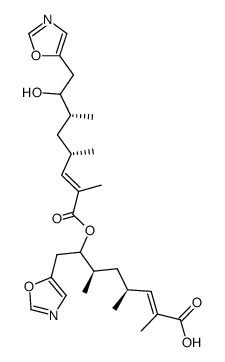
~%
Conglobatin CAS#:72263-05-9 |
| Literature: Schregenberger; Seebach 1986 , vol. 1986, # 12 p. 2081 - 2103 |
|
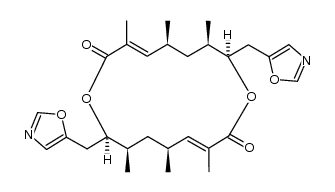
~%
Conglobatin CAS#:72263-05-9 |
| Literature: Schregenberger; Seebach 1986 , vol. 1986, # 12 p. 2081 - 2103 |

This table collects all English aliases, systematic names and CAS‑related synonyms of the compound.
| (-)-Conglobatin |
| (3E,5R,7S,8S,11E,13R,15S,16S)-3,5,7,11,13,15-Hexamethyl-8,16-bis(5-oxazolylmethyl)-1,9-dioxacyclohexadeca-3,11-diene-2,10-dione |
| FW-04-806 |
This section contains frequently‑asked‑questions about this compound, including basic parameters, properties, storage conditions and corresponding answers.
| Q: What English synonyms does conglobatin have? |
| A: English synonyms of conglobatin: (-)-Conglobatin, (3E,5R,7S,8S,11E,13R,15S,16S)-3,5,7,11,13,15-Hexamethyl-8,16-bis(5-oxazolylmethyl)-1,9-dioxacyclohexadeca-3,11-diene-2,10-dione, FW-04-806. |
| Q: What is the molecular weight of conglobatin? |
| A: Molecular weight of conglobatin is 498.61100. |
| Q: What is the SMILES notation of conglobatin? |
| A: SMILES notation of conglobatin is CC1=CC(C)CC(C)C(Cc2cnco2)OC(=O)C(C)=CC(C)CC(C)C(Cc2cnco2)OC1=O. |
| Q: What is the LogP of conglobatin? |
| A: LogP of conglobatin is 5.50220. |
| Q: What is the polar surface area (PSA) of conglobatin? |
| A: Polar surface area (PSA) of conglobatin is 104.66000. |
| Q: What is the English name of conglobatin? |
| A: The English name of conglobatin is conglobatin. |
| Q: What is the Chinese name of 72263-05-9? |
| A: Chinese name of 72263-05-9 is Conglobatin. |
| Q: What is the InChIKey of conglobatin? |
| A: InChIKey of conglobatin is LAJRJVDLKYGLOO-WAPFQFPOSA-N. |
| Q: What is the molecular formula of conglobatin? |
| A: Molecular formula of conglobatin is C28H38N2O6. |
| Q: What are the uses of conglobatin? |
| A: Main uses of conglobatin: Conglobatin (FW-04-806), a macrolide dilactone, is isolated from the culture of Streptomyces conglobatus. Conglobatin is an orally active Hsp90 inhibitor. Conglobatin can bind to the N-terminal domain of Hsp90 and disrupt Hsp90-Cdc37 complex formation. Conglobatin induces apoptosis in human breast cancer cells and esophageal squamous cell carcinoma cells, and exhibits antitumor activity in vivo[1][2][3]. |
This table lists manufacturers and suppliers of this compound, including vendor names and product supply reference information.
| Shanghai Nianxing Industrial Co., Ltd |