Formamide
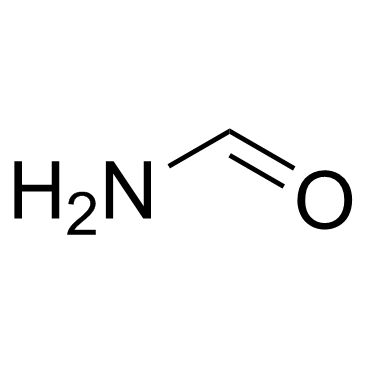
Formamide structure
|
Common Name | Formamide | ||
|---|---|---|---|---|
| CAS Number | 75-12-7 | Molecular Weight | 45.041 | |
| Density | 1.0±0.1 g/cm3 | Boiling Point | 210.5±9.0 °C at 760 mmHg | |
| Molecular Formula | CH3NO | Melting Point | 2-3 °C(lit.) | |
| MSDS | Chinese USA | Flash Point | 81.1±18.7 °C | |
| Symbol |

GHS08 |
Signal Word | Danger | |
Use of FormamideFormamide is an amide derived from formic acid and has been used as solvent for many ionic compounds. |
This table lists Chinese names, IUPAC names and various aliases of this chemical substance.
| Name | formamide |
|---|---|
| Synonym | More Synonyms |
This table contains bioactivity, target information and biological‑assay experimental data of this compound.
| Description | Formamide is an amide derived from formic acid and has been used as solvent for many ionic compounds. |
|---|---|
| Related Catalog |
This table shows physicochemical parameters including melting point, boiling point, density, solubility and optical rotation. Missing data is marked as N/A.
| Density | 1.0±0.1 g/cm3 |
|---|---|
| Boiling Point | 210.5±9.0 °C at 760 mmHg |
| Melting Point | 2-3 °C(lit.) |
| Molecular Formula | CH3NO |
| Molecular Weight | 45.041 |
| Flash Point | 81.1±18.7 °C |
| Exact Mass | 45.021465 |
| PSA | 43.09000 |
| LogP | -1.51 |
| Vapour density | 1.55 (vs air) |
| Vapour Pressure | 0.2±0.4 mmHg at 25°C |
| Index of Refraction | 1.370 |
| InChIKey | ZHNUHDYFZUAESO-UHFFFAOYSA-N |
| SMILES | NC=O |
| Water Solubility | miscible |
This table provides MSDS information including hazard classification, first‑aid, fire‑fighting, spill handling, operation and storage instructions.
This table summarizes toxicological test data, acute & chronic toxicity and ecological hazard parameters for this chemical.
CHEMICAL IDENTIFICATION
HEALTH HAZARD DATAACUTE TOXICITY DATA
MUTATION DATA
|
This table covers safety warnings, protective measures, incompatible substances and disposal guidelines for this compound.
| Symbol |
GHS08 |
|---|---|
| Signal Word | Danger |
| Hazard Statements | H351-H360D-H373 |
| Precautionary Statements | P201-P281-P308 + P313 |
| Target Organs | Blood |
| Personal Protective Equipment | Eyeshields;full-face respirator (US);Gloves;multi-purpose combination respirator cartridge (US);type ABEK (EN14387) respirator filter |
| Hazard Codes | T:Toxic |
| Risk Phrases | R61 |
| Safety Phrases | S53-S45-S36/37/39-S26-S23 |
| RIDADR | NONH for all modes of transport |
| WGK Germany | 2 |
| RTECS | LQ0525000 |
| HS Code | 2924199090 |
This table presents publicly reported synthetic routes, reaction conditions, reactants and product information of the compound.
|
~%
Formamide CAS#:75-12-7 |
| Literature: Maier, Guenther; Endres, Joerg European Journal of Organic Chemistry, 2000 , # 6 p. 1061 - 1063 |

This table lists upstream starting materials and downstream derivative products related to this chemical.
| Precursor 1 | |
|---|---|
| DownStream 0 | |
This table shows customs‑related data including HS‑code, tariff and regulatory conditions for import and export.
| HS Code | 2924199090 |
|---|---|
| Summary | 2924199090. other acyclic amides (including acyclic carbamates) and their derivatives; salts thereof. VAT:17.0%. Tax rebate rate:13.0%. . MFN tariff:6.5%. General tariff:30.0% |
This table lists relevant public references with title, journal and publication metadata for this compound.
|
RETRA exerts anticancer activity in Ewing's sarcoma cells independent of their TP53 status.
Eur. J. Cancer 51(7) , 841-51, (2015) Mutant p53 can exert oncogenic activity by inhibitory interaction with p73. The small-molecule RETRA has been described to disrupt this interaction and to suppress carcinoma cells (Kravchenko et al., ... |
|
|
Characterization of Pythium oligandrum populations that colonize the rhizosphere of vines from the Bordeaux region.
FEMS Microbiol. Ecol. 90(1) , 153-67, (2014) This study focused on one oomycete, Pythium oligandrum, well-known for its plant protection abilities, which thrives in microbial environment where bacteria and fungal communities are also present. Th... |
|
|
Proper migration and axon outgrowth of zebrafish cranial motoneuron subpopulations require the cell adhesion molecule MDGA2A.
Biol. Open 4(2) , 146-54, (2015) The formation of functional neuronal circuits relies on accurate migration and proper axonal outgrowth of neuronal precursors. On the route to their targets migrating cells and growing axons depend on... |
This table collects all English aliases, systematic names and CAS‑related synonyms of the compound.
| Formic amide |
| potassium deuteroformate |
| methanimidic acid |
| formamidic acid |
| MFCD00007941 |
| Formamide |
| AMINOFORMALDEHYDE |
| Hydroxyformaldimin |
| Formimidsaeure |
| formic-d acid,potassium salt |
| EINECS 200-842-0 |
| Formamine |
| formimidic acid |
| Kalium-d-formiat |
| Potassium formate-d |
This section contains frequently‑asked‑questions about this compound, including basic parameters, properties, storage conditions and corresponding answers.
| Q: What is the polar surface area (PSA) of formamide? |
| A: Polar surface area (PSA) of formamide is 43.09000. |
| Q: What is the molecular weight of formamide? |
| A: Molecular weight of formamide is 45.041. |
| Q: What is the molecular formula of formamide? |
| A: Molecular formula of formamide is CH3NO. |
| Q: What is the SMILES notation of formamide? |
| A: SMILES notation of formamide is NC=O. |
| Q: What are the uses of formamide? |
| A: Main uses of formamide: Formamide is an amide derived from formic acid and has been used as solvent for many ionic compounds. |
| Q: What are the upstream materials of formamide? |
| A: Related upstream materials(CAS) of formamide: 77287-34-4. |
| Q: What is the InChIKey of formamide? |
| A: InChIKey of formamide is ZHNUHDYFZUAESO-UHFFFAOYSA-N. |
| Q: What English synonyms does formamide have? |
| A: English synonyms of formamide: Formic amide, potassium deuteroformate, methanimidic acid, formamidic acid, MFCD00007941, Formamide, AMINOFORMALDEHYDE, Hydroxyformaldimin, Formimidsaeure, formic-d acid,potassium salt, EINECS 200-842-0, Formamine, formimidic acid, Kalium-d-formiat, Potassium formate-d. |
| Q: What is the melting point of formamide? |
| A: Melting point of formamide is 2-3 °C(lit.). |
| Q: What is the CAS number of formamide? |
| A: CAS number of formamide is 75-12-7. |
This table lists manufacturers and suppliers of this compound, including vendor names and product supply reference information.
| Henan Tianfu Chemical Co., Ltd. |
| Zhongshan Xingrui Chemical Co. , Ltd. |
The content on this webpage is sourced from various professional data sources. If you have any questions or concerns regarding the content, please feel free to contact service1@chemsrc.com.
- Shanghai Nianxing Industrial Co., Ltd
- China
- Product Name: Palmitic acid
- Price: Check
- Purity: 98.0%
- Delivery: 10 Day
- Contact: Yang
- Email: sales@echemcloud.com
- Henan Tianfu Chemical Co., Ltd.
- China
- Product Name: formamide
- Price: $Inquiry/1kg $Inquiry/25kg $Inquiry/1000kg $Inquiry/10ton
- Purity: 99.0%
- Delivery: Inquiry
- Contact: Anson
- Email: info@tianfuchem.com
- Zhongshan Xingrui Chemical Co. , Ltd.
- China
- Product Name: Formamide
- Price: ¥Inquiry/25kg
- Purity: 99.5%
- Delivery: Inquiry
- Contact: Wang Jie

- Email: 3096638339@qq.com
Get all suppliers and price by the below link:
Reference only. check more Formamide price