Cytochrome C
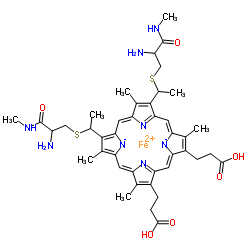
Cytochrome C structure
|
Common Name | Cytochrome C | ||
|---|---|---|---|---|
| CAS Number | 9007-43-6 | Molecular Weight | 884.887 | |
| Density | N/A | Boiling Point | 1323.5ºC at 760 mmHg | |
| Molecular Formula | C42H52FeN8O6S2 | Melting Point | 300ºC | |
| MSDS | Chinese USA | Flash Point | 754.2ºC | |
Use of Cytochrome CCytochrome C is a multi-functional enzyme involving in life and death decisions of the cell. Cytochrome C is essential in mitochondrial electron transport and intrinsic type II apoptosis[1]. |
| Name | Cytochrome C |
|---|---|
| Synonym | More Synonyms |
| Description | Cytochrome C is a multi-functional enzyme involving in life and death decisions of the cell. Cytochrome C is essential in mitochondrial electron transport and intrinsic type II apoptosis[1]. |
|---|---|
| Related Catalog | |
| In Vitro | 哺乳动物 Cytochrome C 在健康状态下清除活性氧 (ROS),在凋亡过程中与辅因子 p66Shc 产生 ROS,氧化心磷脂[1]。 |
| References |
| Boiling Point | 1323.5ºC at 760 mmHg |
|---|---|
| Melting Point | 300ºC |
| Molecular Formula | C42H52FeN8O6S2 |
| Molecular Weight | 884.887 |
| Flash Point | 754.2ºC |
| Exact Mass | 884.280090 |
| PSA | 286.03000 |
| LogP | 3.85300 |
| InChIKey | WFVBWSTZNVJEAY-UHFFFAOYSA-L |
| SMILES | CNC(=O)C(N)CSC(C)C1=C(C)c2cc3[n-]c(cc4[n-]c(cc5nc(cc1n2)C(C)=C5C(C)SCC(N)C(=O)NC)c(C)c4CCC(=O)O)c(CCC(=O)O)c3C.[Fe+2] |
| Storage condition | −20°C |
| Water Solubility | H2O: 10 mg/mL, clear, dark red-brown | 100 g/L (20 ºC) |
CHEMICAL IDENTIFICATION
HEALTH HAZARD DATAACUTE TOXICITY DATA
MUTATION DATA
|
| Personal Protective Equipment | Eyeshields;Gloves;type N95 (US);type P1 (EN143) respirator filter |
|---|---|
| Hazard Codes | Xi: Irritant;Xn: Harmful; |
| Risk Phrases | 36/37/38-20/21/22 |
| Safety Phrases | S24/25 |
| RIDADR | NONH for all modes of transport |
| WGK Germany | 3 |
| RTECS | HA5365000 |
| HS Code | 3507909000 |
| HS Code | 3507909000 |
|---|
|
Mitochondrial dysfunction in early life resulted from perinatal bisphenol A exposure contributes to hepatic steatosis in rat offspring.
Toxicol. Lett. 228(2) , 85-92, (2014) An emerging literature suggests that bisphenol A (BPA), a widespread endocrine disrupting chemical, when exposure occurs in early life, may increase the risk of metabolic syndrome. In this study, we i... |
|
|
Involvement of CaM-CaMKII-ERK in bisphenol A-induced Sertoli cell apoptosis.
Toxicology 324 , 27-34, (2014) Bisphenol A (BPA), one of the most prevalent chemicals for daily use, has been reported as a xenoestrogen to induce reproductive toxicity, but its mechanism is poorly understood. In the present study,... |
|
|
Assessment of cytochrome C oxidase dysfunction in the substantia nigra/ventral tegmental area in schizophrenia.
PLoS ONE 9(6) , e100054, (2014) Perturbations in metabolism are a well-documented but complex facet of schizophrenia pathology. Optimal cellular performance requires the proper functioning of the electron transport chain, which is c... |
| Cytochromert |
| EINECS 232-700-9 |
| myohematin |
| Cytor-est |
| 21H,23H-Porphine-2,18-dipropanoic acid, 7,12-bis[1-[[2-amino-3-(methylamino)-3-oxopropyl]thio]ethyl]-3,8,13,17-tetramethyl-, iron(2+) salt (1:1) |
| CYT-C |
| Iron(2+) (1Z,6Z,12Z,17Z)-4,9-bis(1-{[2-amino-3-(methylamino)-3-oxopropyl]sulfanyl}ethyl)-15,19-bis(2-carboxyethyl)-5,10,14,20-tetramethyl-21,22,23,24-tetraazapentacyclo[16.2.1.1.1.1] tetracosa-1,3(24),4,6,8,10,12,14,16(22),17,19-undecaene-21,23-diide |
| Cytomac P |
| cytorest |
| MFCD00130890 |
The content on this webpage is sourced from various professional data sources. If you have any questions or concerns regarding the content, please feel free to contact service1@chemsrc.com.
- Shanghai Nianxing Industrial Co., Ltd
- China
- Product Name: Palmitic acid
- Price: Check
- Purity: 98.0%
- Delivery: 10 Day
- Contact: Yang
- Email: sales@echemcloud.com
- Shanghai Amole Biotechnology Co., Ltd. TOP
- China
- Product Name: Cytochrome C
- Price: ¥Inquiry/100mg ¥Inquiry/25mg ¥Inquiry/500mg ¥Inquiry/1g
- Purity: 95.0%
- Delivery: Inquiry
- Contact: Xiyao Wang
- Email: 3623107365@qq.com
- Shanghai Nianxing Industrial Co., Ltd
- China
- Product Name: Cytochrome C
- Price: Check
- Purity: 95.0%
- Delivery: 10 Day
- Contact: Yang
- Email: sales@echemcloud.com
- Shanghai Jizhi Biochemical Technology Co., Ltd
- China
- Product Name: Cytochrome C
- Price: ¥798.0/500mg ¥238.0/100mg ¥198.0/25mg ¥198.0/25mg
- Purity: 95.0%
- Delivery: 3 Day
- Contact: Liu jia


- Email: 2130147988@qq.com
- Dayang Chem (Hangzhou) Co., Ltd.
- China
- Product Name: Cytochrome C
- Price: $Inquiry/100g $Inquiry/1kg $Inquiry/100kg $Inquiry/1000kg
- Purity: 98.0%
- Delivery: Inquiry
- Contact: Ms Wang
- Email: enquiry@dycnchem.com
- Henan Tianfu Chemical Co., Ltd.
- China
- Product Name: Cytochrome C
- Price: $Inquiry/1kg $Inquiry/25kg $Inquiry/1000kg $Inquiry/10ton
- Purity: 99.0%
- Delivery: Inquiry
- Contact: Anson
- Email: info@tianfuchem.com
Get all suppliers and price by the below link: