N-甲基羟胺盐酸盐
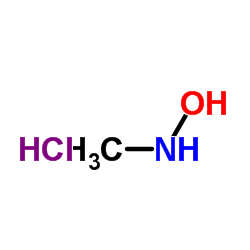
N-甲基羟胺盐酸盐结构式

|
常用名 | N-甲基羟胺盐酸盐 | 英文名 | methylhydroxylammonium chloride |
|---|---|---|---|---|
| CAS号 | 4229-44-1 | 分子量 | 83.517 | |
| 密度 | N/A | 沸点 | 69.4ºC at 760 mmHg | |
| 分子式 | CH6ClNO | 熔点 | 86-88 °C(lit.) | |
| MSDS | 中文版 美版 | 闪点 | 41.9ºC | |
| 符号 |

GHS07 |
信号词 | Warning |
|
Metabolic changes in paraquat poisoned patients and support vector machine model of discrimination.
Biol. Pharm. Bull. 38(3) , 470-5, (2015) Numerous people die of paraquat (PQ) poisoning every year in the world. Although several studies regarding paraquat (PQ) poisoning have been conducted, the metabolic changes in plasma remain unknown. In this study, the metabolomics of 15 PQ poisoned patients ... |
|
|
An evaluation of acute hydrogen sulfide poisoning in rats through serum metabolomics based on gas chromatography-mass spectrometry.
Chem. Pharm. Bull. 62(6) , 505-7, (2014) Hydrogen sulfide (H2S) is the second leading cause of toxin-related deaths in the operational site. Its main target organs of toxic effects are the central nervous system and respiratory system. In this study, we developed a serum metabonomic method, based on... |
|
|
Identification of sulfation sites of metabolites and prediction of the compounds' biological effects.
Anal. Bioanal. Chem 386(3) , 666-74, (2006) Characterizing the biological effects of metabolic transformations (or biotransformation) is one of the key steps in developing safe and effective pharmaceuticals. Sulfate conjugation, one of the major phase II biotransformations, is the focus of this study. ... |
|
|
E2P phosphoforms of Na,K-ATPase. I. Comparison of phosphointermediates formed from ATP and Pi by their reactivity toward hydroxylamine and vanadate.
Biochemistry 37(39) , 13634-42, (1998) The properties of Na,K-ATPase phosphoenzymes formed either from ATP in the presence of Mg2+ and Na+ or from Pi in the absence of alkali cations were investigated by biochemical methods and spectrofluorometry employing the styryl dye RH421. We characterized th... |
|
|
Kinetic studies on the reduction of the tyrosyl radical of the R2 subunit of E. coli ribonucleotide reductase.
Biochim. Biophys. Acta 1247(2) , 215-24, (1995) Kinetic studies at 25 degrees C, I = 0.100 M (NaCl), on the reduction of the tyrosyl radical of the R2 protein of E. coli ribonucleotide reductase with hydroxyurea (HU), N-methylhydroxylamine, catechol, and seven hydroxamic acid derivatives are reported. Ther... |
|
|
In vitro haematotoxic effects of three methylated hydroxylamines.
Arch. Toxicol. 71(5) , 299-305, (1997) Hydroxylamine (HYAM, HONH2) and some of its derivatives are known to cause erythrotoxic effects both in vitro and in vivo. Previous studies have shown that the primary in vitro effect of HYAM and O-ethyl hydroxylamine (OEH) is methaemoglobin formation, leadin... |
|
|
Free radical intermediates in the oxidation of N-methylhydroxylamine and N,N-dimethylhydroxylamine by oxyhemoglobin.
Free Radic. Res. Commun. 8(2) , 123-31, (1990) Nitroxide radicals have been detected in the methemoglobin formation reaction between oxyhemoglobin and the substituted hydroxylamine compounds, N-methylhydroxylamine and N,N-dimethylhydroxylamine, by ESR spectroscopy. The stability of these nitroxide radical... |
|
|
Two mechanisms for toxic effects of hydroxylamines in human erythrocytes: involvement of free radicals and risk of potentiation.
Blood Cells Mol. Dis. 24(3) , 280-95, (1998) The toxic potency of three industrially used hydroxylamines was studied in human blood cells in vitro. The parent compound hydroxylamine and the O-ethyl derivative gave very similar results. Both compounds induced a high degree of methemoglobin formation and ... |
|
|
Nitric oxide formation from hydroxylamine by myoglobin and hydrogen peroxide.
Biochim. Biophys. Acta 1336(3) , 502-8, (1997) Hydroxylamine (HA), which is a natural product of mammalian cells, has been shown to possess vasodilatory properties in several model systems. In this study, HA and methyl-substituted hydroxylamines, N-methylhydroxylamine (NMHA) and N,N-dimethylhydroxylamine ... |
|
|
Reactivity and chemical synthesis of L-pyrrolysine- the 22(nd) genetically encoded amino acid.
Chem. Biol. 11(9) , 1317-24, (2004) L-pyrrolysine, the 22(nd) genetically encoded amino acid, was previously deduced to be (4R, 5R)-4-substituted-pyrroline-5-carboxylate attached to the epsilon-nitrogen of lysine based on the crystal structure of the M. barkeri monomethylamine methyltransferase... |