2,2',5-PCB
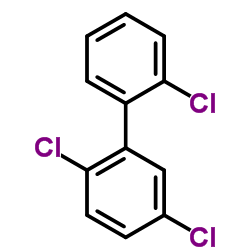
2,2',5-PCB structure
|
Common Name | 2,2',5-PCB | ||
|---|---|---|---|---|
| CAS Number | 37680-65-2 | Molecular Weight | 257.543 | |
| Density | 1.4±0.1 g/cm3 | Boiling Point | 317.6±27.0 °C at 760 mmHg | |
| Molecular Formula | C12H7Cl3 | Melting Point | 43-44ºC | |
| MSDS | Chinese USA | Flash Point | 216.1±19.3 °C | |
| Symbol |


GHS08, GHS09 |
Signal Word | Warning | |
|
Alteration of regiospecificity in biphenyl dioxygenase by active-site engineering.
J. Bacteriol. 184(13) , 3682-8, (2002) Biphenyl dioxygenase (Bph Dox) is responsible for the initial dioxygenation step during the metabolism of biphenyl. The large subunit (BphA1) of Bph Dox plays a crucial role in the determination of the substrate specificity of biphenyl-related compounds, incl... |
|
|
Dihydroxylation and dechlorination of chlorinated biphenyls by purified biphenyl 2,3-dioxygenase from Pseudomonas sp. strain LB400.
J. Bacteriol. 177(1) , 20-6, (1995) Oxidation of biphenyl and nine chlorinated biphenyls (CBs) by the biphenyl 2,3-dioxygenase from Pseudomonas sp. strain LB400 was examined. The purified terminal oxygenase required the addition of partially purified electron transport components, NAD(P)H, and ... |
|
|
Uterotropic and enzyme induction effects of 2,2',5-trichlorobiphenyl.
Bull. Environ. Contam. Toxicol. 54(4) , 494-500, (1995)
|
|
|
Distribution and metabolism of 2,5,2'-trichlorobiphenyl in houseflies (Musca domestica L.).
Bull. Environ. Contam. Toxicol. 49(6) , 839-46, (1992)
|
|
|
Influence of enzyme levels on the toxicity and in vitro metabolism of 2,2',5-trichlorobiphenyl in houseflies.
Ecotoxicol. Environ. Saf. 28(2) , 111-20, (1994) Adult female houseflies (Musca domestica) were topically dosed with 10, 15, and 20 micrograms of 2,2',5-trichlorobiphenyl (PCB-18) in acetone at 1, 5, and 15 days following emergence. These doses caused a significant decrease in the mean survival time in 5-da... |
|
|
Effects of polychlorinated biphenyl 19 (2,2',6-trichlorobiphenyl) on contraction, Ca2+ transient, and Ca2+ current of cardiac myocytes.
J. Cardiovasc. Pharmacol. 38(1) , 11-20, (2001) Polychlorinated biphenyls (PCBs) have been known as serious environmental pollutants, causing developmental delays, motor dysfunction, and decrease in brain dopamine level in humans and animals. We have investigated the effects of a PCB congener, 2,2',6-trich... |