Netropsin dihydrochloride
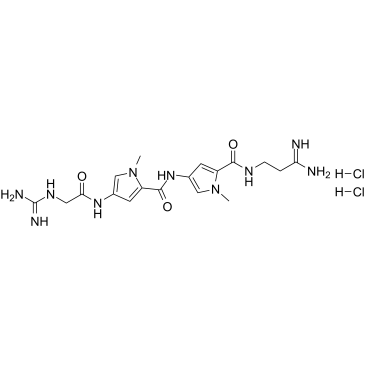
Netropsin dihydrochloride structure
|
Common Name | Netropsin dihydrochloride | ||
|---|---|---|---|---|
| CAS Number | 18133-22-7 | Molecular Weight | 466.92500 | |
| Density | N/A | Boiling Point | N/A | |
| Molecular Formula | C18H28Cl2N10O3 | Melting Point | N/A | |
| MSDS | Chinese USA | Flash Point | N/A | |
| Symbol |

GHS06 |
Signal Word | Danger | |
|
Free energy calculations offer insights into the influence of receptor flexibility on ligand-receptor binding affinities.
J. Comput. Aided Mol. Des. 25(8) , 709-16, (2011) Docking algorithms for computer-aided drug discovery and design often ignore or restrain the flexibility of the receptor, which may lead to a loss of accuracy of the relative free enthalpies of binding. In order to evaluate the contribution of receptor flexib... |
|
|
Polyamide-scorpion cyclam lexitropsins selectively bind AT-rich DNA independently of the nature of the coordinated metal.
PLoS ONE 6(5) , e17446, (2011) Cyclam was attached to 1-, 2- and 3-pyrrole lexitropsins for the first time through a synthetically facile copper-catalyzed "click" reaction. The corresponding copper and zinc complexes were synthesized and characterized. The ligand and its complexes bound AT... |
|
|
DNA site-specific N3-adenine methylation targeted to estrogen receptor-positive cells.
Bioorg. Med. Chem. 19 , 5093-102, (2011) A compound that can target cells expressing the estrogen receptor (ER), and produce predominantly 3-MeA adducts in those cells has been designed and synthesized. This compound produces mainly the 3-MeA adduct upon reaction with calf thymus DNA, and binds to t... |
|
|
Comparison of binding sites in DNA for berenil, netropsin and distamycin. A footprinting study.
Eur. J. Biochem. 167 , 281, (1987) Techniques of DNase I and micrococcal nuclease footprinting have been used to compare the binding sites for berenil, netropsin and distamycin on two different DNA fragments. Each ligand binds to the A + T-rich zones which contain clusters of at least four A.T... |
|
|
[Estimation of activity of bis-netropsin derivatives based on a model of an experimental cutaneous herpes simplex virus disease of guinea pigs].
Vopr. Virusol. 58(1) , 32-5, (2013) Using the model of an experimental cutaneous infection of guinea pig males caused by herpes simple virus type 1, it is shown that application of dimerico derivatives of netropsin Lys-bis Nt and 15Lys-bis Nt in the form of polietilenglicol-based ointment suppr... |
|
|
A new phenanthroline-oxazine ligand: synthesis, coordination chemistry and atypical DNA binding interaction.
Chem. Commun. (Camb.) 49(23) , 2341-3, (2013) 1,10-Phenanthroline-5,6-dione and l-tyrosine methyl ester react to form phenanthroline-oxazine (PDT) from which [Cu(PDT)(2)](ClO(4))(2) and [Ag(PDT)(2)]ClO(4)·2MeOH are obtained. Binding to calf-thymus DNA by Ag(I) and Cu(II) PDT complexes exceed bis-1,10-phe... |
|
|
Structural studies on ligand-DNA systems: A robust approach in drug design.
J. Biosci. 37(3) , 553-61, (2012) Molecular docking, molecular mechanics, molecular dynamics and relaxation matrix simulation protocols have been extensively used to generate the structural details of ligand-receptor complexes in order to understand the binding interactions between the two en... |
|
|
Efficient synthesis and biological evaluation of proximicins A, B and C.
Bioorg. Med. Chem. 20 , 2019-24, (2012) A quick and efficient synthesis and the biological evaluation of promising antitumor-antibiotics proximicins A, B and C are reported. The characteristic repetitive unit of these molecules, the methyl 4-Boc-aminofuran-2-carboxylate 15, was prepared in three sy... |
|
|
Overexpression of HMGA1 deregulates tumor growth via cdc25A and alters migration/invasion through a cdc25A-independent pathway in medulloblastoma.
Acta Neuropathol. 123(4) , 553-71, (2012) Overexpression of high mobility group AT-hook 1 (HMGA1) is common in human cancers. Little is known about the mechanisms underlying its deregulation and downstream targets, and information about its clinical and biological significance in medulloblastoma (MB)... |
|
|
Expanding the repertoire of natural product-inspired ring pairs for molecular recognition of DNA.
Org. Lett. 13(20) , 5612-5, (2011) A furan amino acid, inspired by the recently discovered proximicin natural products, was incorporated into the scaffold of a DNA-binding hairpin polyamide. While unpaired oligomers of 2,4-disubstituted furan amino acids show poor DNA-binding activity, furan (... |