VIP (6-28) (human, mouse, rat) trifluoroacetate salt
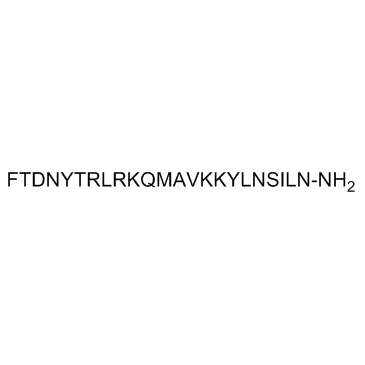
VIP (6-28) (human, mouse, rat) trifluoroacetate salt structure
|
Common Name | VIP (6-28) (human, mouse, rat) trifluoroacetate salt | ||
|---|---|---|---|---|
| CAS Number | 69698-54-0 | Molecular Weight | 2816.28000 | |
| Density | N/A | Boiling Point | N/A | |
| Molecular Formula | C126H207N37O34S | Melting Point | N/A | |
| MSDS | Chinese USA | Flash Point | N/A | |
|
Fishbein, V.A., et al.
Peptide 15 , 95, (1994)
|
|
|
Polarized enteric submucosal circuits involved in secretory responses of the guinea-pig proximal colon.
J. Physiol. 506 , 539-550, (1998) 1. Neuronal retrograde tracing with the dye DiI (1,1'-didodecyl-3,3,3',3'-tetramethylindocarbocyanine perchlorate), in combination with immunohistochemical detection of choline acetyltransferase (ChAT) and vasoactive intestinal peptide (VIP), were used to ide... |
|
|
Vasoactive intestinal peptide enhances its own expression in sympathetic neurons after injury.
J. Neurosci. 18 , 5285-5293, (1998) Neurons in the adult rat superior cervical sympathetic ganglion (SCG) dramatically increase their content of vasoactive intestinal peptide (VIP) and its mRNA after axotomy in vivo and after explantation. Because the VIP gene contains a functional cAMP respons... |
|
|
Protective effects of vasoactive intestinal peptide against delayed glutamate neurotoxicity in cultured retina.
Brain Res. 809 , 127-136, (1998) The effects of vasoactive intestinal peptide (VIP) on glutamate-induced delayed death were examined using the primary cultures of rat retinal neurons. Effects of VIP on glutamate-induced neurotoxicity were evaluated by double staining with fluorescein diaceta... |
|
|
Pituitary adenylate cyclase-activating polypeptide (PACAP) contributes to the proliferation of hematopoietic progenitor cells in murine bone marrow via PACAP-specific receptor.
Sci. Rep. 6 , 22373, (2016) Pituitary adenylate cyclase-activating polypeptide (PACAP, encoded by adcyap1) plays an important role in ectodermal development. However, the involvement of PACAP in the development of other germ layers is still unclear. This study assessed the expression of... |