Perfluorobenzene
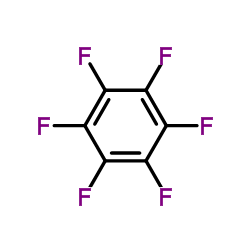
Perfluorobenzene structure
|
Common Name | Perfluorobenzene | ||
|---|---|---|---|---|
| CAS Number | 392-56-3 | Molecular Weight | 186.055 | |
| Density | 1.6±0.1 g/cm3 | Boiling Point | 80.5±35.0 °C at 760 mmHg | |
| Molecular Formula | C6F6 | Melting Point | 3.7-4.1 °C(lit.) | |
| MSDS | Chinese USA | Flash Point | 10.0±0.0 °C | |
| Symbol |

GHS02 |
Signal Word | Danger | |
|
Gas chromatography with parallel hard and soft ionization mass spectrometry.
Rapid Commun. Mass Spectrom. 29(1) , 91-9, (2014) Mass spectrometric identification of compounds in chromatography can be obtained from molecular masses from soft ionization mass spectrometry techniques such as field ionization (FI) and fragmentation patterns from hard ionization techniques such as electron ... |
|
|
Oxidative dehalogenation of perhalogenated benzenes by cytochrome P450 compound I.
Biochemistry 46(20) , 5924-40, (2007) Resolution of the identity PBE (RI-PBE) and B3LYP density functional theory calculations are used to understand the cytochrome P450-catalyzed, Compound I-mediated oxidation of perchlorobenzenes, perfluorobenzenes, their phenols, and mixed chlorofluorobenzenes... |
|
|
The pH-dependence of organofluorine binding domain preference in dissolved humic acid.
Chemosphere 90(2) , 270-5, (2013) In this study we explore the relationship between solution pH and the distribution of the binding interactions at different domains of a dissolved humic acid (HA) for three xenobiotics: pentafluoroaniline (PFA), pentafluorophenol (PFP), and hexafluorobenzene ... |
|
|
Don't be so BOLD: potential limitations in the use of BOLD MRI for studies of renal oxygenation.
Kidney Int. 71(12) , 1327-8; author reply 1328, (2007)
|
|
|
The effects of volatile aromatic anesthetics on voltage-gated Na+ channels expressed in Xenopus oocytes.
Anesth. Analg. 107(5) , 1579-86, (2008) Many inhaled anesthetics inhibit voltage-gated sodium channels at clinically relevant concentrations, and suppression of neurotransmitter release by these anesthetics results, at least partly, from decreased presynaptic sodium channel activity. Volatile aroma... |
|
|
Hexafluorobenzene acts in the spinal cord, whereas o-difluorobenzene acts in both brain and spinal cord, to produce immobility.
Anesth. Analg. 104(4) , 822-8, (2007) Previous work demonstrated that isoflurane and halothane act on the spinal cord rather than on the brain to produce immobility in the face of noxious stimulation. These anesthetics share many effects on specific receptors, and thus do not test the broad appli... |
|
|
The effects of aromatic anesthetics on dorsal horn neuronal responses to noxious stimulation.
Anesth. Analg. 106(6) , 1759-64, (2008) Gamma-aminobutyric acid type A receptor potentiation and/or N-methyl-d-aspartate (NMDA) receptor inhibition might explain the anesthetic properties of fluorinated aromatic compounds. We hypothesized that depression of dorsal horn neuronal responses to noxious... |
|
|
The effects of perfluorination on carbohydrate-pi interactions: computational studies of the interaction of benzene and hexafluorobenzene with fucose and cyclodextrin.
Phys. Chem. Chem. Phys. 12(28) , 7959-67, (2010) The effect of benzene fluorination on C-H...pi interactions is studied using a number of computational methods applied to a range of intermolecular complexes. High level wavefunction methods (CCSD(T)) predict a slightly greater interaction energy for complexe... |
|
|
Stabilisation energy of C(6)H(6)...C(6)X(6) (X = F, Cl, Br, I, CN) complexes: complete basis set limit calculations at MP2 and CCSD(T) levels.
Phys. Chem. Chem. Phys. 9(6) , 755-60, (2007) Stabilisation energies of stacked structures of C(6)H(6)...C(6)X(6) (X = F, Cl, Br, CN) complexes were determined at the CCSD(T) complete basis set (CBS) limit level. These energies were constructed from MP2/CBS stabilisation energies and a CCSD(T) correction... |
|
|
The effect of perfluorination on the aromaticity of benzene and heterocyclic six-membered rings.
J. Phys. Chem. A 113(24) , 6789-94, (2009) Despite having six highly electronegative F's, perfluorobenzene C(6)F(6) is as aromatic as benzene. Ab initio block-localized wave function (BLW) computations reveal that both C(6)F(6) and benzene have essentially the same extra cyclic resonance energies (ECR... |