Forsythoside B
Modify Date: 2025-08-23 10:57:37
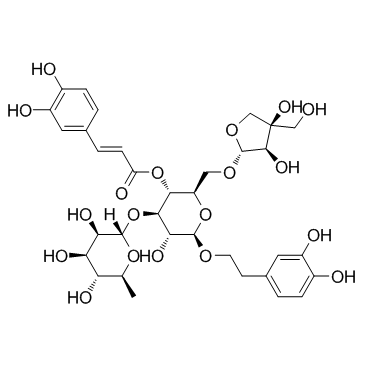
Forsythoside B structure
|
Common Name | Forsythoside B | ||
|---|---|---|---|---|
| CAS Number | 81525-13-5 | Molecular Weight | 756.702 | |
| Density | 1.7±0.1 g/cm3 | Boiling Point | 1040.3±65.0 °C at 760 mmHg | |
| Molecular Formula | C34H44O19 | Melting Point | N/A | |
| MSDS | N/A | Flash Point | 323.9±27.8 °C | |
Use of Forsythoside BForsythoside B is a phenylethanoid glycoside isolated from the leaves of Lamiophlomis rotata Kudo, a Chinese folk medicinal plant for treating inflammatory diseases and promoting blood circulation. Forsythoside B could inhibit TNF-alpha, IL-6, IκB and modulate NF-κB. |
| Name | 2-(((3,4-dihydroxy-4-(hydroxymethyl)tetrahydrofuran-2-yl)oxy)methyl)-6-(3,4-dihydroxyphenethoxy)-5-hydroxy-4-((3,4,5-trihydroxy-6-methyltetrahydro-2H-pyran-2-yl)oxy)tetrahydro-2H-pyran-3-yl (E)-3-(3,4-dihydroxyphenyl)acrylate |
|---|---|
| Synonym | More Synonyms |
| Description | Forsythoside B is a phenylethanoid glycoside isolated from the leaves of Lamiophlomis rotata Kudo, a Chinese folk medicinal plant for treating inflammatory diseases and promoting blood circulation. Forsythoside B could inhibit TNF-alpha, IL-6, IκB and modulate NF-κB. |
|---|---|
| Related Catalog | |
| Target |
TNF-α NF-κB |
| In Vitro | Forsythoside B concentration-dependently down-regulates the levels of TNF-α, IL-6 and high-mobility group-box 1 protein (HMGB1) in lipopolysaccharide (LPS)-stimulated RAW264.7 cells, inhibits the IκB kinase (IKK) pathway and modulated nuclear factor (NF)- κB[1]. |
| In Vivo | Intravenous injection of forsythoside B alone or plus imipenem reduces serum levels of TNF-α, IL-6, HMGB1, triggering receptor expressed on myeloid cells (TREM-1) and endotoxin, while the serum level of IL-10 is up-regulated and myeloperoxidase (MPO) in lung, liver and small intestine is reduced[1]. Forsythoside B at doses higher than 8 mg/kg produces a significant neuroprotective potential in cerebral ischemia and reperfusion rats. Forsythoside B (20 mg/kg) demonstrates significant neuroprotective activity even after delayed administration at 1 h, 3 h and 5 h after cerebral ischemia and reperfusion. Forsythoside B 20 mg/kg attenuates histopathological damage as demonstrated by smaller brain infarct size and brain edema, decreased cerebral Evans blue extravasation and myeloperoxidase activity, inhibited cerebral phosphor-IκB-α and NF-κB expression[2]. Forsythoside B shows a significant recovery in myocardial function with improvement of LVSP and +/-dp/dt(max). The myocardial infarct volume, serum levels of Tn-T, TNF-alpha and IL-6, content of MDA and MPO activity in myocardial tissue are all reduced, protein expression of HMGB1, phosphor-I kappaB-alpha and phosphor-NF-kappaB are down-regulated, while attenuate the decrease of SOD and GPx activities[3]. |
| Cell Assay | Forsythoside B is dissolved in sterile saline solution and added to the medium at various concentrations (from 0.1 to 10 μM) and incubated with LPS stimulated RAW264.7 cells. Cell-free supernatants are collected after Forsythoside B treatment for 24 h. Cell viability is assessed by measuring lactate dehydrogenase (LDH) in the medium[1]. |
| Animal Admin | Rats: Forsythoside B is dissolved in sterilized saline. For the dose–response study, forsythoside B at doses of 1.3, 3.2, 8, 20 or 50 mg/kg is administered as an intravenous bolus injection at 15 min after reperfusion. The sham or vehicle-treated rats are injected with saline. Neurological deficits are determined at 23 h after reperfusion followed by brain infarct volume examination[2]. |
| References |
| Density | 1.7±0.1 g/cm3 |
|---|---|
| Boiling Point | 1040.3±65.0 °C at 760 mmHg |
| Molecular Formula | C34H44O19 |
| Molecular Weight | 756.702 |
| Flash Point | 323.9±27.8 °C |
| Exact Mass | 756.247681 |
| PSA | 304.21000 |
| LogP | 1.87 |
| Vapour Pressure | 0.0±0.3 mmHg at 25°C |
| Index of Refraction | 1.696 |
| InChIKey | JMBINOWGIHWPJI-UNSOMVRXSA-N |
| SMILES | CC1OC(OC2C(O)C(OCCc3ccc(O)c(O)c3)OC(COC3OCC(O)(CO)C3O)C2OC(=O)C=Cc2ccc(O)c(O)c2)C(O)C(O)C1O |
| Hazard Codes | Xi |
|---|---|
| HS Code | 29389090 |
|
Name: Antagonist activity at human TRPV3 channel expressed in HEK293T cells assessed as inh...
Source: ChEMBL
Target: Transient receptor potential cation channel subfamily V member 3
External Id: CHEMBL5358079
|
|
Name: Antipruritic activity in carvacrol-induced scratching C57BL/6 mouse model assessed as...
Source: ChEMBL
Target: Mus musculus
External Id: CHEMBL5577497
|
|
Name: Antipruritic activity in carvacrol-induced scratching C57BL/6 mouse model assessed as...
Source: ChEMBL
Target: Mus musculus
External Id: CHEMBL5577498
|
|
Name: Antipruritic activity in histamine-induced scratching C57BL/6 mouse model assessed as...
Source: ChEMBL
Target: Mus musculus
External Id: CHEMBL5577499
|
|
Name: Small-molecule inhibitors of ST2 (IL1RL1)
Source: 20881
Target: interleukin-1 receptor-like 1 isoform [homo sapiens]
External Id: ST2_IL33_Inhibitors_Primary_Screening_77700
|
Total 5, Current Page 1 of 1
1
| 2-(3,4-Dihydroxyphenyl)ethyl 3-O-(6-deoxy-α-L-mannopyranosyl)-6-O-[(2R,3R,4R)-3,4-dihydroxy-4-(hydroxymethyl)tetrahydro-2-furanyl]-4-O-[(2E)-3-(3,4-dihydroxyphenyl)-2-propenoyl]-β-D-glucopyrano side |
| Forsythoside B |
The content on this webpage is sourced from various professional data sources. If you have any questions or concerns regarding the content, please feel free to contact service1@chemsrc.com.
- Shanghai Nianxing Industrial Co., Ltd
- China
- Product Name: Forsythoside B
- Price: Check
- Purity: 90.7%
- Delivery: 10 Day
- Contact: Yang
- Email: sales@echemcloud.com
- BioBioPha
- China
- Product Name: Forsythoside B
- Price: ¥Inquiry/5mg
- Purity: 98.0%
- Delivery: 10 Day
- Contact: Xueping-Zheng
- Email: 1477035482@qq.com
- Dayang Chem (Hangzhou) Co., Ltd.
- China
- Product Name: Forsythoside B
- Price: $Inquiry/100g $Inquiry/1kg $Inquiry/100kg $Inquiry/1000kg
- Purity: 98.0%
- Delivery: Inquiry
- Contact: Ms Wang
- Email: enquiry@dycnchem.com
- Shanghai Jizhi Biochemical Technology Co., Ltd
- China
- Product Name: Forsythoside B
- Price: ¥888.0/20mg
- Purity: 98.0%
- Delivery: 1 Day
- Contact: Liu jia


- Email: 2130147988@qq.com
- naturewill
- China
- Product Name: Forsythoside B
- Price: ¥Inquiry/5mg ¥Inquiry/20mg ¥Inquiry/100mg ¥Inquiry/1g
- Purity: 98.0%
- Delivery: Inquiry
- Contact: Bella
- Email: 3157321941@qq.com
Get all suppliers and price by the below link:
Price: $120/10mM*1mLinDMSO
Reference only. check more Forsythoside B price