1438416-21-7
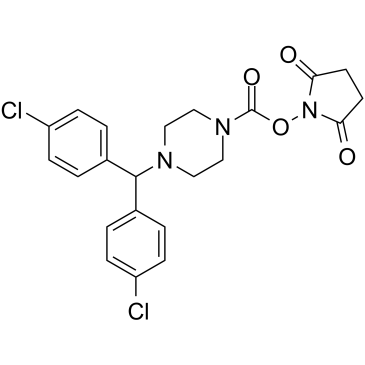
1438416-21-7 structure
- Name: MJN110
- Chemical Name: [2,5-dioxopyrrolidin-1-yl 4-(bis(4-chlorophenyl)methyl)piperazine-1-carboxylate]
- CAS Number: 1438416-21-7
- Molecular Formula: C22H21Cl2N3O4
- Molecular Weight: 462.32600
- Catalog: Signaling Pathways Metabolic Enzyme/Protease MAGL
- Create Date: 2018-02-10 18:01:20
- Modify Date: 2026-07-01 17:53:51
-
MJN110 is a potent and selective monoacylglycerol lipase (MAGL) inhibitor[1]. MJN110 reduces hepatic macrophage number, inflammatory gene expression and slowes down fibrosis progression[2].
| Name | [2,5-dioxopyrrolidin-1-yl 4-(bis(4-chlorophenyl)methyl)piperazine-1-carboxylate] |
|---|---|
| Synonyms |
MJN110, 10 mM in DMSO
1-Piperazinecboxylic acid, 4-[bis(4-chlorophenyl)methyl]-, 2,5-dioxo-1-pyrrolidinyl ester KT195 KT172 2,5-dioxopyrrolidin-1-yl 4-[bis(4-chlorophenyl)methyl]piperazine-1-carboxylate MJN110 >= (HPLC) (2-Benzylpiperidin-1-yl)(4-(2′-methoxy-[1,1′-biphenyl]-4-yl)-1H-1,2,3-triazol-1-yl)methanone N-(5-(3-(5,5-Difluoro-7,9-dimethyl-5H-4l4,5l4-dipyrrolo[1,2-c:2′,1′-f][1,3,2]diazaborinin-3-yl)propanamido)pentyl)-N-phenethyl-4-(4-(trifluoromethoxy)phenyl)-1H-1,2,3-triazole-1-cboxamide Cravatt 2,5-dioxopyrrolidin-1-yl 4-(bis(4-chlorophenyl)methyl)piperazine-1-cboxylate KT109 MAGL,MJN 110,Inhibitor,Monoacylglycerol lipase,MJN110,MJN-110,inhibit (4-([1,1′-Biphenyl]-4-yl)-1H-1,2,3-triazol-1-yl)(2-benzylpiperidin-1-yl)methanone HT-01 |
| Description | MJN110 is a potent and selective monoacylglycerol lipase (MAGL) inhibitor[1]. MJN110 reduces hepatic macrophage number, inflammatory gene expression and slowes down fibrosis progression[2]. |
|---|---|
| Related Catalog | |
| In Vivo | MJN110 (i.p.; 0.0818 mg/kg; twice daily for 5.5 days) reverses chronic constriction injury (CCI)-induced mechanical allodynia and thermal hyperalgesia in a dose-dependent manner. The respective ED50 value (95% confidence limits) is 0.430 (0.233-0.793) mg/kg[1]. Animal Model: Male C57BL/6J mice ranged from 18 to 35 g[1] Dosage: 0.0818 mg/kg Administration: I.p.; twice daily for 5.5 days Result: Reversed CCI-induced mechanical allodynia and thermal hyperalgesia in a dose-dependent manner. |
| References |
| Density | 1.47±0.1 g/cm3 |
|---|---|
| Boiling Point | 561.5±60.0 °C |
| Molecular Formula | C22H21Cl2N3O4 |
| Molecular Weight | 462.32600 |
| Exact Mass | 461.09100 |
| PSA | 70.16000 |
| LogP | 3.71470 |
| Symbol |

GHS07 |
|---|---|
| Signal Word | Warning |
| Hazard Statements | H302 |
| Hazard Codes | Xi |
| Risk Phrases | 22-50/53 |
| Safety Phrases | 26-60-61 |
| RIDADR | NONH for all modes of transport |